• December 2025
    S M T W T F S
     123456
    78910111213
    14151617181920
    21222324252627
    28293031  
  • On Facebook

  • Archives

  • Categories

  • Comic Blog Elite

    Comic Blogs - BlogCatalog Blog Directory

Back to Old Gaming Stuff (With a Little New)

Over the holiday weekend, I had a chance to dig out some dice, pull my old Players Handbook for Dungeons & Dragons off its shelf, and for the first time in 13-15 years, play D&D.

gaming_01_dnd_and_dice

I’d bought this volume when it was brand-new, back whenever that was (early 2000s!), and shortly after also bought the Dungeon Master’s Guide…though I never really got around to being able to use them. (It would be several more years before I snagged the Monster Manual after 3.5 had hit and it was "on sale" as an outdated edition.)

I was unable to actually find my old dicebag (having recently moved, and it being so long since I’d had need of the thing, I haven’t a clue where it’s wound up!)…so I scrounged up another bag from some USB multi-piece set, and managed to pull together a small assortment of dice from several different gaming bins (Heroclix, Shadowrun: Duels, D&D Miniatures). But then, not satisfied with that, I hit a comic/game shop and snagged a cheap set of 7 dice and then a number of random misc. dice to beef up my now-current collection.
mtg_0905_01

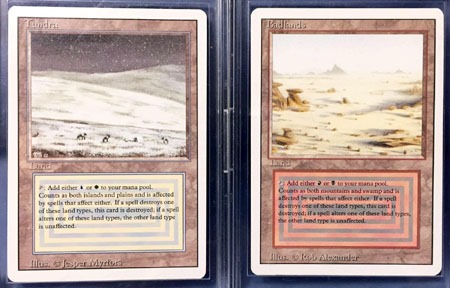
In rummaging through everything looking for the old dice, I found two large card boxes that proved to hold a number of stand-out Magic: the Gathering cards I remember.

Above: two "dual lands" from the Revised Edition. I’d at one point had a third, but I’d traded that to someone for a couple other cards I was more interested in. That was before these become such incredibly expensive cards. I obviously stuck them into card protectors, and for the moment, they can stay there.

mtg_0905_03

A couple more "fun" cards–the hydras! The Balduvian Hydra is from the Ice Age expansion, while the Rock Hydra is from the Revised Edition, I believe. I quite enjoyed using both, being a fan of the token-creatures and stuff, and just the rarity and air about ’em (the Ice Age card being the "new" or "poor man’s" Rock Hydra).

mtg_0905_02

Similar to the Balduvian Hydra, the Polar Kraken was–to me–a neat creature that seemed like a new version of an older one–and fun to use as one of the largest (if not THE largest) creatures in the game at the time, the Leviathan. I believe I traded or bought the two Leviathan cards from the The Dark set, and "inherited" the Fourth Edition one from a friend when he got out of the game.
mtg_0905_00

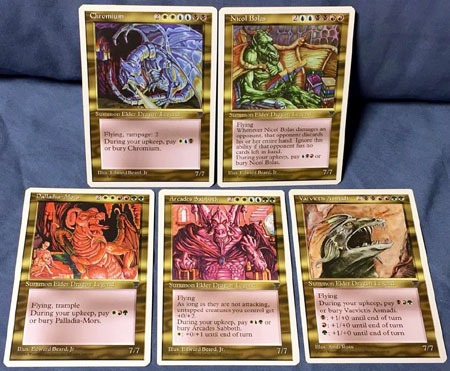
And then there’s my favorite subset of cards from the game: the Elder Dragons! (The Nicol Bolas pictured here is out of its case for the group photo…it was in the case in a photo shared several weeks ago.)

Chromium was by far my favorite of the five, if only for the art and concept, but probably also for its inclusion in some of the early comics. Nicol Bolas has come to be a favorite as well thanks to use of the character in the books (Time Spiral in particular) and for getting a toy made!

While probably not at all powerful nowadays, some 65 sets and 12,000+ cards later, considering I got into the game in early 1995 or so (the game had not yet been out for 2 years!), these were great at the time, and truly the stuff of legends.

Though they’re obviously not comic books, I may start "showing off" some of my old favorites as I come across them, sorting through all these old cards that I hadn’t realized were not in with what I’d thought was my entire collection (oops!).

Time will tell, though!

mtg_0905_04

Showing Off a Shelf – Nicol Bolas & Magic: The Gathering

It’s been a number of years since I had my Magic: The Gathering novels properly shelved, and in my recent moving re-discovered my Nicol Bolas card from 1995’s Chronicles set. Additionally, I have the 6" "oversized" Pop vinyl of Nicol Bolas that I picked up a couple years ago.

nicol_bolas_mtg_08152016

So here I’m showing them off.

Back in 1999/2000 I was loving the novels, and followed them (keeping up with the actual reading of them, even!) for at least a couple years, through the publication of Apocalypse that pretty much drew together the entirety of M:TG‘s story from its start to that point. I also read a bunch of the earlier ones from the mid-1990s years before and have those as well.

I may have more to show off in coming days/weeks as I get settled in after last month’s move and utilize two newly-assembled bookcases (this photo comes off a repurposed one).

Revisiting Dakkon Blackblade – A Magic: The Gathering Legend

Writer: Jerry Prosser
From a story by: Steve Conard & Jeff Gomez
Pencils: Rags Morales
Inks: Barbara Kaalberg
Letters: Bryan Dresner
Color: Atomic Paintbrush
“The Dragon War”: Jack C. Harris & Alex Glass
“Magic: The Untold STory”: Sharon Claire Mitchell
Graphic Design Edtorial Pages: Kenny Martinez
Assistant Editor: Jeof Vita
Armada Line Edtor: Jeffrey Artemis-Gomez
Published by: Armada/Acclaim Comics
Cover Price: $5.95
Cover Date: June, 1996

This is another of Armada‘s MTG projects that I’ve actually just read for the first time. I’m not sure where I got this volume–whether it was new at the time, from a bargain bin, or from a friend. Whatever the case–it’s one of the later books, and not one I’ve found to be all that common.

This issue has art by Rags Morales–something I found to be very interesting, as he’s been an artist whose stuff I’ve had an eye on since 2004’s Identity Crisis from DC. The art works really well–the issue looks like good fantasy to me. The style has something that I haven’t noticed in the other MTG books that at the same time is obviously fantasy but also looks like mainstream comic art.

The story itself doesn’t impress me all that much, as it seems to be a bit of a legend within a legend. While we learn a bit about Dakkon and how he gets his blade, and I’m not entirely sure what I did expect…this wasn’t it. The cover, I suppose, put me in mind of Dakkon being on some quest to track down/fight the Swamp King, and I just thought this would be a bit more “epic” than it proved to be. However…I got a huge kick out of learning the origin of the Carthalion line.

Given contemporary MTG comics are $4.99, for another 96-cents, this is a “prestige-format” one-shot with plenty of story pages, a notable absence of advertising, and PLENTY of “back-matter” which makes it quite worthwhile at the cover price by today’s standards. I’m not sure it would have seemed as worthwhile 15/16 years ago…but this is absolutely worthwhile if you find it for cover price or under, anywhere.

I had to force myself to read the prose story in the back–something about the larger-than-a-book pages and double-columns put me off. In the end, it was an enjoyable story, and definitely a “compressed” thing–it could easily have been a mini-series in itself if it was put out in non-prose comics format. The essay “analyzing” the various Armada comics wasn’t all that informative, though I read it all the way through without too much trouble, once finally in the mindset to read pages of text in a comic. These definitely packed a lot more time and value into the issue as I probably spent–all told–at least an hour to read everything cover to cover, which beats pretty much any other comic out there.

As said above, I’d not read this before, so no real sentimental value on this; no particular memories of when it came out and all that. It’s another MTG comic, that I enjoyed reading as I read it, had to force myself to read the prose, but generally it was a good read.

Other Revisiting Magic: The Gathering posts:

Revisiting Homelands on the World of Magic: The Gathering

Writer: D.G. Chichester
Artist: Rebecca Guay
Letters: Kenny Martinez
Asst. Editor: Jeofrey Vita
Editor: Jeffrey Artemis-Gomez
Cover Painting: Tim & Greg Hildebrandt
Published by: Armada/Acclaim Comics
Cover Price: $5.95
Cover Date: February, 1996

It’s been a lot of years since I’ve read this. I have a number of memories associated with the Homelands expansion of Magic: The Gathering (the card game itself). For one thing, it was the first (and to date, only) expansion set I ever got a full box of–my parents bought me a box for Christmas that year. In addition to the awesomeness of seeing more story in the cards–finding out the character of Serra herself (already being familiar with her Angels) as well as Baron Sengir (whose Sengir Vampire was always creepy-looking), to the various analogues and soft reprints of other cards–there was this comic, getting the actual story of a set all in one place at one time.

If I remember correctly, the issue came polybagged with one of several “rare” cards…unless misremembering, I got a Baron Sengir this way.

The story itself is huge in scope–spanning centuries, definitely not your “street-level” kind of story, but one from the point of view of near-immortality. While it’s an interesting approach, too much time passes too quickly in such a short span to really get to know any characters in any organic sense–we get “told” more than we’re “shown.”

While very highly-compressed (if this were a Marvel property it would probably be spread across at least 12 issues) I do appreciate the overview or “survey” of the world and its cultures, and seeing the impact of Feroz and Serra upon the place.

Flipping through, it looks like a quick read, but the actual reading took a lot longer than I would have expected…part of the “compression,” I guess.

Prior to recognizing her name, I recognized Rebecca Guay‘s art with the Serra Angel special while trying to find a copy of it last month without spending $50+. I’d recognized the art without knowing quite why–connecting it to this issue cleared that right up. The visual style is a bit impressionistic, sort of surreal and maybe slightly abstract…but it works for this story.

This is specifically the story of Homelands–but it’s also the stuff of legend, as one has to have already passed through a huge span of time to talk about it, so while we see the story unfold, this could be a story being told to someone well after the fact–a legend of the world’s history told to a child, perhaps.

As part of the Armada MTG universe, we get a cameo of Taysir–whether this is early Taysir or not, I’m not entirely sure–but it roots that character in the “canon” of Magic: The Gathering, not just some character created in a licensed comic but an actual part of the official story.

Also as part of the Armada line, we have the usual “backmatter” that is very much a part of all of the Armada MTG comics. We have a 2-page article from one of the creators of the Homelands expansion, talking about what went into the making of the set itself. Then we get a specific timeline of the history of the world, from the beginning of the story to the present, further contextualizing everything that was just read about and putting things into more solid terms. There are another couple pages on the history of Dominaria, and then a couple pages about Taysir. Set creators each share their favorite cards from the set, and we get a several-page overview of the set’s themes, by color after that. Finally we get the typical Seer Analysis that looks at some of the specific cards referenced in the story and how they were adapted.

I really like the Hildebrandts‘ cover…it’s very fantasy-esque, though also very highly colorful, making it stand out quite a bit to me.

In my experience, this issue/volume seems to be the most common of the prestige-format issues Armada released…I’ve come across this several times through the years in bargain bins, where I have not the other Armada prestige issues.

While this carried a $6 cover price back in the 1990s, by contemporary standards this is well worth that price. The story is a good length, and the back-matter (if of interest to you) lends a lot of extra time to spend on reading beyond just the comic itself. This also serves as a sort of “guide” to Homelands, and I see it as the precursor to the MTG novels that would later be released along with each card set, doing the same thing this did: tell the canon story of the set including incorporating the various characters and cards into the story, the ongoing continuity of the game, providing a richer context for those who wanted to delve deeper than just the flavor text on the cards themselves.

While Homelands never proved to be a particularly key set and never seemed to me to be all that popular…in terms of MTG comics, this is–for me–probably one of the most significant ones, and definitely my favorite of all the covers.


Other Revisiting Magic: The Gathering posts:

Revisiting Elder Dragons – A Magic: The Gathering Legend

Full post at FantasyRantz.wordpress.com.

A 2012 look at Acclaim/Armada‘s 2-issue mini-series from the 1990s with a tale of the Elder Dragons from the Legends expansion of Magic: The Gathering.

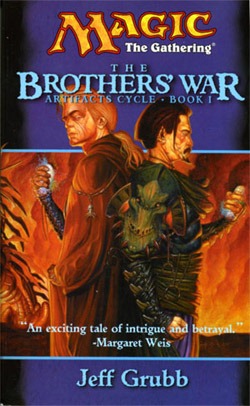
Revisiting The Brothers’ War – a Magic: The Gathering novel

I pulled this off my shelf a few weeks ago after re-reading some of the earliest Armada Magic: The Gathering comics. (The Shadow Mage, Ice Age, Fallen Empires, and Antiquities War). Something about the Antiquities War mini-series reminded me of the acknowledgements in the novel to prior versions of the story of The Brothers’ War. And rediscovering that the comics left the “whole story” incomplete–Armada only got to publish 2/3 of their planned arc for the story–my interest was reignited.

A few years ago, I read Time Spiral, the first book in a trilogy of novels covering that block of Magic: The Gathering card sets; part of what really drew me in was that it revisited the world of Dominaria, which seemed to have been largely left behind after the Invasion block. And not really having read any of the books since Apocalypse, I was interested in seeing where Dominaria had wound up.

Anyway, The Brothers’ War.

This is easily one of my favorite books of all time–this is at least the third, maybe the fourth or fifth time I’ve read the novel cover to cover…something I do very rarely and with so few books.

This came out in 1998 or so, kicking off a huge line of MTG novels from Wizards of the Coast. There’d been another line of MTG novels (published through HarperPrism) several years earlier–but those were (for the most part) generic fantasy novels with the MTG “branding.” This line provided the actual story of the cards, the continuity of the game itself.

At least with the early MTG expansions, as WotC was world-building and beginning to pull everything together into one continuity (albeit across a multiverse), everything came back to the war between Urza and Mishra. Much of the detail was vague and loose–but what was clear was that a conflict between these brothers had caused much destruction and deeply impacted their world. An unnatural ice age actually descended on the world after the conflict, and the world itself was cut off from the multiverse for centuries.

But this novel went back to the beginning–Urza and Mishra as young boys, arriving at Tocasia’s school, where they began learning of artifacts and the Thran (an ancient civilization). They grew into the school–Mishra learning of the Fallaji, a desert-dwelling people while Urza focused on his inventions. Eventually, they visit an ancient cave, where they discover intact Thran artifacts, and are introduced to Phyrexia–a plane of living machines. They also each gain a half of an incredibly powerful Power Crystal. Mishra’s becomes known as the “Weakstone” as it can weaken artifacts while Urza’s becomes known as the “Mightstone” as it strengthens them and brings life to the machines.

From there, the brothers each covet the other’s half, leading to a rivalry that lasts the rest of their lives as the entire world eventually pays an astronomical cost for the brothers’ jealousy. Their rivalry results in the death of their teacher, sending the boys onto their own individual paths: Mishra into the desert where he becomes a part of the Fallaji, while Urza returns to “civilization” and marries into royalty. Eventually rising to top levels of government in each culture, the brothers have immense resources to throw at each other, draining the world’s resources in the process, until the only thing left is destruction.

The novel’s story is told in sections, each encapsulating a period of years in the brothers’ lives. All told, the novel spans over 60 years, following the brothers from being young boys into old age; a lifetime of conflict. Structurally, I find it interesting to see stories that do span characters’ entire lifetime (or the majority of it)…something to it seems more interesting and complete to me than just continuous stories all bunched into a small span of time.

This story also seeds the foundation of stories to come, as we are introduced to a number of prominent concepts that play out across much of the Magic: The Gathering continuity. We’re also introduced to some core concepts from the cards–getting backstory on prominent cards and locations, nicely “transforming” the source material into essentially adaptation material; that is, the book’s story draws from concepts set forth in the cards, but does so in such a way that the cards then can seem like they were adapted instead from the book.

This book is marked as the first volume of the Artifacts Cycle, but it truly stands alone as a self-contained story. There’s no “to be continued” or traditional-cliffhanger sort of ending. The end does leave an opening to transition into the larger MTG continuity, but you’d pretty much have to know where it goes to truly pick up on that; even knowing it myself, it’s a bit of a disconnect, like taking a standalone movie and then 15/20 years later making a sequel. The sequel can work and validly pick up the story, but the sequel is far from any sort of “essential” to the original.

For a 1998 book–now 14ish years old–this held up remarkably well. This could have been written in 2012 if I didn’t know any better. This has been reprinted in a “trade paperback”-sized edition combined with another early MTG book, The Thran. While I would definitely love to have a standard-sized hardback of just this novel, I’m not terribly interested in the “collected edition.”

What also proved surprising (and very disappointing) for me was that this book is NOT currently (late October 2012) available as an ebook. Perhaps I’m an extreme minority, but I would gladly have paid the $6-$8 for a nook-book edition, for the convenience of re-reading this on my phone’s nook app. Instead, I spent 4-5 weeks carrying my 1998 mass-market paperback edition around, which of late has been a less than ideal prospect.

I’m fairly tempted to re-read several of the other books from this series, though I lack (by far) the kind of time TO read that I had in late high school and early college. Honestly, the primary drawback is that these are not ebooks–if they were available that way, I’d be further tempted with the ability to buy/download them and have them on my phone, to jump into “whenever” spur of the moment.

If you’re into fantasy–even if you don’t care a lick about Magic: The Gathering the card game or anything from the past 10 years from MTG in general, this is well worth reading. For me, it’s been worth reading at least three times, and I enjoyed it as much now as I did in 1998 and 1999, with a number of scenes and “moments” having stuck with me that I’d forgotten came from this book.

MTG

Recent Cool Acquisitions

I recently acquired several cool comics that I’ve had my eye on for awhile. With Valiant being back, and a bit of sticker shock at the price on early issues of the original 1990s series, I made use of Amazon to order the other two hardcovers I missed back in 2007/2008. I got the Archer and Armstrong volume when it came out (pre-ordered through DCBS) but never got around to tracking these others down.

The Harbinger volume came from a Half-Price Books online seller through Amazon; X-O came new from Amazon. Shipped, I paid about $12 under cover price total for the two books. And though marked as “used,” the Harbinger volume is in just as good (if not slightly better) condition than the X-O one…just that I didn’t have to peel the shrink-wrap off of it.

And not too long ago, I complained about the pricing eBay folks are asking for a Magic: The Gathering comic I’ve been after. Amidst all of the ridiculously-priced auctions, I did come across one with a reasonable opening bid. With a gift balance on my account, all told I wound up getting the Serra Angel issue for just under $10 (shipped).

Not a bad purchase, if a bit much in a way. Yet, something like this would easily be an $8+ product from Marvel or DC these days, if not $10 in and of itself. As-is, it’s got a $6 cover price from the 1990s, and will probably take at least as long to read as 2 1/2 issues of most $3.99 contemporary comics.

This came as-is; already opened–so no giant Serra Angel card. BUT given I specifically want to read the thing, and I’m sure the lack of original/sealed bag and card helped to keep the price “low” I have no problem whatsoever with what I got. Actually makes it easier as I don’t wind up tempted with the thought of leaving it in the bag or trying to re-offer it or such myself.

Magic: The Gathering “Classics”

I’m honestly fairly surprised in a way that IDW has not published (that I am aware of) any Magic: The Gathering Classics volumes. They’ve got a Classics line for several other licensed properties, so why not MTG? Granted, the property doesn’t have quite the same quantity of “classic” material as the others, but surely they could get at least a few good volumes out of what’s there.

Given I’ve seen nothing whatsoever regarding any actual volumes, here are the six volumes I’d propose for a series of MTG Classics volumes.

Vol. 1 – The Shadow Mage
Collecting The Shadow Mage 1-4 and Wayfarer 1-5.

This would make for a nice-size 9-issue volume…a bit thicker than your average 6-issue book but not so hefty as a 12-issue collection. This would be–I believe–the complete run of issues featuring Jared Carthalion, and be all the issues that did not focus on a pre-existing MTG card or story.

I put these in the first volume as The Shadow Mage was the first series from Armada, and I’ve just always associated it as starting everything off. I believe Wayfarer picked up the month after, so this is essentially a 9-issue story anyway, which would make for a solid single-volume I think.

Vol. 2 – Ice Age
Collecting Fallen Empires 1-2, Ice Age 1-4, and Nightmare 1.

I’d put Ice Age and Fallen Empires together as they tied together a bit. To go chronologically I’d probably put the FE issues first in the volume–with the origin of a major character that appeared in IA.

I place these here as they were the next series to come out from Armada

I’ve got the Nightmare one-shot here mostly for lack of good placement elsewhere. This issue was a bit on the early side of the Armada run, and would seem to me out of place to be grouped with the various Legends issues.

Additionally, it being extra-sized helps fill out the pagecount for the volume as it’s otherwise almost two issues smaller than the first.

Vol. 3 – The Brothers’ War
Collecting Antiquities War 1-4 and Urza/Mishra War 1-2.

While it would have been great to have the full intended “trilogy” of series that would have been the “entirety” of the story of the Brothers’ War, it just makes sense to me to put these two minis together. While technically only six issues, the Urza-Mishra War issues were extra-sized, filling this out to approximately an 8-issue size.

Even if this wouldn’t quite reach 8 issues, it’d be very similar in size to the previous volume, and could always be filled out a bit with a selection from the The Brothers’ War prose novel.

There’s also (as with previous volumes) the Seer Analysis and such “backmatter” that would fill things out a bit.

Vol. 4 – Legends I
Collecting Arabian Nights 1-2, Shandalar 1-2, Homelands, and Fallen Angel plus material from Convocations.

This volume and the next are sort of catch-alls for the rest of the Armada stuff.

Arabian Nights and Homelands fit together as they’re short stories based at least in part on actual MTG expansion sets. Though Shandalar was based on a story from a computer game, in its own way that could be seen as another expansion.

Since that would still leave the volume a bit short, I’d go ahead and put Fallen Angel here, to begin the series of Legends-focused issues. The volume could be rounded out with a few pages from the Convocations “gallery” issue.

Vol. 5 – Legends II
Collecting Elder Dragons 1-2, Dakkon Blackblade, Jedit Ojanen 1-2, and Serra Angel plus material from Convocations.

This volume would finish out the run of Armada MTG issues with the rest of the Legends-based specials. Considering the prestige-format issues to be roughly double-sized, this would be about 8 issues, and the Convocations pages not included in vol. 4 would up the pagecount a bit for the volume.

Just as I associate Shadow Mage as kicking off the Armada line, I associate these with the end of the line–as of this typing I actually don’t even yet own the Jedit Ojanen issues, just acquired Serra Angel and only found the Elder Dragons issues a couple years ago–at least a decade after the issues first saw print.

Vol. 6 – Gerrard’s Quest
Collecting the Dark Horse mini-series 1-4.

This would obviously be the smallest of the volumes with only 4 issues–moving from the Armada comics to the 4-issue mini produced by Dark Horse Comics. This would basically be a reprint of the Gerrard’s Quest TPB with a new cover.

I know Wizards of the Coast has produced plenty of their own MTG material, and there are at least a couple graphic novels out from them. I don’t know that any of that would fit well here, and as those are relatively recent, they wouldn’t really fall into the realm of “classics” the way all these others do.

I’d expect these volumes to be at least $19.99 cover price…though that could feel a bit rough as Shadow Mage and Ice Age in particular seem to be pretty common bargain-bin issues. It’s the later issues that had smaller print runs and grew quite rare. As such, it would seem a bit on the expensive side for the content; but then in turn, the prestige-format issues were $6 or so apiece, and I don’t think I’ve seen any of those in bargain bins, so it would all balance out.

The sixth volume would seem to me ripe to be priced at $14.99 or so if not bargain-price it to $9.99, as with only four issues it’d be about half the size of the previous volumes.

So there you have it–the contents and collections I’d imagine as ideal for production by IDW, assuming they thought the sales warranted (of course, they probably don’t). Heck, these could even be shrink-wrapped with reprints of key cards from the time of the comics, with the old art. Whether playable or not, I don’t know.

Revisiting Urza-Mishra War on the World of Magic: The Gathering

Full post at FantasyRantz.wordpress.com.

A 2012 look at Acclaim/Armada‘s 1996 mini-series continuing the Brothers’ War saga.

Revisiting Antiquities War on the World of Magic: The Gathering

Full post at FantasyRantz.wordpress.com.

A 2012 look at Acclaim/Armada‘s 1995-1996 mini-series detailing the start of the Brothers’ War saga.