• January 2026
    S M T W T F S
     123
    45678910
    11121314151617
    18192021222324
    25262728293031
  • On Facebook

  • Archives

  • Categories

  • Comic Blog Elite

    Comic Blogs - BlogCatalog Blog Directory

Booking Through Thursday: Age-INappropriate

image

In contrast to last week’s question–What do you think of censoring books BECAUSE of their intended age? Say, books too “old” for your kids to read?

I tend to be torn on the subject of censorship, especially when it comes to books. On one hand, there are subjects that I–as an individual with my own personal beliefs–am uncomfortable with and would “prefer” maybe to not see spread. On the other hand, I fully believe that everyone should have the freedom to choose what we read, just as we have a choice in what we DO with what we read.

I’m honestly disgusted when I hear about schools banning entire books for a single instance of a single word, or for the historically-accurate use of a particular word in-context in a piece of historical fiction. Or when adults would apply a one-size-fits-all directive to hand down without accounting for the fact that everyone is unique, and just because one 9-year old might be too immature or simply “not ready” to handle or deal with certain material does not mean that another 9-year old hasn’t already faced something in real life and its presence in a book might be cathartic. (and any combination of situations in-between, etc.)

Given all that, I believe very firmly in having a ratings system. Some might say that even giving something a “rating” such as “MA 17” or simply “MA” for “Mature Audiences/over-17/over-18” or “A” or “K” for “All-ages/Kids” or such is censoring…but really, ratings are a guide. Sure, kids may intentionally seek out something rated for adults out of curiosity or simply because the subject matter interests them. (While books are not movies, I always remember Alien3. I’d gotten my hands on the book, and read it, but had to convince my mom to let me see the movie (I think I was 12 at the time and the movie’s rated R).

By applying a ratings system, it serves as a guide. Readers can determine what they’re up for or interested in–if they’re interested based specifically on the rating or how “age-appropriate” the material is.

And I also believe very firmly that if parents or other adults are particularly concerned about the age appropriateness of material, it’s on them to voice exactly why, and to share that with others, and still allow them to make a choice.

If I had children and they were interested in, say, Harry Potter (to take an easy shot)…it would be my responsibility to share the experience with them, and to express my feelings about it. I mean…I greatly enjoyed the series in and of itself, but also saw plenty of stuff that would make for valuable conversations with young readers.

On the comics side of things, comics are not “just for kids.” DC Comics has their Vertigo line, comics generally intended as being for adults. I would not hand The Sandman, Preacher, Y: The Last Man, or Hellblazer to a young child blindly. But particularly in the case of The Sandman, if a young reader is particularly interested I do not believe they should be hindered.

I do find it acceptable to separate graphic novels between “adult” and “non-adult” in libraries. I’m uncomfortable with–in a library setting–shelving the likes of Bone and Owly in a kids or intended-for-young-teens section with Preacher and Hellblazer right alongside ’em.

BUT even if everything’s separated specifically by age groups…no one should be DIScouraged from reading, in my mind. Reading’s highly important. And if the 60-year-old wants to look at the picturebooks, he should be allowed; and if the 9-year-old is ready to read something traditionally aimed at adults, she should be allowed as well.

[I’ve run out of time for writing at present…surely this is a far deeper topic that I could write much longer and at length on…and which–if I were writing academically–would certainly benefit from better organization of thoughts, rather than this stream-of-consciousness freeform this morning. Thoughts/questions/etc? Please post in the comments…]

Booking Through Thursday: Cereal

btt button

If you’re like me, you grew up reading everything under the sun, like the cereal boxes while you ate your breakfast, the newspapers held by strangers on the subway, the tabloid headlines at the grocery store.

What’s the oddest thing you’ve ever read? (You know, something NOT a book, magazine, short story, poem or article.)

Honestly, I’m not really sure how to answer this, off the top of my head. I don’t really think much about what I’m reading, except for this meme, or other occasional random/isolated moments. Like: for as few books as I really read anymore, I read a crapload of comics and graphic novels—which is still reading, just in much smaller chunks than full-length prose novels.

Reading headlines on magazines, tabloids, strangers’ newspapers, or random text on cereal boxes or signs in stores or posted on the door of the apartment building, or whatever….I’ve never really considered those as any particular reading material, nor as something odd TO read.

I suppose email or blogs could factor in here. Facebook statuses and Twitter posts. Subtitles in tv programs or films. But I don’t find it odd TO read any of those.

Maybe warning labels and disclaimers. Heck, even claims that I find to be outright ludicrous given experience.

Like this claim by Sprint regarding their Picturemail service.

I find it EXTREMELY odd that they claim that it’s easier to download stuff using a Flash-y interface, where you cannot simply download an entire album, and that is highly UNfriendly when one has over 5,000 photos they want to download and can’t reliably do it more than 21 photos at a time.

I guess I’m just being extremely wordy to not really say anything at all.

What do YOU think is the oddest thing you’ve read? (Besides any of my writing, that is). Feel free to comment on this post to share!

Booking Through Thursday: Serial

bookingthroughthursdaybuttonSeries? Or Stand-alone books?


When it comes to non-graphic books…I don’t think it really matters to me if the book is standalone or part of a series. At least, I don’t choose a book because it’s one or the other.

Most of the Stephen King, Brad Meltzer, and John Grisham books I’ve read have been standalone (even if they’re set in the same world/continuity, they aren’t necessarily part of a series). I look forward to their new books based on it being a new book by an author whose work I enjoy…not because it’s the next book in a series.

At the same time, in the last couple years, I’ve read the Twilight series, the Percy Jackson series, and I just finished listening to the latest two books in Weis/Hickman’s Lost Chronicles (Dragonlance) series. A few years back, I spent six weeks reading the entire original Left Behind series. A couple books on my to-be-read list for this year are the first books in new series—but they’re there due to the author, and not for kicking off new series.

When it comes to comics, though, I’m a bit more choosey.

I prefer series. If something is an “ongoing” series and has proven itself to last, I’m more likely to give it a shot. (a $2.99 or under price point certainly helps). Superman, Batman, X-Men, Green Lantern…there’s a history, there’s a reasonable expectation of the series continuing indefinitely, and so I’m more likely to be comfortable checking things out long-term.

For the most part, I tend to avoid “mini” or “limited” series as these will inevitably be collected into collected volumes/graphic novels, which I may pick up if my interest’s there by the time that edition is published.

Given the serial nature of comics, while there are the occasional great self-contained stories…overall, if it’s just a one-off short story (under 12 issues) I’m generally not going to check it out without much prior critical acclaim—I’ll feel cheated, as it’s a comic, I enjoy it, and I want more. V for Vendetta and Watchmen are a couple of notable exceptions on my own shelf.

Of course, as always…I’m sure there are plenty of exceptions to all this, holes to be poked in my thoughts that make sense before 9am. But hey…that’s the point of discussion. These are my stand-alone thoughts, for the moment…and they’re open to the changes/molding/evolution of a series of posts…

Booking Through Thursday: Headlines

bookingthroughthursdaybuttonHmm … I can’t quite come up with an outright question to ask, but thinking about the theory of fiction and how it can affect and be affected by real world events can act as a buffer between the horrific events on the news and having to actually face that horror. So … what happens when the line between fiction and reality becomes all-too slim? Discuss!

We often use fiction to escape reality, or at least visit something beyond “reality,” so when the huge events of fiction happen in real life…or something from real life pops up in our fiction, it really can be a bit jarring.

dckingdomcomeIn DC ComicsKingdom Come—the novelization of the graphic novel, at least—there’s a scene where the main character is going about his life, and comes to realize that everyone around him is focused on a giant tv screen—where news of a nuclear explosion that’s wiped out much of Kansas is coming through.

The morning of September 11, 2001 was eerily like that for me. I got out of an early morning class, to find the entire lobby filled with people, all focused on a  single tv on a cart someone had wheeled out of an office. It was a standing crowd, and people lined the stairs, no one really talking, everyone just taking in the shocking news.

I recall coming across a quote that I believe was attributed to Grant Morrison, then writer of New X-Men:

“How close is the real world coming to the comic world?  We were talking about crazy madmen launching attacks on the world years ago.”

bttexmachinaThen there’s Ex Machina by Brian K. Vaughan…whose premiere issue brought a huge surprise twist as its cliffhanger, providing a huge “what if..?” and setting itself in an “alternate reality” from our own, splintered off based on what happened that day.

In the last several weeks, I’ve been on an Ultimate X-Men tear, reading from early in the series right up to Ultimatum in barely a week…and then realizing that I actually now own Ultimatum, reading that as part of the experience…the whole thing also filling out my knowledge from the confusion I had last year when I read about half of the Ultimate Spider-Man series.

ultimatumIn Ultimatum, a huge tidal wave suddenly strikes Manhattan, destroying it. The various heroes rally to deal with the disaster—but many of their own are lost when the “Ultimatum Wave” first hits, and many others are lost in the aftermath.

There’s also reference to Europe freezing, as it seems Magneto managed to switch the magnetic poles of the planet, and the destruction caused is world-wide.

In the Magic: The Gathering novels, the early books in the series begun in 1998 with The Brothers’ War…we find all sorts of disaster, localized and global…all of which affect the local or global culture.mtgapocalypse

Additionally, this is seen in the Dragonlance novels, where an entire continent is devastated by a “fiery mountain from the sky” that completely destroys one city, and causes a huge upheaval that changes the terrain (another city famed for its sea and ships finds itself suddenly landlocked without a sea).

Given how I’m rambling a bit here…I would really suspect it possible to write a whole series of posts, each one focusing on and digging into any of these examples individually, and so many more. I’ll probably kick myself later today as more examples come to me.

Ah, yes: The Sum of All Fears. I don’t honestly recall if I’ve read the book, but I certainly saw the movie…and I recall that freaking me out.

Booking Through Thursday: Multi-Tasking

bookingthroughthursdaybuttonDo you multi-task when you read? Do other things like stirring things on the stove, brushing your teeth, watching television, knitting, walking, et cetera?

Or is it just me, and you sit and do nothing but focus on what you’re reading?

(Or, if you do both, why, when, and which do you prefer?)

Very rarely, I’ll physically multitask while reading. Sometimes while I’m waiting for water to come to a boil, or waiting for noodles to boil that proper amount of time, I’ll read a couple pages in a book as able. This tends to be if I’m toward the very end of a book, incredibly involved in the book, or particularly antsy or bored with the water/noodles.

On a slightly more passive note, I’ll often read while I wait for something that’s in the microwave for more than 5 minutes, or something in the oven for awhile.

I prefer to focus on my reading and ideally have time to read a significant chunk of something in one go. If I’m reading a comic, I want to read the whole issue at once—or at least the main story if the issue has more than one story in it (such as Specials, One-Shots, Annuals, Anniversary issues, etc). If I’m reading a graphic novel or collected edition, I like to also read at least a fully issue’s worth of pages. If I’m reading a book, I prefer to be able to read at least a full chapter.

Mostly, my “multi-tasking” with books is the fact that I rarely have one finished when I start another. And through the years, I’ve found myself with dozens of books that I’ve started, but to this day have not finished. I get distracted by life, or another book, or other books, or comics, and eventually a book that’s sitting around waiting to finished will get shelved, and for the most part forgotten.

Because of more than two decades of reading comics—typically this tiny chunk of a much larger story, with at least a month between issues—I usually have very little trouble with picking a book up after weeks or even months away and simply resuming where I left off…even if I’ve read another book since putting this one down.

This tends to be the primary reason I find myself BUYING most of the books I read, and rarely obtaining them from a library. Library books have an odd feel to them for me, as I see the “due date” as a “deadline,” and a deadline implies “forced” reading, and I have trouble trying to read something that may not be IMMEDIATELY engaging, AND/or that I feel like I’m being forced to read. The library’s due date comes and goes, and being just a few pages into the book or not yet fully engaged, I’ll return it with the best of intentions of checking it out again later.

Booking Through Thursday: Cheating

imageDo you cheat and peek at the ends of books? (Come on, be honest.)

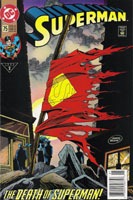
superman075For the most part, no. If I don’t already know the ending, I don’t want to know it ahead of time. The only reasons I really ever have to “peek at the end” of a book is to check the pagecount of the story itself (doing my darnedest to view the page number while forcing myself to NOT visually register the words on the page) or to see if there’s a “preview chapter” of some other book lumped at the end that’ll throw me off by a couple dozen pages with the true end of the book hitting too soon.

Now, the main exceptions come from graphic novels. At the bookstores or occasionally comic shops, if there’s tons of internet buzz and no one’s spoiling online, I might take a peek to see what the hype’s all about. I also have the problem occasionally with hardcovers, where I’ll remove the dust jacket so I can carry the book around and not worry about the DJ getting screwed up. Occasionally while pulling it away from the back side of the book, I’ll wind up catching a glimpse of a page or two at the back, which might grab my attention just enough to see what, exactly, is going on there.

The other primary exception comes if I’m trying to determine if I’ve already read something—such as a Star Trek novel I may or may not have read 15 years ago…I may look at the end to see if I remember it, as I have an easier time recalling endings than I do beginnings.

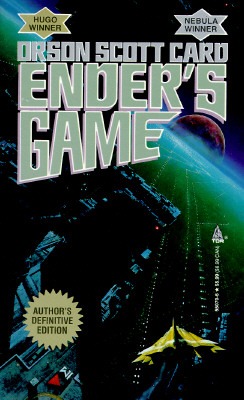
endersgamemmpbANECDOTE: If you’ve read Ender’s Game, you know that that has a doozy of an ending. It’s that ending that draws me back to the book on occasion (and partially influenced me on Ender’s Shadow a couple years back). Early in college, a friend was telling me about the book, and I convinced him to sum it up for me, as I didn’t see getting around to reading it. Sounded interesting, but having been told, I mentally filed it away as one of those things, and life went on.

A couple years later, for some reason or another, I happened to get a copy of the book, and got pulled in enough to read the whole thing. And I was blown away by the ending…only later realizing that this was THAT book my friend had told me about. And here I was “lucky” enough to not have made the connection, so I was still taken by surprise.

DragonsofAutumnTwilightIt’s this sort of phenomena that causes me to see re-reading books as a bit of an analogy for the time-travel experience, were it not fiction.

Having read the book, if you go back and re-read it…you’re traveling to the past, and re-joining characters who don’t yet know what’s going to happen…but as the reader…you DO know what’s going to happen. Or at least, have access to it. Of course, you can’t change what’s going to happen…but you’re aware of it.

Yet, there are details that slip away, and you might only remember the broad strokes and biggest players.

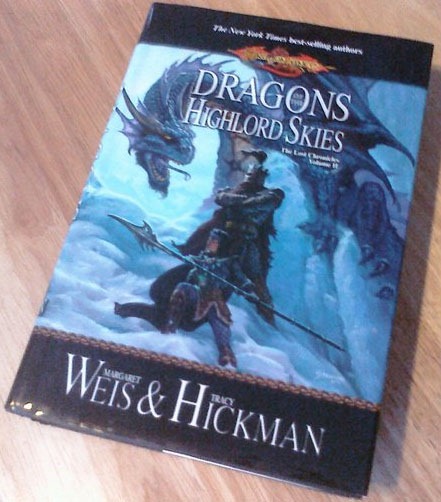
highlordskiesI’m near the end of Dragons of the Highlord Skies, and something’s just happened to a couple characters that has me on-edge, as I’d swear this isn’t something that happened to them, and I thought I remembered them doing something else. But this book delves back to a time between-pages of Dragons of Winter Night, which I haven’t actually read in a decade or more now…so I may be thinking of other characters.

Just as, if someone were to travel back 100 years…they might know big details, broad strokes…but not have any clue of what roles people play in the smaller stuff.

But I digress from the topic at hand.

TBR Challenge: The Last Days of Krypton

lastdaysofkryptonA good friend gave me this book a couple years back. Unfortunately, I didn’t get around to reading it right away…and it sat on a shelf with several other comic-related/adapted novelizations.

Then last year I came across Superman & Batman: Enemies & Allies, and wound up starting that randomly one day. I finished it fairly soon after, and realized I’d have to read The Last Days of Krypton before long–the writer had certainly proven himself to me with Enemies & Allies.

And, of course, there was that reading challenge I decided to adopt at the start of the year…this book was part of my list’s core, perfectly fitting the purpose of this challenge: to read books that I’ve been meaning to read, but haven’t been around to reading just yet. I decided to start the year out with this one, though didn’t think it would take me almost a full month to get through. (Though I determined several days ago to finish it tonight–or BY tonight–so I could start another book for February, as I should go through at least one book per month to achieve the goal of the reading challenge).

Just tonight I got to thinking a bit more "metatextually" about this book–how, in the final hundred pages or so–I wasn’t even thinking about the story being set on Krypton exactly–not as an alien planet with a different culture, anyway. It was simply the setting. Characters like Jor-El, his wife Lara, the politically-minded General Zod…they’re just who they are, in this book.

And it’s a shame, because I do think that was part of what put me off at first–I was hesitant to get into a story dealing with Krypton itself, before Kal-El was even born (even conceived, at that!). Yet, after over a year of the comics having the whole World of New Krypton thing going on…this wasn’t as much a leap as it might otherwise have been. And proved far more enjoyable.

Anderson shows a great bit of craftsmanship in the telling of this tale. At the start of the book, Krypton indeed comes off as alien–as it should. But somewhere along the way, it just simply…is. It’s no different than when I first opened Dragons of Autumn Twilight early Freshman year of high school and first discovered the world of Krynn, or the first time I read The Fellowship of the Ring and found myself in Tolkien‘s detailed landscape…or for that matter, turned the pages of a comic in which a man could fly or dress as a creature of the night and fight crime…in the daytime.

Even as events unfolded–especially toward the very end–in a way that I didn’t expect, nothing actually contradicts what I already know about Superman and his background. A couple characters have names I’m unfamiliar with, others have names that would almost have to be intentional plays on words…but nothing truly contradicts stuff.

In fact, toward the latter part of this book, I was put even more in mind of the Donner movie continuity, as certain elements came together in such a way that I was visualizing what I think I recall from the original film’s time spent looking at the end of Krypton.

Even though this book details–as the title says–the last days of Krypton, and you’d have to have zero idea who Superman is, his background, and probably not even see this book’s cover to not know how it ends….it’s the story leading there that draws one in. And Superman fan or not, this makes for a nice, solid sci-fi story…just that it has something extra going for it knowing what it technically "leads into."

All in all, a very enjoyable read–one I’m glad to have read, and I look forward to possibly tracking down some of the author’s other works at some point down the line.

Booking Through Thursday: Periodically

bookingthroughthursdaybuttonEven I read things other than books from time to time … like, Magazines! What magazines/journals do you read??

These days, I really don’t read anything other than books or comics/graphic novels/TPBs/whatever you want to call ‘em. I suppose comics COULD be considered magazines—or periodicals. But for ME, that’s such a given, and for as much as I read traditional-format comics…the better question in that case would be what books do I read, as they’re something I read other than comics.

I’m known to dip into Reader’s Digest when I have one handy and don’t have other stuff onhand to read. I keep an issue at my desk at work in case I ever find myself without a book, so I have SOMEthing to read.

Though there are some “high end” magazine-like publications for comics, I don’t follow those, not really. I used to—years ago—read Wizard magazine…but that publication has (at least to me) fallen to such depths that I can’t even bring myself to bother reading cover blurbs if I even see the thing at all.

lifewitharchie001 Perhaps the best answer to this would be Life With Archie: The Married Life. It’s a magazine-sized publication, produced monthly. It has a few fluff features to round things out, but the heart of the publication is the presentation of two full-length comic-sized stories. One follows a future in which Archie married Betty; the other follows a future in which Archie married Veronica.

It’s a fantastic product at only $3.99…the price of a single Marvel comic, but oversized and containing two Archie comics.

And these stories—of an adult, post-college Archie—are far more relatable and relevant to me as an adult than the usual Archie fare (nothing wrong with the usual…but I’m getting to where high school was almost half a lifetime ago).