• March 2026
    S M T W T F S
    1234567
    891011121314
    15161718192021
    22232425262728
    293031  
  • On Facebook

  • Archives

  • Categories

  • Comic Blog Elite

    Comic Blogs - BlogCatalog Blog Directory

Revisiting Dakkon Blackblade – A Magic: The Gathering Legend

Writer: Jerry Prosser
From a story by: Steve Conard & Jeff Gomez
Pencils: Rags Morales
Inks: Barbara Kaalberg
Letters: Bryan Dresner
Color: Atomic Paintbrush
“The Dragon War”: Jack C. Harris & Alex Glass
“Magic: The Untold STory”: Sharon Claire Mitchell
Graphic Design Edtorial Pages: Kenny Martinez
Assistant Editor: Jeof Vita
Armada Line Edtor: Jeffrey Artemis-Gomez
Published by: Armada/Acclaim Comics
Cover Price: $5.95
Cover Date: June, 1996

This is another of Armada‘s MTG projects that I’ve actually just read for the first time. I’m not sure where I got this volume–whether it was new at the time, from a bargain bin, or from a friend. Whatever the case–it’s one of the later books, and not one I’ve found to be all that common.

This issue has art by Rags Morales–something I found to be very interesting, as he’s been an artist whose stuff I’ve had an eye on since 2004’s Identity Crisis from DC. The art works really well–the issue looks like good fantasy to me. The style has something that I haven’t noticed in the other MTG books that at the same time is obviously fantasy but also looks like mainstream comic art.

The story itself doesn’t impress me all that much, as it seems to be a bit of a legend within a legend. While we learn a bit about Dakkon and how he gets his blade, and I’m not entirely sure what I did expect…this wasn’t it. The cover, I suppose, put me in mind of Dakkon being on some quest to track down/fight the Swamp King, and I just thought this would be a bit more “epic” than it proved to be. However…I got a huge kick out of learning the origin of the Carthalion line.

Given contemporary MTG comics are $4.99, for another 96-cents, this is a “prestige-format” one-shot with plenty of story pages, a notable absence of advertising, and PLENTY of “back-matter” which makes it quite worthwhile at the cover price by today’s standards. I’m not sure it would have seemed as worthwhile 15/16 years ago…but this is absolutely worthwhile if you find it for cover price or under, anywhere.

I had to force myself to read the prose story in the back–something about the larger-than-a-book pages and double-columns put me off. In the end, it was an enjoyable story, and definitely a “compressed” thing–it could easily have been a mini-series in itself if it was put out in non-prose comics format. The essay “analyzing” the various Armada comics wasn’t all that informative, though I read it all the way through without too much trouble, once finally in the mindset to read pages of text in a comic. These definitely packed a lot more time and value into the issue as I probably spent–all told–at least an hour to read everything cover to cover, which beats pretty much any other comic out there.

As said above, I’d not read this before, so no real sentimental value on this; no particular memories of when it came out and all that. It’s another MTG comic, that I enjoyed reading as I read it, had to force myself to read the prose, but generally it was a good read.

Other Revisiting Magic: The Gathering posts:

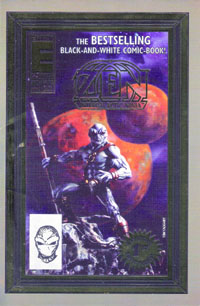
The ’90s Revisited: Zen Intergalactic Ninja Alternity Saga #0

Zen Intergalactic Ninja Alternity Saga #0Writer/Artist: Bill Maus
Plot: Steve Stern
Letters: Karen Hathaway
Editor: Don Chin
Cover Sculpture: Tom Taggart
Published by: Entity Comics
Cover Date: June/July 1993
Cover Price: $2.95

I remember seeing an issue of Zen Intergalactic Ninja back in the early 1990s–whether it was the first or second mini-series is lost to me, but it was one of the Archie Comics-published issues. Yet to this day, I’ve read exactly two issues that I’m aware of: a 1994 “sourcebook” and this issue.

I recently snagged a bunch of Zen comics from a bargain bin (though I know some of them at least are duplicates of a bunch of issues I bought awhile back and haven’t made it around to reading yet). Of these immediately-convenient issues, I chose this one as a #0 and I believe it was the oldest that I saw from a chronology published in the 1994 Sourcebook. I wanted to go back as far as I could to start my Zen reading experience.

The cover’s pretty sturdy–a much heavier stock than even most contemporary comics (sorta had to be, given the foil stamping, I suppose). But the interior pages are the old newsprint, and extremely flimsy by comparison. Also, this is in black and white–something I’m primarily only used to seeing in The Walking Dead or old TMNT comics. I do like the cover painting–the reference in the credits to a cover sculpture makes me wonder if there’s photography involved. Whatever the case, the Zen on the cover doesn’t look like the character inside the issue–I’m assuming this one’s homage to an old version of the character.

Maus‘ art is pretty good–I like the character designs, particularly Zen himself, as well as the other alien he encounters in this issue. While the lack of color takes away some brightness and contrast, it doesn’t really bother me. There are some panels that I’m not entirely clear what’s going on–it’s a bunch of lines and whitespace to me–by and large I followed right along and kept track of what was going on.

Story-wise…I know some very basic info about the character’s origin as related by that 1994 Sourcebook, but overall I pretty much just know Zen as the protagonist, he’s some alien, and he’s got some sort of power-stick as a weapon…and ninja skills (given “Intergalactic Ninja,” after all).

This issue starts with Zen in a spaceship getting shot at by another…he retaliates, and winds up following the other ship down to the planet. The two fight, but eventually realize that everything’s been a huge misunderstanding. As Zen and his new buddy face what’s happened, another figure enters the scene: Paradoxx (yeah, with a double-x on the end of the name, cuz hey, it was the 1990s!). This threat seems to be at the end of some sort of time-loop, promising huge trouble for Zen, as we’re told the next issue begins something called The Alternity Saga. An epilogue scene introduces several other characters that will likely become major factors in the Alternity Saga at least, possibly other Zen comics.

I really enjoyed this issue overall. For as little as I know about this character, I really didn’t feel lost or anything–I just followed along, taking in what’s given as part of the story and art, and vaguely recognized the epilogue characters from other covers and such. The primary drawback is that this Alternity Saga seems promising…but unless I’ve got the other issues from a previous purchase, I’m missing a big chunk of it, which makes me hesitant to dive into the next issue anytime soon: it’ll leave me on a 19-year-old cliffhanger where I have no clue when I’ll be able to get the rest of the story.

This issue as a whole is typical 1990s fare, early ’90s at that, and reminiscent of the TMNT to me as far as the black and white format and being an indy book with creators I’m not familiar with for DC, Marvel, etc. Particularly marking this as a 1990s book is the gold foil stamping all over the issue. The picture frame, the publisher logo and #, price, etc, the Zen logo itself, and of course the blurb “Explosive 1st Entity Issue.” This is from back when #1s were all the rage, even #0s, plus the foil stamping. This is the “1st” (as opposed to “first”–gotta have that “1” on the cover) issue published by Entity Comics, but is not the first issue of Zen to exist–I believe there are almost a dozen other issues published before this one.

The issue’s definitely well worth the 25-cents I paid for it. If you can find a handful of Zen issues together in a bargain bin, they’re probably worth snagging. This one certainly was.

The ’90s Revisited – Superman: Man of Tomorrow #9

History Lesson

Writer: Roger Stern
Artists: Paul Ryan & Brett Breeding
Letterer: John Costanza
Colorist: Glenn Whitmore
Separations: Digital Chameleon
Editing: Mike McAvennie and Joey Cavalieri
Published by: DC Comics
Cover Price: $1.95
Cover Date: Fall 1997

I grabbed this issue out of a 25-cent bin last week. What grabbed me was the cover itself. This is from right in the middle of the whole “Electro-Supes” era from 1997 to 1998 when Superman was transformed into an energy-being with electrical powers and a new costume. The cover is billed as “The Secrets of Superman’s Costume!” and shows a bunch of the different costumes Superman’s had in the current continuity.

I couldn’t remember what the secret(s) of the electric costume were, and liked the cluster of variant costumes, and for only $.25 decided to buy this to re-read (having bought a copy originally the week it came out, at full cover price–but that copy’s buried away in one of my longboxes with the rest of my Superman comics from this era). Re-reading it didn’t bring quite the experience I was looking for, but certainly was worth my 25-cents.

We open on Jonathan Kent falling asleep to some news about Superman, and dreaming an amalgamation of current events and stuff from the 1986 Man of Steel mini-series. He remembers the incident that brought Clark into the public eye as Superman, but replacing the development of the “classic costume” with the energy containment “electric costume.” When Martha wakes him, the two remenisce over the various events their son’s been through, essentially hitting on key points in the then-current continuity of Superman, as measured by the costume variants he’d been depicted in. By the end of the issue, Clark drops in, and we see the current costume in action.

Overall, I really like the art in this issue. I’ve generally enjoyed Breeding‘s art, and while an occasional panel here and there might have an element that seems a bit “off,” it’s hard to know if that should be pinned on the pencils, inking, coloring, or what, within the process. The overall visuals of the issue are a real treat–it’s quite enjoyable seeing all these different costumes Superman’s had, even if most of them lasted for only a few weeks or a single story and weren’t necessarily an “official” costume change the way the electric suit was.

Story-wise, I’m really not all that impressed. This is definitely a throw-away issue in terms of ongoing continuity–it’s relatively “timeless” and seems to have nothing to do with anything immediately before nor does it lead into something else. It’s a one-shot, and fairly contrived: Jonathan dreaming and then he and Martha having a conversation with these sorts of details recapping all these events just doesn’t seem at all realistic.

Despite that, this issue deals very much with long-term continuity by touching on all these events, Stern showing an obvious knowledge of the events, having been part of a lot of them (particularly the Death/Return of Superman). In contemporary terms, this would be a great 0-issue or Point-One issue.

And while this does not continue a particular story from the previous week nor lead into the next week–that makes it a nice stand-alone one-shot. I remember this era so have vague recollection for context, and it’s nice to take a peek back without getting sucked into wanting to immediately re-read anything else from this time.

Revisiting Homelands on the World of Magic: The Gathering

Writer: D.G. Chichester
Artist: Rebecca Guay
Letters: Kenny Martinez
Asst. Editor: Jeofrey Vita
Editor: Jeffrey Artemis-Gomez
Cover Painting: Tim & Greg Hildebrandt
Published by: Armada/Acclaim Comics
Cover Price: $5.95
Cover Date: February, 1996

It’s been a lot of years since I’ve read this. I have a number of memories associated with the Homelands expansion of Magic: The Gathering (the card game itself). For one thing, it was the first (and to date, only) expansion set I ever got a full box of–my parents bought me a box for Christmas that year. In addition to the awesomeness of seeing more story in the cards–finding out the character of Serra herself (already being familiar with her Angels) as well as Baron Sengir (whose Sengir Vampire was always creepy-looking), to the various analogues and soft reprints of other cards–there was this comic, getting the actual story of a set all in one place at one time.

If I remember correctly, the issue came polybagged with one of several “rare” cards…unless misremembering, I got a Baron Sengir this way.

The story itself is huge in scope–spanning centuries, definitely not your “street-level” kind of story, but one from the point of view of near-immortality. While it’s an interesting approach, too much time passes too quickly in such a short span to really get to know any characters in any organic sense–we get “told” more than we’re “shown.”

While very highly-compressed (if this were a Marvel property it would probably be spread across at least 12 issues) I do appreciate the overview or “survey” of the world and its cultures, and seeing the impact of Feroz and Serra upon the place.

Flipping through, it looks like a quick read, but the actual reading took a lot longer than I would have expected…part of the “compression,” I guess.

Prior to recognizing her name, I recognized Rebecca Guay‘s art with the Serra Angel special while trying to find a copy of it last month without spending $50+. I’d recognized the art without knowing quite why–connecting it to this issue cleared that right up. The visual style is a bit impressionistic, sort of surreal and maybe slightly abstract…but it works for this story.

This is specifically the story of Homelands–but it’s also the stuff of legend, as one has to have already passed through a huge span of time to talk about it, so while we see the story unfold, this could be a story being told to someone well after the fact–a legend of the world’s history told to a child, perhaps.

As part of the Armada MTG universe, we get a cameo of Taysir–whether this is early Taysir or not, I’m not entirely sure–but it roots that character in the “canon” of Magic: The Gathering, not just some character created in a licensed comic but an actual part of the official story.

Also as part of the Armada line, we have the usual “backmatter” that is very much a part of all of the Armada MTG comics. We have a 2-page article from one of the creators of the Homelands expansion, talking about what went into the making of the set itself. Then we get a specific timeline of the history of the world, from the beginning of the story to the present, further contextualizing everything that was just read about and putting things into more solid terms. There are another couple pages on the history of Dominaria, and then a couple pages about Taysir. Set creators each share their favorite cards from the set, and we get a several-page overview of the set’s themes, by color after that. Finally we get the typical Seer Analysis that looks at some of the specific cards referenced in the story and how they were adapted.

I really like the Hildebrandts‘ cover…it’s very fantasy-esque, though also very highly colorful, making it stand out quite a bit to me.

In my experience, this issue/volume seems to be the most common of the prestige-format issues Armada released…I’ve come across this several times through the years in bargain bins, where I have not the other Armada prestige issues.

While this carried a $6 cover price back in the 1990s, by contemporary standards this is well worth that price. The story is a good length, and the back-matter (if of interest to you) lends a lot of extra time to spend on reading beyond just the comic itself. This also serves as a sort of “guide” to Homelands, and I see it as the precursor to the MTG novels that would later be released along with each card set, doing the same thing this did: tell the canon story of the set including incorporating the various characters and cards into the story, the ongoing continuity of the game, providing a richer context for those who wanted to delve deeper than just the flavor text on the cards themselves.

While Homelands never proved to be a particularly key set and never seemed to me to be all that popular…in terms of MTG comics, this is–for me–probably one of the most significant ones, and definitely my favorite of all the covers.


Other Revisiting Magic: The Gathering posts:

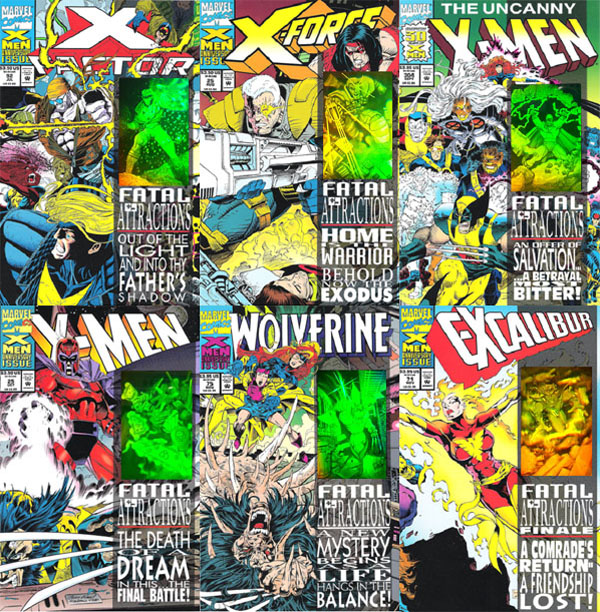
The ’90s Revisited – X-Men: Fatal Attractions

My six-part look back at the Fatal Attractions even/crossover that celebrated 30 years of the X-Men. Links below.

X-Factor #92  |  X-Force #25  |  Uncanny X-Men #304

X-Men #25  |  Wolverine #75  |  Excalibur #71

Revisiting Elder Dragons – A Magic: The Gathering Legend

Full post at FantasyRantz.wordpress.com.

A 2012 look at Acclaim/Armada‘s 2-issue mini-series from the 1990s with a tale of the Elder Dragons from the Legends expansion of Magic: The Gathering.

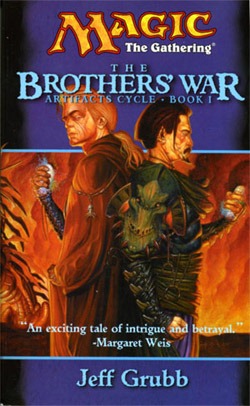
Revisiting The Brothers’ War – a Magic: The Gathering novel

I pulled this off my shelf a few weeks ago after re-reading some of the earliest Armada Magic: The Gathering comics. (The Shadow Mage, Ice Age, Fallen Empires, and Antiquities War). Something about the Antiquities War mini-series reminded me of the acknowledgements in the novel to prior versions of the story of The Brothers’ War. And rediscovering that the comics left the “whole story” incomplete–Armada only got to publish 2/3 of their planned arc for the story–my interest was reignited.

A few years ago, I read Time Spiral, the first book in a trilogy of novels covering that block of Magic: The Gathering card sets; part of what really drew me in was that it revisited the world of Dominaria, which seemed to have been largely left behind after the Invasion block. And not really having read any of the books since Apocalypse, I was interested in seeing where Dominaria had wound up.

Anyway, The Brothers’ War.

This is easily one of my favorite books of all time–this is at least the third, maybe the fourth or fifth time I’ve read the novel cover to cover…something I do very rarely and with so few books.

This came out in 1998 or so, kicking off a huge line of MTG novels from Wizards of the Coast. There’d been another line of MTG novels (published through HarperPrism) several years earlier–but those were (for the most part) generic fantasy novels with the MTG “branding.” This line provided the actual story of the cards, the continuity of the game itself.

At least with the early MTG expansions, as WotC was world-building and beginning to pull everything together into one continuity (albeit across a multiverse), everything came back to the war between Urza and Mishra. Much of the detail was vague and loose–but what was clear was that a conflict between these brothers had caused much destruction and deeply impacted their world. An unnatural ice age actually descended on the world after the conflict, and the world itself was cut off from the multiverse for centuries.

But this novel went back to the beginning–Urza and Mishra as young boys, arriving at Tocasia’s school, where they began learning of artifacts and the Thran (an ancient civilization). They grew into the school–Mishra learning of the Fallaji, a desert-dwelling people while Urza focused on his inventions. Eventually, they visit an ancient cave, where they discover intact Thran artifacts, and are introduced to Phyrexia–a plane of living machines. They also each gain a half of an incredibly powerful Power Crystal. Mishra’s becomes known as the “Weakstone” as it can weaken artifacts while Urza’s becomes known as the “Mightstone” as it strengthens them and brings life to the machines.

From there, the brothers each covet the other’s half, leading to a rivalry that lasts the rest of their lives as the entire world eventually pays an astronomical cost for the brothers’ jealousy. Their rivalry results in the death of their teacher, sending the boys onto their own individual paths: Mishra into the desert where he becomes a part of the Fallaji, while Urza returns to “civilization” and marries into royalty. Eventually rising to top levels of government in each culture, the brothers have immense resources to throw at each other, draining the world’s resources in the process, until the only thing left is destruction.

The novel’s story is told in sections, each encapsulating a period of years in the brothers’ lives. All told, the novel spans over 60 years, following the brothers from being young boys into old age; a lifetime of conflict. Structurally, I find it interesting to see stories that do span characters’ entire lifetime (or the majority of it)…something to it seems more interesting and complete to me than just continuous stories all bunched into a small span of time.

This story also seeds the foundation of stories to come, as we are introduced to a number of prominent concepts that play out across much of the Magic: The Gathering continuity. We’re also introduced to some core concepts from the cards–getting backstory on prominent cards and locations, nicely “transforming” the source material into essentially adaptation material; that is, the book’s story draws from concepts set forth in the cards, but does so in such a way that the cards then can seem like they were adapted instead from the book.

This book is marked as the first volume of the Artifacts Cycle, but it truly stands alone as a self-contained story. There’s no “to be continued” or traditional-cliffhanger sort of ending. The end does leave an opening to transition into the larger MTG continuity, but you’d pretty much have to know where it goes to truly pick up on that; even knowing it myself, it’s a bit of a disconnect, like taking a standalone movie and then 15/20 years later making a sequel. The sequel can work and validly pick up the story, but the sequel is far from any sort of “essential” to the original.

For a 1998 book–now 14ish years old–this held up remarkably well. This could have been written in 2012 if I didn’t know any better. This has been reprinted in a “trade paperback”-sized edition combined with another early MTG book, The Thran. While I would definitely love to have a standard-sized hardback of just this novel, I’m not terribly interested in the “collected edition.”

What also proved surprising (and very disappointing) for me was that this book is NOT currently (late October 2012) available as an ebook. Perhaps I’m an extreme minority, but I would gladly have paid the $6-$8 for a nook-book edition, for the convenience of re-reading this on my phone’s nook app. Instead, I spent 4-5 weeks carrying my 1998 mass-market paperback edition around, which of late has been a less than ideal prospect.

I’m fairly tempted to re-read several of the other books from this series, though I lack (by far) the kind of time TO read that I had in late high school and early college. Honestly, the primary drawback is that these are not ebooks–if they were available that way, I’d be further tempted with the ability to buy/download them and have them on my phone, to jump into “whenever” spur of the moment.

If you’re into fantasy–even if you don’t care a lick about Magic: The Gathering the card game or anything from the past 10 years from MTG in general, this is well worth reading. For me, it’s been worth reading at least three times, and I enjoyed it as much now as I did in 1998 and 1999, with a number of scenes and “moments” having stuck with me that I’d forgotten came from this book.

MTG

The ’90s Revisited: Warlock and the Infinity Watch #25

Blood and Thunder part 12: Raid on Asgard

Creator/Writer: Jim Starlin
Pencils: Angel Medina
Inker: Bob Almond
Letters: Jack Morelli
Colors: Ian Laughlin
Editor: Craig Anderson
Published by: Marvel Comics
Cover Price: $2.95
Cover Date: February, 1994

It’s been years since I’ve read anything from this title; but when I originally read through what I had of the title–probably back in 2000 or so–this issue was not one of them. And, I haven’t read this Blood and Thunder story, either (other than having maybe read one or two other random chapters, but never have read it as a singular story or all the parts in order). Yet, I’ve had a vague concept of what the story was–Thor goes crazy and some of the cosmic characters had to team up to take him down.

That this had such a cool cover of Thanos, Warlock and a chained-up Thor piqued my interest such that I found myself reading the issue in its entirety despite lacking context of any recently-read earlier chapters of the crossover or any recent reading of any Infinity Watch issues for continuity reminders.

Basically, Warlock, the Infinity Watch, Dr. Strange, and the Silver Surfer show up on the Rainbow Bridge with Thor imprisoned in a stasis field of some sort. Odin sees this and assumes with Thanos in their midst that they’ve–despite proving their Character in the past–shown up with Thor as a hostage, and he sends the forces of Asgard against the group. After a lengthy battle, Odin wades into the fray himself before Sif and Beta Ray Bill intervene, finally putting everyone on the same page. Odin attempts to simply fix things, but it doesn’t work, and so he declares that Thor must die.

The story itself is pretty good–sufficiently “cosmic” for me, which makes sense given the characters involved. And this IS classic Starlin…and given his hand in Warlock and Thanos stuff through the years–particularly back in the early/mid-1990s when this issue came out–can’t ask for much better. I really like the way this plays firmly within what I recall of the ’90s Cosmic stuff–Warlock and his group, Thanos, Thor/Odin/Asgard, even the Silver Surfer is found here. Starlin‘s got a great grasp on his “usual” characters, and seems to do the same with the Thor characters–at least, they all seem within the characterization I’m aware of for them.

My main disappointment in the issue is with the art–for me, as a casual reader, it seems incredibly uneven. I really like the cover–it’s got plenty of detail, and the characters all look quite good–recognizable, detailed, etc.–and that goes for the outer as well as inner cover images. The art for the issue itself seems truly simplistic by comparison, though, with many panels having extremely minimalistic background if anything but solid color–and many of the characters (while they remain recognizable as individuals) are distractingly simplified such that they look ugly, rough, and unfinished or rushed–especially compared to the cover. This may be a stylistic thing–and doesn’t fail to get the story across–but it’s not exactly to my liking at present.

All told, though…this was a very welcome read as something I pulled from a bargain bin sometime in the last few years–I found it a few weeks ago while searching out other comics in my unorganized collection, and set it aside TO read. I’m not certain, but I think this issue and the Thanos/Odin battle may even have been referenced in the Dan Jurgens run of Thor, post-Heroes Return, which makes it that much more satisfying to (even a decade later) have finally read for myself.

Even with the cardstock, die-cut dual cover (you open the main cover to the same image of Thor, but surrounded by all the other primary characters involved in this story) and extra story pages, this issue was only $2.95 cover price–over $1 cheaper than a standard Marvel comic today. And with bargain-bin pricing–presumably 25-50 cents–if you’ve any interest in Thanos in particular–this is well worth the price of admission.

Revisiting Urza-Mishra War on the World of Magic: The Gathering

Full post at FantasyRantz.wordpress.com.

A 2012 look at Acclaim/Armada‘s 1996 mini-series continuing the Brothers’ War saga.

Revisiting Antiquities War on the World of Magic: The Gathering

Full post at FantasyRantz.wordpress.com.

A 2012 look at Acclaim/Armada‘s 1995-1996 mini-series detailing the start of the Brothers’ War saga.