• February 2026
    S M T W T F S
    1234567
    891011121314
    15161718192021
    22232425262728
  • On Facebook

  • Archives

  • Categories

  • Comic Blog Elite

    Comic Blogs - BlogCatalog Blog Directory

The ’90s Revisited: Green Lantern #81

greenlantern0081nFuneral for a Hero

Writer: Ron Marz
Pencils: Darryl Banks
Inks: Romeo Tanghal
Color: Pamela Rambo
Letters: Chris Eliopoulos
Associate Editor: Eddie Berganza
Editor: Kevin Dooley
Published by: DC Comics
Cover Date: December 1996
Cover Price: $1.75

“That was a good issue.” That was my initial thought on closing this, the first time I’ve ever read the issue. Oh, there were some odd bits here and there, but the oddity largely comes from my present knowledge of stuff in 2016 contrasting with reading a book that’s some 19+ years old.

This issue gives us the funeral of Hal Jordan. Though this is functionally #31 of Kyle’s series, and he was introduced to “replace” Hal in the title…until now, Hal had not actually been dead. He’d first simply become Parallax, destroyed the Corps and then been “not on Earth.” He returned in Zero Hour trying to re-write reality, to fix things…and was stopped. I recall (though not in much conscious detail) the #0 issue of Green Lantern…of Hal and Kyle interacting, and I believe the then-destruction of Oa, and I think I’d figured Hal was out of the picture. He then came back in The Final Night, where he sacrificed himself to save Earth and re-ignite the sun…which brings us to this issue.

Kyle has created a cathedral construct for all the mourners, in part of the crater that was once Coast City. We see the arrival of Jon Stewart and Donna Troy, and Donna’s reunion with Dick Grayson; she officially introduces Dick to Kyle. We see there are quite a number of individuals gathered–some heroes, some villains, some not even “invited.” (But that’s life, innit?) Superman speaks, followed by Guy Gardner and Jon Stewart (former GLs both), then Dinah Lance (Black Canary) on behalf of Oliver Queen (deceased at this point in continuity). The Flash (Wally West) speaks, followed by Carol Ferris…and the service concludes with Kyle. Next, the mourners move outside, where the memorial “eternal” flame for Coast City is magically transformed into a GREEN flame (Hal now reunited with the city he so loved) by the original Green Lantern, Alan Scott. Finally, Swamp Thing causes a massive growth of plant life in the crater…transforming the lifeless, desolate pit into a massive green space to honor the fallen hero…while Kyle erects a statue construct of Hall at the heart of it.

While many might say that you need to have constant action, constant “big stuff” happening, huge events, every issue must be merely a chapter in an ongoing story…I myself am very much a huge fan of self-contained one-shots…and of quiet, personal stories. A couple of my favorite X-Men comics involve the characters at home, just being themselves and interacting…not saving the world or facing some catastrophic event or the latest apocalyptic villain. This issue is like that. No huge action-event. No action-stars. No villain crashing the party and making trouble. This is not part 1 of some epilogue mini-SERIES to examine the death of Hal. This is not a “bridge” issue shepherding us from the last event right into the next.

This is a quiet, moving story where we get to see a number of DC characters interacting as themselves, in context of a loss. Perhaps there should be mention that the WORLD has just nearly ended, but there’s not even that–this isn’t “just” a follow-up to The Final Night…this is simply a story of people coming together to mourn the death of a man whose life had–in some way–touched all of theirs. And I suppose the way I’m going on and on like this ought to “say” enough in itself, outside of these words I’m typing.

For me–having grown up through the ’90s, having been quite immersed in DC‘s continuity (if only on the Superman side) through much of this period, being “aware of” if not directly following every title–this is an instant classic. I paid $3.99 to buy this from a back-issue bin; no bargain-bin or quarter-bin…just a “full priced back issue” in this case. The $3.99–just over double original cover price–makes this issue a “match” for any current 2016 issue…yet to me, the quality far exceeds most anything I’ve read recently from DC.

To say the least…the writing for this issue is great, and my sole complaint would be what feels like a tacked-on bit from Batman for the sake of a pretty bow on the situation, quite opposite of how Batman would be portrayed through later years until Infinite Crisis nearly a decade after this.

Banks‘ art is fantastic as well…I have no complaints on the visuals, and to me the only way characters seem slightly “off” visually I think is that they look almost “too human.” There’s a deep authenticity to me here, between the visuals and story combined…as any comic book should be! And unlike contemporary comics that seem full of silent or near-wordless 2-page spreads…this issue has an example of where something like that is truly justified…giving us a huge, powerful moment…whose silence echoes loudly as we see the interior of the cathedral, the pews full of mourners, Kyle and Donna moving through.

greenlantern0081cThe copy of this issue that I bought has a $1.75 cover price…which honestly surprised me, as I’d thought all DC books were $1.95 or so at this point. Based on the barcode on the cover and no “Direct Edition” text, I can only assume this is a true “newsstand edition” copy…and perhaps these editions were slightly cheaper than the comic shop editions. (I do recall the X-books having a similar thing with a cheaper lower-paper-quality edition and then the more expensive, high-quality-paper “deluxe edition”). This would be yet another difference with contemporary comics…as in 2016 I have observed the “newsstand” editions being seemingly-arbitrarily priced at $1 more than normal.

All said…this was a great issue, and very much worth my $4, putting virtually any current comic to shame, value-wise by comparison. And it only took me some 16+ years to get around to paying a “premium price” to acquire and get to read this issue.

The ’90s Revisited: The Final Night #4

final_night0004The Final Knight / Week Four: Emerald Dawn

Writer: Karl Kesel
Penciller: Stuart Immonen
Inker: Jose Marzan Jr.
Colorist: Trish Mulvihill
Letterer: Gaspar
Asst. Editor: Ali Morales
Editor: Dan Thorsland
Published by: DC Comics
Cover Date: November 1996
Cover Price: $1.95

After reading the previous issue, I lamented having forgotten the Parallax issue that went along with this series. I did cover that issue a couple years ago, though.

This issue sees a final gambit play out, as Kyle Rayner returns to Earth, believing he’s failed to convince Parallax to help. Luthor and the Genius Crew have had the Flash construct half a million force-field devices, that will be piloted into orbit around the sun, where they will be activated as it goes nova, containing the bulk of the blast and destroying the suneater. Having already survived one trip to the sun, it falls to Kyle to be the pilot…but he mysteriously disappears. Superman steps in, admitting he’d already intended to sneak onboard and replace anyone else sent…though he requests a few moments and we see him begin to pen a note to Lois. The ship takes off unexpectedly to everyone’s surprise…including Superman’s, as Ferro opts to sacrifice himself, figuring he has the best chance of survival outside of Superman, and that the world needs Superman more than it needs Ferro. Parallax shows up with an offer to help, that’s grudgingly accepted–Batman not trusting him after Zero Hour. Moving into space, the plan fails…and as all seems lost, Parallax has paused time to contemplate the ways he could resolve this. He’d given his word that he would “only” fix things as they were without trying to remake reality, the world, or so on…and as he expends his energy to defeat the suneater, reciting the Green Lantern Oath one final time. Earth is saved, the final price is the life of Hal Jordan.

The emphasis on the Green Lantern oath in this issue makes it stand out to me…and unless I’m completely missing something, it strikes me as rather odd here, worded as “In brightest day, in darkest night” but I’ve thought it was “In brightest day, in blackest night.” Given historical context, at the point this issue was published, it’d been over 2–almost 3–years since the demise of the Green Lantern Corps, the passing of the Ring to Kyle, and so on…and I don’t believe Kyle particularly used the “classic” oath at charging his ring, so it strikes me as a bit of potential oversight that the wording so familiar now may have been mis-phrased back then. (Given the “events” Blackest Night and Brightest Day a few years back prior to the New 52).

And unfortunately, as with many things, this ending doesn’t live up to expectation, and seems to me rather anti-climatic. Of course, I’m certain part of that is that this conclusion is some 19 years old at this point and barely warrants a footnote in the current world of comics (let alone DC itself). This event came roughly 2 1/2 years after Zero Hour, and maybe 3 years before Day of Judgment (the latter now going on 17 years old itself) so a lot of the impact is lost on me, knowing what’s happened since, in broad strokes, and that there’s really nothing I’m aware of currently from DC Comics that can be traced back to this story.

Parallax showing up is basically out of nowhere as far as the core story goes–the earliest hint I noticed was the very end of the previous issue, and then I read this (not having the Parallax issue on-hand) so we go from the heroes’ various plans to suddenly having Parallax present to fix things…a bit of a deus ex machina and apparent attempt to “redeem” Hal Jordan in the process.

I’m certainly affected by the difference in twenty years, and being inundated with constant event-streams from Marvel and/or DC these days. I’m “used to” an event series being at least 6 (of not 7-9) issues, spanning half a year. This event mini was but FOUR issues: only 2/3 the length of a contemporary “standard” series. Additionally, while I’ve enjoyed this mini as its own contained thing…it’s not exactly the be-all/end-all to truly convey an event. This was a weekly series of 4 issues; with the issues presumably serving to “launch” plot points to be expanded on by various tie-in titles’ issues, and then for everything to come back to wrap up in this concluding issue.

But to have something so globally-catastrophic just “end” in this issue with no “to be continued in…” nor any noticeable “checklist” or other “house ad” to say where to follow up certain plot points, this is tangibly “the end.” Except that I do recall that while not a focus of this mini (it was explored in his own books) Superman’s lost powers didn’t come back, and when powers did reappear they were electric in nature; and this was the official “death” of Hal Jordan, lasting not quite 8 years, though the character was still used in various ways thanks to time-travel and supernatural elements.

For my $1, The Final Night proved a good read, and whether I’d read it before and forgotten or this was truly my first time all the way through…that’s one more DC Event Mini-series off my “bucket list” of yet-to-be-read stories.

The ’90s Revisited: The Final Night #3

final_night0003Keeping Hope Alive / Week Three: Shallow Graves

Writer: Karl Kesel
Penciller: Stuart Immonen
Inker: Jose Marzan Jr.
Colorist: Patricia Mulvihill
Letterer: Gaspar
Asst. Editor: Ali Morales
Editor: Dan Thorsland
Published by: DC Comics
Cover Date: November 1996
Cover Price: $1.95

Well…that’s grim. And a bit disappointing.

This is the third issue of four under the Final Night title, though there are numerous tie-in issues. And yet, this issue–The Final Night #3–is continued in something else: a special, Parallax: Emerald Night #1 that was apparently on sale simultaneously with this issue.

As things worsen for Earth–the sun-eater’s drawing heat and energy from the sun but not its actual mass–Luthor (with a tip from Ted Knight) realizes that means the sun will soon go nova–incinerating all life in the system, and certainly on Earth. Amidst this, we see Warrior (Guy Gardner) and new hero Ferro getting help for a badly-injured Wildcat, and the Phantom Stranger gives Dusk a tour of humanity, showing sides other than the mob that had attacked and blamed the crisis on her. Etrigan–The Demon–proposes a bargain with humanity, that he and his kind will save the Earth, if a unanimous decision is made to embrace hell; while the Spectre protects Gaia, and Zatanna and Fire save Ray. Not stopping there, the two then enlist Firestorm to bring momentary light to the village, while Jade and Obsidian reunite with Sentinel and Superman visits his parents. Back at Warrior’s, Guy laments what things are and used to be, and then glimpses something Green.

And that “cliffhanger” leads us into the Parallax issue.

Story-wise, this issue seemed a bit more packed, and while I’ve figured stuff with The Ray would play out in his own series (thinking his series was still going on at this time), it seems that it’s been something to play out in this core series instead. I appreciate touches like the Phantom Stranger showing up and helping Dusk to see other sides of humanity–not just the bad–even though it’s a rather cliché thing. It also reminds me that the character exists and was used like this in events of this sort. Similarly, we see the Spectre acting on a global scale while remaining apart from things going on…a difficult character to handle by its nature in the face of something like this.

The art team does a good job, and everything is gotten across pretty well…I have no real complaints visually.

This third issue pushes things into dark territory, as things are looking impossible for the Earth and its heroes. The sun is being consumed, and where the Earth faced being frozen, now it faces incineration…neither condition supports life beyond a few more hours. Even Superman is at a loss–deriving his power from the sun, he’s virtually “normal” at this point, denied the sun’s energy himself. I’m convinced that Dusk does play a role in the end of this story…there’s been enough done with the character (superficial as that’s been) that it would seem a waste to not have something planned.

I’m less than thrilled at the realization that there’s the direct continuation into a side issue: while I know full well there are numerous tie-ins, numerous details going on outside this core story that are relevant to the story–thus far the core mini has technically only continued directly into itself. My satisfaction at scoring all 4 issues for $1 is diminished now, realizing that I missed the fifth issue that would make more sense to have now.

Of course, I have read that issue (though I don’t recall much detail consciously) but it would be much more satisfying to read it now and not have to go on memories from several years in the past.

For 25 cents, this was a good issue, reading in context of the mini-series as a whole, and I’ll be diving into the fourth issue shortly.

The ’90s Revisited: The Final Night #2

final_night0002Darker Grows the Night/ Week Two: Chaos

Writer: Karl Kesel
Penciller: Stuart Immonen
Inker: Jose Marzan Jr.
Colorist: Patricia Mulvihill
Letterer: Gaspar
Asst. Editor: Ali Morales
Editor: Dan Thorsland
Published by: DC Comics
Cover Date: November 1996
Cover Price: $1.95

We open on a page of exposition via a news story to bring us up to speed on the current situation, leading into the new stuff for the issue. Lex Luthor turns himself in by way of offering his genius to help overcome the current crisis. Around the world, heroes do what they can for the general populace, assisting where their powers and abilities allow them, overcoming challenges to conventional services–such as fire trucks being unable to get to fires due to gridlock. Implementing a design from Luthor and modified by Brainiac 5, Green Lantern Kyle Rayner gets a probe into what remains of the sun, gaining valuable data. Meanwhile, the Ray and Dusk come face to face with ground-level reactions to the crisis, and we see new figures emerge.

While my initial reaction to Immonen‘s art with the previous issue was less than stellar, moving into a second issue of the art, building from that first, I found it more appealing here, perhaps for a bit of “normalization” of a growing context and expectation of it. The visuals continue to be solid, and I really was not taken out of the story by any weird/odd art…and I’ve noticed as well that despite being a “core event mini-series,” this has been seriously lacking in full/double-page shots despite the enormity of stuff going on…and that is a great thing, to me! We get a full-page image at the beginning, emphasizing the major moment of Luthor and Superman (which also serves as a credits page), and then we get a full page at the end for the “cliffhanger.” Even something as huge as Kyle Rayner descending into the Sun/being in outer space does not get itself a solo full-page. Which basically means there’s more room for story, for moments, to get development, without stuff being padded out.

The same applies to the story itself–there’s simply more content TO the issue for not falling back on several pages of little to no words and just massive imagery. We get bits with the various heroes, their interactions with each other and the world, as well as what I take to be “hints” of stuff sure to be expanded on in relevant tie-in issues. I don’t think I was ever consciously aware (and even if I was, I would not have been able to tell you so prior to this reading) that Kesel had headed up a DC event like this. I like that despite the larger role of “the trinity” we also have involvement from other heroes, and that this isn’t “just” a Batman/Superman/Wonder Woman thing with near-useless cameos of other characters.

As with the first issue, this is very much part of something larger–firstly in itself as only the second issue of a four-issue series, as well as serving as a generalized narrative impacting the bulk of the DC Universe of its time of publication. So this definitely does not stand alone (where one could sample the first issue and go from there, this isn’t even that) so there’s really no context-less point to get this issue by itself. If you’re interested in the entire mini or event, and it’s one you’re missing, it’s certainly worthwhile, but I suspect as a lone single issue one would be far more satisfied simply reading some other title’s tie-in issue to the event.

For my part, having acquired the entire mini in the same week for 25 cents an issue, I’m thoroughly enjoying the chance to read this, and find myself eager to acquire the tie-ins and get to read those as well.

The ’90s Revisited: The Final Night #1

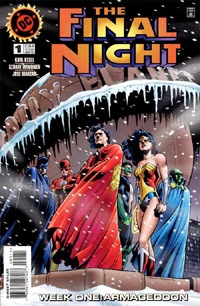
final_night0001Dusk / Week One: Armageddon

Writer: Karl Kesel
Penciller: Stuart Immonen
Inker: Jose Marzan Jr.
Colorist: Lee Loughridge
Letterer: Gaspar
Asst. Editor: Ali Morales
Editor: Dan Thorsland
Published by: DC Comics
Cover Date: November 1996
Cover Price: $1.95

I’m quite sure I’ve read this before…but I’ll be darned if I can remember it. This actually felt like I was reading it for the first time. Knowing I’ve bought the entire series at least once before in bargain bins or as a cheap set, I can’t imagine I didn’t read it…though that’s entirely possible. I know I’d read the Superman tie-ins, as events from this led to the electric-Superman saga.

This issue sees an alien arrive on early, bearing grave news: an entity that consumes all heat/energy is approaching Earth’s solar system and will destroy the sun, and in turn rendering Earth a lifeless iceball. The heroes–around Superman–gather, and launch a two-pronged plan to repel or distract the sun-eater…but this wouldn’t be the start of an event if things worked out right away, would it? The heroes’ plan fails, and Earth is left in darkness…a final night from which nothing will survive more than a few days.

I can’t say I’m overly enthused at the art. I should like it–I usually enjoy Immonen‘s work–but there’s something a bit "off" about it here. Perhaps it’s reading this out of context, or expecting something different, or just seeing a number of no-longer-currently-familiar characters that doesn’t quite do it for me. The art is hardly bad…it’s just not what I "expected" or thought I remembered. Still, we have numerous characters and multiple super-teams represented in this issue, and things move pretty quickly from introduction to action to result in what I would (by contemporary standards) consider an "ultra-compressed" story.

The writing is good, solid stuff, and certainly makes sense for what’s going on. We have the introduction of a massive threat, a gathering of heroes and plan to confront it, the execution of the plan, and the result. Given this event is one month long, and its core is this 4-issue mini-series while more generalized action plays out in other titles, I am ok with the lack of detail to stuff here in favor of moving "core events" along. It also has me very interested in reading the various tie-in titles to see far more detail to the unfolding crisis.

While it certainly benefits by way of 1990s comics being so cheap these days, this is also the sort of "event" I would love to have today in 2016: instead of having to invest in 3, 4, maybe 6 issues of every single tie-in title as well as an event mini-series or few, the event plays out in a single mini-series as well as just one issue of any given title tying in. I almost wish I’d held off on reading this issue, solely for the fact that I’m ready to dive into the rest of the mini, yet have no idea when I’d actually get around to hunting down all the tie-ins to the event.

I snagged 3 of the 4 issues from one set of quarter bins, and the missing issue from another at a different shop a day later–so I have the benefit of scoring the entire mini for $1 total without putting any particular effort into getting it. As such, this issue is very much worthwhile to me FOR my twenty-five cents, as I can move straight into the rest of the series without waiting. However, I do suspect that taken as a singular issue completely apart from issues 2-4, this wouldn’t be all that great an issue in and of itself.

I enjoyed the reading, and look forward to the unfolding story, and continue to dig in on this run through fun back issues and nostalgia.

The ’90s Revisited: Robin #1

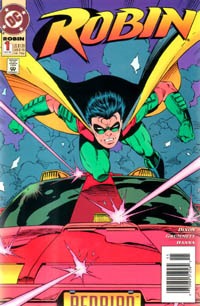
robin0001aOutcast

Story: Chuck Dixon
Pencils: Tom Grummett
Inks: Scott Hanna
Colors: Adrienne Roy
Letters: Tim Harkins
Asst. Editor: Jordan B. Gorfinkel
Editor: Dennis O’Neil
Covers: Tom Grummett, Scott Hanna
Cover Date: November 1993
Cover Price: $1.50 (Newsstand) / $2.95 (Collector’s)

Robin is no longer welcome in the Batcave. Bruce’s back is broken, the man himself off searching for Jack Drake (Robin’s father) as well as his own doctor. Jean-Paul Valley, formerly Azrael, is now the Batman. And Valley is not keen on having a partner. So, Robin takes off–now officially split from the “Batman and” designation.

A gang is stealing cars–and opts to hit a Gotham Heights dance, figuring there’ll be rich kids’ cars there as easy pickings. Meanwhile, Tim is in attendance with Ariana, and the two get caught up in things. Tim pursues as Robin, but gets run off the road…and encounters a new figure who does not seem that friendly.

It’s been probably 15 years since I read this. Elements, I remember. Ariana, and I recognize some of the names of other characters in the cast as characters that play a role going forward. I originally read this when it came out, back in late 1993, and I may have re-read it during my college years when I “caught up” on the series, buying a run of issues 1-40 or so to match to my run from around #50 to whatever was current at that point.

There’s no “previously” page here. No real description of the premise on the opening page. Only some small context to bring us up to date. So, to pick this up “cold” it’s a bit lacking as a first issue, that big question of “what set off ‘Batman’?” But this issue takes place very much in context of the overall “Bat-Universe” of the time, amidst stuff going on with Knightfall/KnightQuest, and part of the overall story at the time, part of the continuity was that with Jean-Paul Valley taking over as Batman, he wasn’t suited for a partner…certainly not a “junior partner” with more experience than he himself had at the time. So it was a good point for the story as a whole to see Robin split off…but in order to take a character like Robin–Tim Drake–and remove him from the midst of the Batman-centric stuff…it makes sense to explore the character in his own series. SO, as the start of the series, we see him essentially kicked out of the Cave, to begin his solo adventures.

I love Grummett‘s Robin work. It certainly works extremely well here…I see the character on these pages, and this IS “my” Robin. Flip through this issue, and it’s simply ROBIN. The character I grew up with. Reading through the issue, nothing stood out or took me out of the story in a negative way…I just flat-out ENJOYED the issue.

Dixon did a fantastic job with a number of Bat-elements…Robin being one of my favorites. As said above…though this issue wasn’t one to come to “cold,” it fits very much in the Bat-Universe, and Dixon does a great job with the character and supporting cast. Having read this, I’d love to dive in and re-read some more, time permitting.

The first Robin Annual–part of Eclipso: The Darkness Within–was the first time I’d see Robin featured on the cover of a comic, getting his own title. I now know (but didn’t at the point in summer 1992 when I first acquired the Annual) that Robin had had a mini-series (and I’ll be darned if I can remember if Robin II: The Joker’s Wild was out yet or not…but I’m pretty sure it was). Then there was Robin III: Cry of the Huntress, that I ‘discovered’ in late 1992, around the time of the Death of Superman, Sword of Azrael, Spider-Man 2099, and so on. Then the Summer of Superman and Bloodlines, Knightfall and the start of KnightQuest…and Robin gets an ongoing title.

A title that lasted some 180 issues, that with a couple of gaps I’ve since filled in I followed mostly from this issue to the end, 1993 to 2009.

robin0001bI’ve seen this newsstand edition in quarter bins a couple times. The copy I read for this post I got off a 4/$1 rack at a Half-Price Books; and I got a copy as part of a 100-something issue set I bought several years ago (for the price of about 10 modern comics). I don’t see the “collector’s edition” much…but both covers are rather iconic to me. I think I did get both when they came out; and though I presently despise variants, I don’t have the same problem with stuff like these that I do with contemporary variants: there were a static TWO COVERS available. To my knowledge, they were individually orderable by comic shops, and they were NOT “ratioed”–neither cover was intentionally “more rare” than the other as far as comic shops. The “Collector’s Edition” was “only” available through comic shops, while the “Newsstand Edition” was what would be found at Waldenbooks, 7/11, grocery stores and general non-comic shop locations. Since they were different venues, and both covers were available through comic shops…I’m ok with them. Additionally, the “enhanced cover” was twice the price…so rather than merely “missing out on” a preferred cover image, you were SAVING MONEY getting one cover over another. You would pay more for the “variant,” sure, but everyone paid the same, and it was readily available.

All that aside…the early issues of this series in particular were quite good, and though this one single issue might not suck you in…for myself, this was well worth the 25 cents, time spent reading, and time spent writing this post.

The ’90s Revisited: Spawn #25

spawn0025Tremors

Writer: Todd McFarlane
Pencils: Marc Silvestri
Inks: Batt, Billy Tan
Copy Editor & Letters: Tom Orzechowski
Color: Brian Haberlin
Computer Colors: Brian Haberlin, Tyson Wengler, Ashby Manson, Juan Carlos Rodriguez
Background Assist: Nathan Cabrera
Production: Dennis Heisler
Production Assist: Peter Steigerwald
Big Gun: David Wohl
Published by: Image Comics
Cover Date: October 1994
Cover Price: $1.95

Like seems to be the case for me with what (relatively) few Spawn issues I’ve read, I don’t have an easy time summarizing it. This one, Spawn seems to have been “outed” in the media–the world now knows he exists–and so he has to deal with that. He’s living in the alleys amongst a number of other Homeless, serving as a protector to them, though he seems to be less than thrilled at their growing “reliance” on him. After being attacked by a rogue demon, he confronts the entity and learns its backstory–it’s not actually a demon, but a man who was experimented on, resulting in his current form. He seeks vengeance on a gangster named Tony Twist, and given the situation, Spawn sees more benefit in helping than opposing, if his people are left alone as a result.

I bought this issue with a number of other “quarter books” at a Half-Price Books earlier this year…and I suppose for that price, it was worthwhile. I have another copy–my original–of this somewhere in one of my too-many longboxes, but was interested in this issue this time the same as when I originally bought it: the cover, and it’s Spawn #25, one of those “special number” issues. I also remembered there being something else about this, like it being part of some “creator swap” month, but on reading this couldn’t tell if it was part of that or not.

The story is typical Spawn for me…I’m not really sure how else to put it. I recognize Spawn himself of course, Al Simmons; his (former) wife Wanda, and at least know of the man Wanda is married to here. I remember (vaguely) the sense of–at the time–having no clue what Spawn was ‘about’ aside from being this disfigured entity with a huge cape, apparently back from the dead with some sort of “deal with the devil” thing involving his powers and some kind of amnesia that resulted in his living with the homeless/street people.

The art is good overall…which I pretty much expect from Silvestri‘s work. I’m not overly familiar with it, but I’ve seen enough of it to know that I associate it with 1990s/Image stuff (as well as the Grant Morrison New X-Men story Here Comes Tomorrow back in early 2004). The art fits the book…though after reading the story itself and getting into some of the text/backmatter stuff, I gather that Silvestri was NOT the series artist at the time, and so that was probably the creator swap–the creators maybe kept on plot/writing, just swapped books for art duties or such. Whatever it was, it was over 21 years ago, and for Spawn, nearly 240 issues ago as of Spring 2016.

I was impressed with the cover’s visual as well as the physical issue itself–not quite a cardstock cover, but hardly some flimsy paper, and the interior pages seem good quality as well. Thus, for the physical product itself, the 25 cents I paid was mostly worthwhile. Though I read the issue in isolation, it brought back slight memories of having read it back in 1994, and given my attempting to follow recent/current issues of the title, I’d consider my money well spent…though I maybe appreciated the issue/reading experience more for the backmatter than the story content.

Among other things, while knowing the title has been notoriously late in its time, this issue seems to have come out at a time the book had had some major issues in timing, shipping in this order: 18, 21-24, 19, 25, 20, 26. There’s even an ad explaining things a bit, as well as a “cartoon” image “Todd Can’t Count” trying to poke fun at the situation. I find that morbidly amusing in a way at present, given recent complaints of books RE-numbering and such, and continued amazement that this title is presently–in 2016–the highest-numbered (legitimately) comic that I can think of published in the US (Regardless of returning to “legacy numbering,” Detective and Action from DC lost that designation in the 2011 New 52 reboot). I somewhat recall seeing mention somewhere of Spawn having shipped issues out of order, in some online discussion years ago, but didn’t recall exactly when that was, so coming across it hear piqued my interest, and I’d actually be somewhat interested in working on tracking those issues down. I actually already have the first 12 or 13 issues of the series, so can’t imagine it would be terribly hard to find the rest of the run up to this point; nor overly expensive given what a “hot” book Spawn was at this point in the ’90s. But I suppose that’ll be a back-issue quest for some other time, if it even still holds my curiosity by the time I’d get around to it.

All told…this was an ok issue, though not anything I’d encourage hunting down. If the cover strikes your fancy or you want a similarly randomish reading experience, it’s worth the 25-cent purchase, but I wouldn’t recommend paying more than $1, possibly $2 and absolute most for this (and it’s a 21+ year old issue with a $1.95 cover price).

The ’90s Revisited: Flash #79

flash0079The Once and Future Flash

Story: Mark Waid
Pencils: Greg Larocque
Inks: Roy Richardson
Letterer: Tim Harkins
Colorist: Gina Going
Assistant Editor: Ruben Diaz
Editor: Brian Augustyn
Published by: DC Comics
Cover Date: August 1993
Cover Price: $2.50

I snagged this issue for 25 cents…the primary reason that it caught my attention was that it felt as thick as an annual…spotting the price, I saw it was priced as one also. Looking at the cover a bit closer, then, I realized it was an issue by Waid, and had the Reverse-Flash on the cover…a dynamic more interesting to me now as a fan of the tv series than any time previous. Plus, it has a nice “old-style” feel to it with the Flash’s speech balloons on the cover getting me curious. “You messed with my memories, threatened my city, and hur tmy friends…now you’re gonna pay!!”

Turns out…this issue seems to cap off the The Return of Barry Allen story that I’ve heard of, but never yet read for myself. So coming in, I’m at a loss of specifics to this story…but still felt like I was able to follow along without much issue, given my prior knowledge of Wally as the Flash, and stuff I’ve read about the character’s development aside of what I’ve actually read OF the character through stories.

Eobard Thawne–Professor Zoom–the Reverse Flash–apparently was posing as Barry Allen. Or rather, for a time he THOUGHT he actually WAS Barry. He stands revealed here, and ready to rumble–as he and Wally collide to fight out who gets to be THE Flash. We learn how Thawne wound up in the position he did, how he came to hate Barry, and so on…this is a younger Thawne, before he ever actually met Barry. Given the history that’s unfolded, he must be returned–alive–to his own time, that events might unfold as they’re known. This puts the entire timeline at risk, meaning that Wally can’t just kill him. In the course of the story we see the damage Thawne has caused, as well as the allies by Wally’s side, and it seems this is “the” issue where Wally fully, truly came into his own, getting out from under Barry’s shadow, etc.

Visually, this was a very solid issue. I read through it pretty quickly, and it wasn’t until I reviewed the first few pages that I really caught on to a nifty element: that we’re seeing Zoom’s fist get closer and closer until he and Wally collide–but interspersed between the fractions of time, we’re given flashbacks and context to bring us up to speed as things then jump to “real time.” On realizing this, it seems extremely cinematic–at least TV-cinematic. And that alone works very well for me. While my mind wants to compare this to the tv series, there are obvious elements that do not sync on a literal panel-to-screen basis…but the tone itself does. Leaving aside the visual differences to the tv show (which came some 20-21 years after this issue was published), the art is quite good and I have no problem with it at all. Given the size of this issue–at least double, if not TRIPLE–there was room for a lot to be packed in, as well as other moments spaced out…which allowed several full or double-page splashes to be VERY effective in a way that seems like a lost art in contemporary comics.

Story-wise, this had plenty of context–it’s from an era when it was NOT “inevitable” for everything to get a collected volume–so even coming in on the final chapter, I picked up readily on the overall “core” story beats related to this issue as I read. There’s plenty of detail, certainly some great moments and such that went over my head or that were in other issues so not even in my realm of awareness–but this felt like a season finale that I jumped in on, and didn’t feel LOST.

The prime drawback to me of reading this issue isolated and now lies in the fact that it illustrates to me–in one issue–just how deserved Waid‘s reputation on the book is and leaves me interested in the rest of the story, as well as more Flash (comics) in general.

I still know very little regarding the other speedsters outside of Jay and Wally…but I appreciate their presence, recognize them by name at least, and enjoy seeing the “Flash family” united, with a great sense of history and development. Though this issue leaves me interested in more Flash comics, it’s an interest tied to this era, to this particular incarnation of the series, emphasis on Wally…as opposed to much from the final several years before and thus far in the New 52.

I enjoyed this on reading it…and in typing the above roughly as stream-of-consciousness, I’m left simply feeling this was a fantastic issue, very well worth my time and money. Consciously knowing it is the end of a larger story, I’m hesitant to recommend this solely as a single issue…but if this one issue is an indicator of the quality of the entire story, I’ll “blindly” recommend that for now, containing this issue.

The ’80s Revisited: The New Adventures of Superboy #1

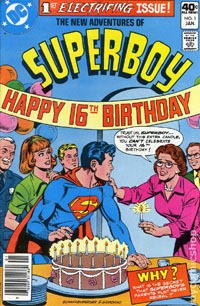
newadventuresofsuperboy0001The Most Important Year of Superboy’s Life!

Writer: Cary Bates
Penciller: Kurt Schaffenberger
Inker: David Hunt
Colorist: Gene D’Angelo
Letterer: Ben Oda
Editor: Julius Schwartz
Published by: DC Comics
Cover Date: January, 1980
Cover Price: $0.40

This issue only just barely makes the cut to be counted as an ’80s comic…though I am pretty sure that is a technicality, as it’s the cover date, while the publication date was likely at least a couple months earlier, the end of 1979. I actually remember this issue as one I’d managed to acquire ages ago, when I was in junior high (probably–early 1990s). I could not have told you anything about the content of the issue from memory, but on reading it, I realized I had also definitely actually READ the thing, too.

We start with a classic Julius Schwartz cover, showing us a rather absurd, dramatic scene that relates to the content of the story within…a relation that plays up some element that doesn’t seem to make much sense on the cover, but has a reasonable story explanation. In this case, Superboy is celebrating a birthday, but his parents insist he needs an extra candle…and this story promises to tell us WHY.

Of course, while we have SUPERBOY on the cover…it’s actually Clark Kent being celebrated within…which fits continuity, as they weren’t THAT open about Superboy’s identity even back then…he held the secret identity knowing enemies of Superboy wouldn’t hesitate to strike at him through those he loved–particularly his parents. Clark’s 16 birthday is here, and he’s asked about the extra candle…he doesn’t know himself why it’s used, just that his parents have added it every year since his 8th. We then get a flashback from Jonathan and Martha’s point of view as the secret is revealed to us–the readers. Two ancient aliens found their way to Earth, where after “testing” the newly-revealed Superboy (that they have searched for since crossing paths with baby Kal-El’s rocket years earlier) deem him their salvation. They accidentally made themselves immortal–something that’s become a curse–and need someone of sufficient makeup that they could SURVIVE a device that would transfer one’s ability to age into them. Yet, they mean Superboy (and Earth) no harm…so provide the 8-year-old Superboy the choice: help them, or don’t.

We see the noble boy choose to help them, using their device on himself, which means he will no longer (ever) age, giving his ability TO age to the aliens, that they might finally age and find the end of their (unnaturally-long) lives. They also impart a bit of amnesia to the young Clark so that he won’t remember his choice, and can live with the thought that his ‘immortality’ comes from being Kryptonian on earth, rather than choosing to sacrifice a part of himself. After they leave and the Kents lament their boy’s fate, Clark reveals that he noticed from what the aliens had said about their plight that it was their own minds keeping them from aging…he actually countered their device with his heat vision…granting the aliens the BELIEF that they could age, which tricked their minds into ALLOWING them to age. Meanwhile, Clark will continue to age as normal…a win/win situation. Though the amnesia kicked in and he no longer remembers the aliens or his solution/decision, his parents do–and honor their pride in him with the extra candle.

I recognize the names Cary Bates and Kurt Schaffenberger, though I can’t particularly place them off the top of my head, as of this typing. I’m pretty sure they’re either “big names” at DC from the late-’70s/early-’80s, or on the Superman family of titles (or both). I of course recognize Julius Schwartz as the editor as mentioned above.

This issue’s story worked decently for me–I’m not thrilled with it, nor does it play much into “continuity” that I recall except the obvious references and Editor’s Notes to remind (or inform) the reader of things of note (like the elder Kents having been de-aged). Stuff like that I took at face value as a kid, and took at face value here, but the added benefit of–as an adult–now having some vague memories of reading about the stuff being referenced, since I’d originally read the issue. In and of itself, I don’t know if I “buy” Superboy as an 8-year-old…but then, some of that may simply be that I’m so far removed from that age now, where I was only several when I would have originally read this. The story is a done-in-one, with nothing of note added to an ongoing saga or anything; just another “adventure” that takes an issue and leaves things in place for the next issue.

The art is quite good, and I really like the style overall…there’s something particularly familiar to it that puts me in mind of some of these characters even into the then-current comics I read in the late-’80s. It certainly fit the story and nothing to the art drew me out or distracted me, so it definitely succeeded in doing its job.

All in all, I enjoyed the issue as what it is–a “random” one-off, done-in-one issue that just so happens to be a #1 from an age when an issue with a #1 actually had some measure of significance. This was more than worth the 25 cents I paid for it.

Additionally, there’s an ad in the issue for the then-current issue of Adventure Comics that grabbed my attention…to the point that I actually sought it out in a non-bargain back-issue bin and found/bought it. It’s possible dabbling in these older back issues lately is just that–a dabbling. At the same time, I find myself more and more interested in older comics than new, and I’m increasingly willing to buy an issue from the back issue bins where I used to hold myself strictly to the quarter-bins.

The ’90s Revisited: Quasar #59

quasar059Brothers in Arms

Writer: Ron Marz
Penciler: Andy Smith
Inker: Ralph Cabrera
Letterer: Diana Albers
Colorist: Paul Becton
Editor: Mike Rockwitz
Group Editor: Ralph Macchio
EIC: Tom DeFalco
Published by: Marvel Comics
Cover Date: June 1994
Cover Price: $1.25

This issue grabbed my attention for the Thanos reference on the cover. By the coloring of Thanos’ head/face in the background, I would not have recognized the character from any other random Marvel Cosmic character while simply flipping through issues in a 25c-bin, so seeing Thanos’ name is what caught me. Contextualize it further with rather ticked-off looking Starfox and Quasar, and there was little that would convince me to NOT buy the issue.

I’ve recently been building up my Thanos/Warlock/Infinity ______ library, which also contributed to this grabbing my attention. Despite the cover, this issue was really not what I expected…whatever it was that I WAS expecting.

We open with Quasar telling someone he’d be there soon…and then find the very IMPRESSED Quasar marveling at Titan. He’s there to meet up with Starfox–Eros–for a bit. After greetings and brief showing off, Eros asks Quasar to join him for an errand, that turns out to be an annual tradition. Despite whatever bitter blood between the two, Eros and his brother Thanos put aside their differences for one day a year to spend time as brothers. While Thanos extends their truce to include Quasar, our hero is none too happy to be in the presence of one of the biggest threats to the universe he’s ever known. As the brothers exchange gifts, a squad of alien authorities show up…Thanos’ gift was stolen, and they’ve arrived to take it back (dealing death as penalty for the theft). The trio fights back, and the authorities are eventually sent off, nudged a bit by Eros’ powers of suggestion. As Eros and Quasar leave, we see Thanos…still in posession of the stolen item.

Quasar looks a bit “off” to me somehow…which is particularly noticeable to me as I’m not OVERLY familiar with the character. I just know that he doesn’t look quite right to my eye throughout this issue. On the other hand, Starfox doesn’t look that bad. And Thanos looks pretty good to me. Everyone is recognizeable so there’s no harm there, and I never had to pause to figure out what was going on or wonder at confusion at something shown in a panel. 

Story-wise, this is rather throw-away and generic, with no real change to any of the characters, their status quo, no tie to some bigger event or story…and yet I really, truly quite enjoyed this.

As stated above, I’m not overly familiar with Quasar, but I know of the character and while I have no idea as of this typing where the character is at present in 2015, he’s perfectly standard in the Marvel Universe I recall from the 1990s.

This issue is functionally a standard-sized issue one-shot. There’s no note saying this is continued from anywhere else, and the final panel of the final page clearly states END (though we can wonder exactly what Thanos is up to in the grander scheme of things). And particularly for only costing me 25 cents…I’m very happy with this being a one-shot. I’ve got characters I’m familiar with, as well as one I’m particularly interested in at present (Thanos), no catch-up or follow-up to do based on this issue, and it was an enjoyable read that didn’t leave me scratching my head.

I’m aware of having read a fair bit of Ron Marz‘s work–on Green Lantern as well as (I believe) Silver Surfer, and other stuff through the years. I certainly prefer Jim Starlin‘s Thanos to most…but Marz‘s take on the character seems very Starlin-esque to me and does nothing to make me question this appearance of the character. I’m not consciously familiar offhand with the art team…but this is from the mid-90s and I associate the period with a huge body of creatives that never stood out to me at the time, and apparently never made a name for themselves or stuck around for me to be familiar with contemporary work.

This is from mid 1994, putting this after the three Infinity Events (Gauntlet/War/Crusade) yet ahead of the Onslaught, Heroes Reborn, and Heroes Return stuff. While if I thought hard enough i could probably find (an) example(s) otherwise, I largely have a several-year blind spot with Thanos that this falls into. 

If–like me–you just want to read a “random” Thanos appearance (and I don’t know that this is reprinted or collected anywhere) this is certainly a fun one-off. All the better if you’re a fan of Quasar and/or Starfox. Though I wouldn’t see this as anything much more than a bargain-bin book (worth little more than 25-50 cents) I definitely recommend this as something worth the time it takes to read, just for the fun of it.