• December 2025
    S M T W T F S
     123456
    78910111213
    14151617181920
    21222324252627
    28293031  
  • On Facebook

  • Archives

  • Categories

  • Comic Blog Elite

    Comic Blogs - BlogCatalog Blog Directory

Fatal Attractions Revisited: Wolverine #75

Nightmares Persist

Writer: Larry Hama
Penciler: Adam Kubert
Inkers: Mark Farmer, Dan Green, Mark Pennington
Letterer: Pat Brosseau
Colorist: Steve Buccellato
Cover: Adam Kubert, Mark Farmer
Editor:
Bob Harras
Published by:
Marvel Comics
Cover Date:
November 1993
Cover Price:
$3.95

Bishop arrives in the blackbird (having been called by Colossus) to take the X-Men home. Wolverine’s obviously gravely injured from losing the adamantium. Xavier, weakened from the exertion of the exo-suit and shutting Magneto down gets Jean’s help to go into Wolverine’s mind, to try to deal with the psychological trauma of what’s happened. They see bits of his past–as he remembers it–but it’s not much help. They’re ripped out of his mind when the Blackbird hits turbulence and Jean winds up having to hold the plan together with her telekinesis, leaving Xavier alone to keep Wolverine alive. As things get particularly bad, Jean is taxed to her limit and about to lose it–while on the ground, Moira, Cyclops, Jubilee, and the others are horrified by what they’re hearing. Just as Jean does lose the plane, she’s caught by a bandaged arm–Wolverine. They share a moment, as they realize that while he was basically dead, some part of him was aware of her situation and he came back–for her.

Later, Wolverine’s determined to prove himself, to see if he still has what it takes to call himself an X-Man, and takes on a Danger Room scenario. Others watch, and while he’s holding his own, he’s having trouble. Instinctively, he finally pops his claws, to everyone’s horror–not only does he still HAVE the claws, but they’re BONE…and his healing factor so taxed, the punctures of them ripping out of the back of his hands are not closing easily, leaving him literally a bloody mess. A couple weeks later, Wolverine spends some time with Jubilee, catching up a bit, before offering some “final advice” that makes her suspicious. Finally, we close with a letter he leaves for her as he’s made the decision to leave the school and strike out on his own–to find himself, and deal with what’s happened and how it affects things moving forward.

This is the only “solo” title of Fatal Attractions-all the other issues are team-books: X-Factor, X-Force, Uncanny X-Men, X-Men, Excalibur. As such, the hologram on this cover is the most appropriate–Wolverine himself. While it’s a cool hologram, it’s not my favorite–I think that distinction goes to the Havok or Magneto ones. The cover takes a different perspective than X-Men #25, showing Wolverine with all these curvy spikes sticking out of his body, apparently representing the adamantium; rather than him just injured with metal/bone showing through.

As I’ve been saying over the past several posts, this issue and X-Men 25 are my favorites of the 6, and form the “heart” of the story. X-Men 25 climaxes with Wolverine losing the adamantium; this issue picks up the pieces, and ultimately results in Wolverine leaving the team for a time. Also as I’ve said, this issue is such a core part of my childhood with comics that it’s not an issue I see particularly objectively. It’s an iconic, key issue in things–and began nearly six years of Wolverine NOT having the adamantium (a long enough time and becoming a part of the character that the depiction even made it out into licensed products at the time). From #75, Wolverine was without the adamantium until #146, 71 issues later; nearly half the entire run of his series to that point.

I remember this issue being a tense read–the situation the characters were in, and their not knowing what was actually gonna happen. I like the way it shows the characters working together–a team–and the sense of family sprinkled in. There are a lot of great moments that are truly enhanced by knowing about the characters and continuity; maybe even moreso now, with the knowledge of where many of the characters wind up. Xavier’s sense of responsibility to Wolverine–bringing him into the X-men to begin with, involving him in the mission to Avalon, his inability to help Wolverine break through the memory implants, but the help he has provided the man through the years. Stuff with Jean–her past with the Phoenix, and that other horrific return-journey to earth.

The art is a pretty definitive take on the characters–everyone’s familiar, and the visuals are very similar to X-Men 25, further placing both issues at the heart of the story. It also definitely helps that it’s one art team rather than an entire group, and thus a singular consistency throughout the issue.

Probably the roughest part of the issue for me is Wolverine’s letter at the end–the font is hard on the eyes after the lettering of the rest of the issue. I appreciate the representation of a hand-written note, but for just reading the issue, it’s a bit jarring.

On the whole, though…this is one of THE most memorable issues of Wolverine for me, in all the series/incarnations. It’s certainly my favorite, particularly for the time. And for awhile, this was the end of my experience with Fatal Attractions. I originally missed the Excalibur issue as these were coming out, and I’m not even 100% sure if I’d even read the issue until I read a copy for this series of ‘Fatal Attractions Revisited’ posts.

This issue is definitely well worth picking up–particularly if you come across it in a bargain bin. In the years since it originally came out, I’ve paid up to cover price for it–but know I’ve snagged at least one copy from a quarter-bin and one from a dollar bin, another as part of a 3-for-$10 purchase.

52 Week #36 [Review]

Quick Rating: Very Good
Story Title: How to Win a War in Space

The space heroes confront Lady Styx, Montoya’s spurred to action, and Supernova’s in a spot of trouble…

52week36Writers: Geoff Johns, Grant Morrison, Greg Rucka, Mark Waid
Art Breakdowns: Keith Giffen
Pencils: Jamal Igle
Inks: Keith Champagne
Colors: David Baron
Letters: Pat Brosseau
Asst. Editor: Harvey Richards
Assoc. Editor: Jeanine Schaefer
Editor: Michael Siglain
Cover Art: J.G. Jones & Alex Sinclair
Publisher: DC Comics

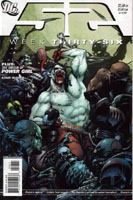
There’s a lot going on in this issue. We pick up with Lobo delivering the space-heroes to Lady Styx, and betrayal mounts. As the heroes face the threat posed by Styx, one of them falls, delivering on the expected death. On earth, Montoya comes to a decision on what to do about her friend, rather than sit around waiting for him to die without his dignity in the Gotham hospital. Finally, as promised on the cover’s ticker, we get to see Rip Hunter’s ‘secret location’ as well as glean a bit more information on Supernova.

I remember with earlier reviews of this series, talking about the slow build and hoping there’d be payoff later on; that establishment of a foundation was a necessary evil (well, they may not have been my exact words then, but they are now.) We get a fair amount of payoff in this issue, as well as some forward movement (if not outright teasing) of what’s to come in the near future.

I for one have quit looking for individual voices in scenes, content to know that the writers are all contributing in one form or another, maintaining a consistency from issue-to-issue. On that note of consistency, we get to see a logical progression of Lobo’s character, maintaining both what has been established of him in this series over the last 4 months or so as well as much earlier in the character’s existence, with a nice nod to a couple specials, even. There even seems to be some room to question some translation–I for one derived a bit of twisted amusement contemplating the authenticity versus some other motivation.

Montoya’s scene seems to straddle a nice line between the real and the fiction that is comic books–her frustration/desperation and sadness at what seems to be a foregone conclusion is blended with the supernatural that is commonplace in the comic book world, allowing a glimmer of hope that may not be realistic in terms of our real world…but it seems to fit very well into the universe we know of through this series.

Supernova and Rip Hunter are shown briefly–and for the moment weigh as the weakest part of the series for me at present. While I expect some cool payoff later on, right now I find that I’m just not that interested in Supernova as a character–I don’t feel anything’s really known about him, and other than "teases" as to identity (and I for one have not picked up on clues that apparently have been dropped here and there, nor "gotten" any that I’ve spotted) there seems to be very little TO the character as yet. It certainly doesn’t help when so few pages have been afforded the character thus far.

The art stays fairly subtle–it’s there, but doesn’t overstep its bounds; it serves the story without offending the eye. My one gripe visually would be the panel when Lady Styx first strikes Lobo–I can figure it out based on context, but without context it’s hard to clearly make out exactly what is happening there. Still, the complaint’s one panel of many, and may just be my own eyes.

Overall, this is another very good issue of the series, and reminds me that I do indeed enjoy the story and format, and look forward to next week’s issue.

The Origin of Power Girl
Writer: Mark Waid
Art & Color: Adam Hughes
Letterer: Jared K. Fletcher
Asst. Editor: Harvey Richards
Assoc. Editor: Jeanine Schaefer
Editor: Michael Siglain

Another standard-ish origin. Pretty much a simplified version of the telling of what I’d already figured out from pre/during Infinite Crisis stories. Still not a big fan of these, though that DOES seem to be tempered in part on whether or not I’m (personally) familiar with the character. Visually, may be a treat for certain folks, but doesn’t appeal to me. Still, it’s two pages…hardly enough to "break" an issue…and it certainly beats the pages being used for ads.

Ratings:

Story: 4/5
Art: 3.5/5
Overall: 4/5

52 Week #24 [Review]

Quick Rating: Quite Good!
Story Title: Just Imagine

The rise of the NEW Justice League, what the Martian Manhunter’s been up to, a bit of magic, and the origin of Booster Gold (from the JLA’s archives).

52week24Writer: Geoff Johns, Grant Morrison, Greg Rucka, Mark Waid
Art Breakdowns: Keith Giffen
Pencils: Phil Jimenez
Inks: Andy Lanning
Colors: David Baron
Lettering: Pat Brosseau
Assistant Editors: Harvey Richards & Jeanine Schaefer
Edited by: Stephen Wacker
Cover Art: J.G. Jones & Alex Sinclair
Publisher: DC Comics

The first thing that stands out with this issue is the cover…the flag background seems to be quite similar to the one used for last month’s Justice League of America, perhaps a simple nod to that series and what this issue represents story and history-wise to the overall Justice League. (That Ambush Bug has a shirt reading ‘This Shirt’s a Clue’ is amusing in itself, given all the little clues folks look for that I tend to not "get.")

This issue basically serves to introduce us to the "new" Justice League that’s forming in the absense of the big guns. We also get to see what the Martian Manhunter’s been up to the last few months, and the continuing development of the Ralph/helmet plot.

This issue’s art by Jimenez is great overall, capturing a detailed, clear look at the events of the story and its characters. The bottom-right panel of the first page with Ollie is possibly the best I’ve seen the character look in recent memory (granted, I don’t read the character’s solo title). The visuals just seem to click in this issue, and aside from the occasional apparent shift (go from that panel with Ollie to the 3rd page and compare it visually to Firehawk’s cape/wings/whatever to get what I mean) is very much up there in my list of well-done art that is cool to look at in itself rather than "merely" as a vehicle to suggest imagery for the story being told.

The story itself here runs true-to-form of late for this title…rather than a couple pages here and there for a bunch of simultaneous plots, the core of the issue ("episode," if you want to use the tv analogy) focuses on Firestorm’s Justice League forming (they’re working to recruit Green Arrow as this issue opens), chronicles their first big battle, and sets the stage for events to come. In a way, the plot of the issue is largely simplistic–nothing too terribly deep–but it shows development of events as well as the characters (Firestorm–THIS Firestorm–pulling together a Justice League? Skeets back? Citizen recipients of Luthor’s metahuman treatment springing into action?) Components just fall into place believably, and I think we’re really beginning to see payoff from the foundation the earlier issues worked to lay.

While we don’t see MUCH of the "usual" cast, we continue to see the interactions between the DCU characters active during this year. Though just a couple pages, the Black Adam Family scene would hold very little resonance had we not seen the development of things with Black Adam himself the last 5-6 months, nor the last several months’ development with Isis, and so on.

Following this series from the beginning allows for that deeper "getting" of the overall story…but it by no means excludes one from reading this issue in particular. Even if you’re not following this series, I highly recommend this issue, for the Justice League stuff alone. The closest I came to "discovering" the classic Giffen League initially back in the early 90s was the Doomsday issue. I would love to see a title starring an incarnation such as we see here; I find this League’s story more interesting at the moment than the ‘core’ version with its own title now.

The Origin of Booster Gold
Writer: Mark Waid
Penciller: Dan Jurgens
Inker: Andy Lanning
Colorist: Alex Sinclair
Letterer: Pat Brosseau
Asst. Editor: Harvey Richards
Editor: Stephen Wacker

I’m still not terribly thrilled with these origin segments, but growing used to them (as opposed to the initial disappointment of the format), this one’s pretty good. The art’s quite good–I really like Jurgens‘ visuals–and I actually learned something from it. (I suppose that’s another dissatisfaction with other issues’ origins: when it’s a character whose background I’m already quite familiar with, seeing such a boiled-down version is disappointing).

I might’ve said it in an earlier review, but I’ll reiterate it now (and likely again in coming months): I think that while these make for an ok backup feature, I’d rather see a single "special" or one-shot that contained a bunch of these, and get a couple more story-pages per issue in their place.

Ratings:

Story: 4/5
Art: 4.5/5
Overall: 4/5

Faces of Evil: Deathstroke #1 [Review]

Quick Rating: Very Good
Story Title: Faces of Evil: Deathstroke

After suffering a humiliating defeat, Deathstroke takes stock of his life and makes plans for moving forward.

facesofevildeathstroke001 Writer: David Hine
Penciller: Georges Jeanty
Inker: Mark McKenna
Colorist: Jo Smith
Letterer: Pat Brosseau
Assistant Editor: Janelle Siegel
Editor: Michael Marts
Cover: Ladronn
Publisher: DC Comics

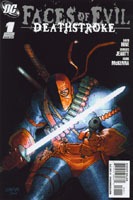
Last I recall seeing Deathstroke was in the Last Will and Testament special last Fall, when Deathstroke was defeated in combat by Geoforce. After that humiliating defeat, Deathstroke has had some time to recover, and to take stock of his life. This issue opens with him in the hospital–where those attending to him marvel at his very survival. Once he’s awake, Deathstroke arranges a meeting with his daughter, and the two deal with "family issues" they have with one another. Finally, we see Deathstroke beginning to set up what may be his new status quo.

Hine seems to get this character quite well. The story here is believeable and well within what I’d expect of the character despite my limited exposure to him. We have a man who’s been pushed to his limit and forced to reassess what he is going to do with his life. We get to see him contemplative and in action, see what makes him very dangerous.

The art is solid, too. No complaints here–everything’s nice and clear, with no problems following the action. There’s a slight change in the coloring for a flashback scene that sets that sequence apart from the rest of the issue–gives it a bit of a surreal effect without going hokey or cheesey on us.

Next to Meltzer‘s writing of this character in Identity Crisis and Last Will, this has to be the best depiction I’ve seen of Deathstroke. This issue is–at standard cover price, even!–well worth snagging if you’ve any interest in Deathstroke. And if you’ve never dealt with the character before, you could probably still quite enjoy this issue, as it deals with the here-and-now of the title character as he prepares for what he is going to do moving forward from here.

Ratings:

Story: 4/5
Art: 3.5/5
Overall: 4/5

Steel #1 [Review]


Full review posted to cxPulp.com
.


Story: 3.5/5
Art: 4/5
Overall: 3.5/5

Joker’s Asylum II: Clayface #1 [Review]

Mudnight Madness

Writer: Kevin Shinick
Artist: Kelley Jones
Colorist: Michelle Madsen
Lettering: Pat Brosseau
Asst. Editor: Harvey Richards
Editor: Michael Siglain
Published by: DC Comics

There’s not a whole lot of depth to this issue…it’s a sort of generic kind of tale of Basil Karlo, the original Clayface (for those of you keeping score, Matthew Hagan was Clayface II, and the one with the containment suit was Preston Payne (Clayface III), and Sondra Fuller was turned into a Clayface IV in the 1980s story The Mud Pack. Matthew Hagan was the version used for the animated series and in Batman: Hush, I believe, and so would be the more familiar character).

While out and about, Karlo finds that a bunch of kids are participating in an audience-participation showing of one of his old movies, “The Terror.” Seeing this Rocky Horror Picture Show type treatment as a sign of disrespect, he intervenes intending to show the terror of the film for real, but finds that the teens gathered idolize him, and hold him–Basil Karlo, Clayface–as their hero. Seeing how this could work, he accepts their willingness to be part of his legacy. When Batman shows up, he finds that the teens may have achieved more than they bargained for, as he faces this old foe.

The art on this issue, by Kelley Jones really takes me back quite a bit. I believe Jones was the artist on one of the Bat-titles (Detective Comics) in the early 1990s, during the Knightfall epic. I recognize the abnormally-large bat-ears on Batman’s cowl, and the exaggerated scalloping of the cape…just from the cover. Other than that, the art provides a solid visual for the story.

The story itself, as said, is not all that deep…it’s just a story that we see more of Clayface than we do Batman…but Batman’s involvement is much more noticeable here than I recall any of the other issues in this round of Joker’s Asylum. While this is not a bad Clayface vs. Batman story, it doesn’t offer as much of the title character and somewhat leaves a suggestion that without Batman’s actual involvement, there’s no story to tell at all.

This is probably the palest of this round…I don’t feel I learned anything new, gained any new insight, or otherwise got anything out of this that couldn’t be gotten from any other issue involving (to say nothing of starring this Clayface.

Recommended only if you’re specifically interested in Clayface as a concept, the Basil Karlo Clayface, or a completist interested in having all 5 of the Joker’s Asylum II issues.

Story: 4/10
Art: 7.5/10
Overall: 5.5/10

Doom Patrol #4 [Review]

Dead Reckoning; The Coming of…The Clique!

DOOM PATROL
Writer: Keith Giffen
Penciller: Justiniano
Inker: Livesay
Letterer: Pat Brosseau
Colorist: Guy Major
Cover: Justiniano, Andrew Mangum, Guy Major
Associate Editor: Sean Ryan
Editor: Elisabeth V. Gehrlein

METAL MEN
Plot: Keith Giffen
Dialogue: J.M. Dematteis
Art: Kevin Maguire
Colorist: Guy Major
Letterer: Nick J. Napolitano
Associate Editor: Sean Ryan
Editor: Elisabeth V. Gehrlein

It took me 3 attempts to make it all the way through this issue. The first two, I got hung up in the main feature. At the third attempt I managed to get through the main feature, and then all the way through the co-feature with no trouble at all.

I’m not entirely sure what was going on in the main story. To my knowledge all the characters are new to me–none of them rang any bells for me. We’re introduced to a bunch of characters contextually, though to be honest–I’m not sure if those are characters that are part of the current book, or references to the previous incarnation of this title, or what.

But as standard in Blackest Night comics so far, we see dead rise to elicit emotional response from the living, the aim being to ripen a heart with strong emotion before the subject is killed to power up the Black Lanterns.

The art’s quite good, to keep it simple. Though I’m unfamiliar with the characters, there’s no trouble telling them apart nor in following the action. And nothing to the visual style gave me any pause to contemplate quality.

The story itself was not enjoyable for me. I was not interested in the concept of this Doom Patrol before, and I’m not now after reading this issue. That’s not to say the story itself is bad–it’s not–but it doesn’t appeal to me.

This reminds me a bit of my early days in reading X-Men comics: being entirely unfamiliar with the characters and having no real sense of continuity, who characters were, and so on. While the story structure seems good, it just doesn’t interest me. However, for sake of following the entire Blackest Night event, I still intend to pick up the next issue.

If Doom Patrol’s your thing, this’ll be well worthwhile I think. If not…it doesn’t seem like it’s going to–from this issue, at least–add much to the Blackest Night event. Moreso the other way around–the event’s inserting something into this title’s story.

The Metal Men co-feature has nothing to do with Blackest Night, and seems quite timeless. A group of “female” robots have been activated by an arrogant creator seeking to outdo Magnus’ Metal Men. These girlbots proclaim themselves The Clique, and stir up trouble that gets the Metal Men involved (though they were quite happy enough to begin with, shopping with Magnus for a birthday present to give Tina–aka Platinum.)

I’m somewhat familiar with Magnus from 52, as well as the Metal Men from same as well as elsewhere around the DCU. They’re hardly my favorite characters; basically a take ’em or leave ’em situation. However, something about this story kept a sense of fun about things with some goofiness and the fantastic.

I was more engaged by this story than the Doom Patrol, and while I find The Clique to be a stupid/stereotypical element, it still works overall.

As a whole, I’m not entirely satisfied with the purchase as just a comic. In addition to simply being a Blackest Night crossover issue–the first tie-in of the event that’s not a Green Lantern book or mini-series–this issue is the first of several that are part of DC’s “ring promotion,” wherein retailers could order a bag of rings for every X number of copies of this issue they ordered. This issue came with a Yellow Ring. My inner fanboy was almost giddy at receiving the ring at no additonal cost–and for sheer enjoyment of starting a collection of the colored rings, this issue was more than worth its cover price to me.

Doom Patrol
Story: 4/10
Art: 7/10

Metal Men
Story: 6/10
Art: 7/10

Whole: 6/10

Magog #1 [Review]

Lethal Force

Writer: Keith Giffen
Penciller: Howard Porter
Inker: John Dell
Colorist: Hi-Fi Designs
Letterer: Pat Brosseau
Assoc. Editor: Rachel Gluckstern
Editor: Mike Carlin
Cover: Glenn Fabry (variant by Porter & Dell)
Publisher: DC Comics

I was rather surprised at this issue. I almost passed on it, figuring the character to not be something I’m interested in following long-term. But I gave it a shot, and I’m pretty much glad I did.

We open on a scene that provides us with some exposition–who Magog is, his recent past and what he’s about. We also see him into action with a couple pages that were seen originally in the “preview” in the back of a bunch of DC’s books a few weeks back, showing the more military/black ops side of Magog as the soldier. What he finds there leads him back to his current home and to confrontation with the JSA. After an exchange with Alan Scott, and an introduction to supporting cast members, we see Magog back into action. He’s currently the agent of the JSA who can or WILL get his hands dirty in ways the others can’t or won’t. Magog is not a super-hero; he’s a metahuman in a world of super-heroes, but he’s a soldier. (It would be interesting to see Magog interact with The Shield, come to think of it!).

Storywise, this issue is largely setup and contextualization. It does a good job of that–bringing one up to speed on the basics of the character, putting into place a supporting cast and status quo.

The art is high quality…I really like the visual style we’re presented with here. It’s not totally some grim ‘n gritty visual, but it’s not bright, hopeful and flashy, either. It feels very down-to-earth, and appropriate for the title character.

While this Magog is not the exact same character introduced in Kingdom Come nearly a decade-and-a-half ago, the similarities are there in tone as well as name and costume. One could envision this character developing into that one, but the differences are what add a layer of interest. Differences…or simply more information and insight into the individual…giving him depth rather than being a plot-point in someone else’s story.

Giffen seems to have a good handle on this character, and though I’m not entirely ready to “commit” to this series, I’m sufficiently hooked for at least another issue to see if the magic holds beyond this premiere issue.

Story: 7/10
Art: 8/10
Whole: 7.5/10

Red Circle: The Web #1 [Review]

Full review posted to comixtreme.com.

Story: 4/5
Art: 3.5/5
Overall: 3.5/5

The Red Circle: The Hangman #1 (one-shot) [Review]

Full review posted to comixtreme.com.

Story: 4/5
Art: 4/5
Overall: 4/5