• January 2026
    S M T W T F S
     123
    45678910
    11121314151617
    18192021222324
    25262728293031
  • On Facebook

  • Archives

  • Categories

  • Comic Blog Elite

    Comic Blogs - BlogCatalog Blog Directory

Zero Hour Revisited – Outsiders #11

90srevisited_zerohour

outsiders_0011Final Blood II

Writer: Mike W. Barr
Penciller: Paul Pelletier
Inker: Robert Campanella
Colorist: Stuart Chalfetz
Letterer: Kevin Cunningham
Asst. Editor: Eddie Berganza
Editor: Kevin Dooley
Published by: DC Comics
Cover Date: September 1994
Cover Price: $1.95

This incarnation of the Outsiders is one I’ve long been aware of, but really never read. It came to my attention back in the day thanks to the use of the Eradicator character–moving from the Superman books, I was at least "interested" in the title, though it was not one I ever got around to acquiring during its actual publication. If this isn’t my first issue reading, it’s at least the first I can consciously recall reading…and though I know OF several of the characters, recognize them at least in name if not by appearances elsewhere over the years…I just felt lost.

This issue basically sees the outsiders fighting vampires (or werewolves? But I think they’re supposed to be vampires), and arguing amongst themselves as the fighting and such happens. Even when the team would seem to have emerged victorious, there are breaks between characters, and outcomes from recent events I have not read that play into their relationships and the team dynamic, leaving the team quite splintered. Most disappointingly, the only actual tie that I noticed to Zero Hour (on the single "casual"/"reading for the experience as with every other issue of this project" read-through) is that two characters who appear in this issue also appear in Zero Hour.

That this issue carries that Zero Hour banner is very disappointing as such, and I’m not at all thrilled at the virtual "deception," as I did not enjoy the characters, the story, nor get anything "new" for Zero Hour. There was a throw-away line by Katana in Zero Hour #4 that I suppose references what happened here, but it was just that–trivial and throw-away.

I suppose the art works for the title, but I was so thoroughly out of the loop reading the issue that I hardly noticed it. When I hardly have a clue who’s who or what’s going on, I don’t much care how anyone looks. They could all be alternate timeline doppelgangers of one another for all I know.

All that said…while I appreciate that this issue probably made some sense in context of reading the earlier issues leading to this…I’m highly disappointed to have taken the time to read it as a Zero Hour tie-in when it doesn’t do a thing for the Event story.

Definitely an issue to pass on if reading stuff to get the "full" Zero Hour experience, I’d say!

Zero Hour Revisited – Legionnaires #18

90srevisited_zerohour

legionnaires_0018End of an Era part 4: Changing Times

Story: Mark Waid
Pencils: Chris Gardner
Inks: Dennis Cramer
Letterer: Pat Brosser
Co-Plotter/Colorist: Tom McCraw
Assistant Editor: Mike McAvennie
Editor: KC Carlson
Published by: DC Comics
Cover Date: September 1994
Cover Price: $1.50

I continue to find myself a bit disappointed at these early tie-ins to Zero Hour…as they don’t really seem very much like tie-ins, or only just briefly, tangentially tie in to the Event story.

This issue is both a Zero Hour issue as well as chapter 4 of a 6-part 3-title crossover. Coming in on the start of the back half of the story is not the best place…especially with no "previously" page or such to highlight key developments so far. In that regard–the lack of conscious context makes this seem a lot more like it’d fit contemporary comics, where "jumping in" at the fourth chapter of six is not very prudent.

The main thrust of this issue is that the current Legionnaires fail to stop a couple of baddies from gaining Ultimate Power…and said baddies remake the universe–or at least parts of it…including their own "dark" Legionnaires. Combine that with time-issues associated with Zero Hour anyway, and it’s a bit confusing for a reader not overly familiar with the characters involved. Adding to the confusion is the knowledge (or so I think) that the Legionnaires are "younger versions" of the older Legion of Super-Heroes characters so there’s already at least two versions of several characters without even getting to Time anomalies. We do see several Legionnaires trapped in the 20th century who receive the Superman/Green Lantern/Metron call-to-arms, but outside of that, this issue has nothing useful to add or expand upon regarding Zero Hour itself so far.

The art’s not bad, though I’m not now (nor have ever been) all that familiar with the characters, so there’s no significantly defining version of the characters nor a favorite artist for me to compare this to. Even elements I’m lost on are more my own lack of immersion than necessarily any fault of the art…the characters just ARE what they are…and they’re familiar enough that I’d just have to say that I have no problem with the art itself.

I’m also in a weird place in trying to critically consider the writing…because as said, this is the FOURTH chapter of six…so while I did not enjoy the story, it’s not to say that it’s bad writing or anything. It’s my slogging forward into  this chapter due to it having the Zero Hour banner on the cover, instead of going back to seek out the first three chapters of this story, at least, to gain context on what’s up.

I’m pretty sure I remember Zero Hour being a fairly major "break point" for the Legion books, or so I’d heard, and that would make sense–this seems like an ok chapter within the context of the Legion/Valor stuff…but this really adds nothing of particular value to my reading of the Event itself, and is an issue that should be easy enough to skip without missing out if you were to try to read the event in general.

Zero Hour Revisited – Green Lantern #55

90srevisited_zerohour

green_lantern_0055Assault & Battery

Story: Ron Marz
Pencils: Daryl Banks, Derec Aucoin, Craig Hamilton
Inks: Romeo Tanghal, Craig Hamilton, Ray Snyder
Colors: Steve Mattsson
Letters: Albert DeGuzman
Assists: Eddie Berganza
Editor: Kevin Dooley
Published by: DC Comics
Cover Date: September 1994
Cover Price: $1.50

This is a pretty simple issue. Green Lantern (Kyle Rayner) is getting his butt handed to him in a fight with Major Force. Of course, it’s Major Force that deserves the beatdown–he killed Kyle’s girlfriend and stuffed her remains in a refrigerator…but that’s more a story and topic for some other post. As the hero takes a beating, refusing to give up his ring to the villain, it looks like it’s all over…but then MF wants one final answer from Kyle regarding a chunk of green rock found in the alley where he got his ring. This turns out to be the key to recharging Kyle’s ring, and he quickly defeats the villain…before the battle is cut short by the intervention of the LA Special Crimes Unit. Refusing to stick around for questioning, Kyle flies off. Waiting at his apartment, though, is another man who’d been known as Green Lantern–Alan Scott. Scott fills Kyle in on the basic background of the former Green Lantern Corps. As Kyle processes what he’s just learned, Superman and Metron show up to recruit him.

As tie-in issues go, thus far I’ve far preferred the Batman issue, feeling like it actually took place in the midst of the unfolding event. The Flash issue only just barely–at its end–touched the event, and now basically the same thing for this Green Lantern issue. I’d actually consider this almost a "Red Skies" tie in–that is, you DON’T actually need to read this to get anything extra, really, pertaining to the Zero Hour event. Having the context allows for a bit of empathy later in that story from what I recall, but for right this moment, I’m a bit disappointed by how un-connected this issue was.

I read this issue back when it first came out–after Green Lantern’s involvement in Reign of the Supermen and learning of new goings-on with the title, I jumped in with #50 (Hal’s villainous turn) and then followed the title from Kyle’s FULL premiere in #51 (which was functionally a #1, but in an age when titles didn’t get rebooted just because someone blinked)…so I was getting this issue anyway, it just happened to be part of Zero Hour.

The art isn’t bad, though there are a few more names involved with the art than I’m used to…whatever the case, if I didn’t see the list in the credits I don’t think I would have actually noticed…I just kinda flew through the issue, consciously trying to remember other details from this early, early part of Kyle’s run to contextualize. Story-wise, this is essentially a #5 issue, so Kyle is still being established, and there’s no real feel for him quite yet…so this works well, tossing the rookie hero into things as part of his initial journey.

As the issue of Green Lantern that this is, it’s worthwhile, and definitely a meaningful issue in the early development of Kyle…but as a Zero Hour issue, it’s tangential and really not needed (though I recall the #0 issue of the title being VERY tightly tied to the events of Zero Hour!).

Zero Hour Revisited – Flash #94

90srevisited_zerohour

flash_0094Reckless Youth chapter three: Just Do It!

Story: Mark Waid
Guest Pencils: Carlos Pacheco
Inks: Wayne Faucher and Jose Marzan Jr.
Letterer: Kevin Cunningham
Colorist: Gina Going
Assistant Editor: Ruben Diaz
Editor: Brian Augustyn
Published by: DC Comics
Cover Date: September 1994
Cover Price: $1.50

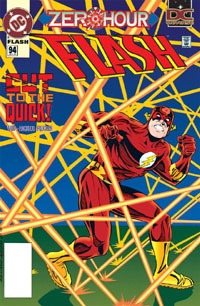
Well, that explains a bit, on multiple fronts. Some early Wally/Bart interaction, as well as (now) confirming [1.] that yes, that was “the” Wally in Zero Hour #4 and [2.] How he wound up in the future with no real context provided.

We open on Bart, with Wally’s narration…Bart’s not familiar with his own power/abilities, and Wally’s job is to keep an eye on him. Iris Allen–Barry’s wife–is present, and plays coy on details of Wally’s future. Meanwhile, Linda’s got a guy named Argus involved in some current investigation (I think he’s the Bloodlines character introduced in the Flash 1993 Annual). Wally’s none too happy about being pressed into responsibility for Bart…and takes full advantage when Argus phones in a tip. Wally investigates,and finds himself about to get some really good intel on Kobra when Bart rushes in, spoiling things. Resigned, Wally joins the fight, but soon finds himself facing Kadabra…and then he’s pulled into the far-future, Kadabra’s own time…and while still trying to get his bearings, Waverider appears.

The credits list Pacheco as a guest penciller…which explains my relative (but only slight) surprise at this not being a Weiringo-drawn issue. Though some panels come off slightly more cartooney than I’d prefer, with an odd sort of simplicity to them, on the whole the issue is quite good-looking, and not bad to see. I can mostly follow stuff, though I’m mentally piecing together context, as this is listed as part 3 of a story, but I’m reading it because it’s a Zero Hour tie-in. We get plenty of linework to suggest Flash’s speed, but nothing special or surprising. I “get” that Flash is fast, but there’s no particular creative styling to suggest the speed in a way that the very layout of the page does it, and the art style in general isn’t something drastically different from other contemporary books. It’s “just” superhero art, works well, and fits the issue.

Story-wise, I’m a bit lost, with not knowing where the story began (if this is part 3, I can assume #92) nor how long it should go (six issues from this would be #100, though there’s the #0 yet between). Similarly, given the tight continuity, I spent most of the issue wondering how Wally’s here doing this stuff when in Zero Hour #4 he’s in the far future, apparently having just captured someone (Kadabra). That does get addressed at the end of this issue, and perhaps my expectations were thrown by the Batman issue: that one shared several pages’ worth of story with Zero Hour #4…this one basically a panel. I’d “assumed” we’d get something a bit more detailed in this issue on Wally’s actions trying to shut down the Time Rift…but apparently that was “uniquely” contained to the Event Book itself.

I’d half thought/assumed over the years that Bart–Impulse–first appeared in Zero Hour itself, that this story shoehorned the character into the Flash mythology…but it would seem that I was wrong…and that has me all the more interested in getting up to speed (no pun intended) with the Flash book. This was a first-time-through for me with this issue…I didn’t read it back in 1994, nor had I ever read it prior to this reading project…so it’s actually rather cool to get this taste of the Flash’s own story, knowing the exact point it’s taking place in relation to a bunch of other ’90s issues…namely, during July 1994, and the Zero Hour event.

As this issue is part of the earliest stage of the story, the Time Anomalies are just being discovered, the wibbly-wobbly-ness just started to get noticed, so the bulk of the issue really IS “just” a typical Flash story, just any issue of the Flash book.

I enjoyed it, and look forward to the #0 issue, and eventually/someday getting fully caught up contextually with Wally’s time as the Flash.

Zero Hour Revisited – Batman #511

90srevisited_zerohour

batman_0511The Night Before Zero

Writer: Doug Moench
Artist: Mike Manley
Inker: Josef Rubinstein
Colorist: Adrienne Roy
Letterer: Ken Bruzenak
Assistant Editor: Jordan B. Gorfinkel
Editor: Dennis O’Neil
Published by: DC Comics
Cover Date: September 1994
Cover Price: $1.50

I definitely remember this issue’s Batgirl. I remember the fact OF her showing up, I remember her appearance in the main Zero Hour book, and I especially remember the impact she had toward the end of that book. But it’s quite likely, having re-read this issue, that this is the first time in nearly 22 years THAT I’ve read it…because I sure did not remember the DETAILS.

We’re only JUST past the Knightfall/Knightquest/Knightsend stuff…like, I think that wrapped with the previous issue, and then we’re dumped straight into Zero Hour. We open with the same scene that we got in Zero Hour #4–of the Joker “discovering” he’s being chased by Batgirl and wondering if it’s a joke. Even though Batman and Robin quickly arrive on the scene, the Joker escapes, leaving the heroes to try to figure out exactly what’s going on. Also on the trail of the Joker, the GCPD arrive, and their presence elicits a surprising reaction from Batgirl–fear. Then they open fire, surprising Batman and Robin (as ANOTHER Robin watches from somewhere out of their sight). Eluding the police, Batman demands answers, and things begin to come together. That horrible night years earlier saw Jim Gordon shot instead of Barbara, though he died. When the new PC–Harvey Dent–took office, he issued a shoot-to-kill-on-sight order against the masked vigilantes. Of course, though this is “normal” for Batgirl, it’s NOT the way Batman and Robin remember events unfolding. Meanwhile, the Joker decides to dispatch PC Harvey Dent, and digs up Gordon’s grave for extra theatrics, but Batman intervenes. Time continues to go wibbly-wobbly, and elements shift–reality returns to normal, though the “other” Batgirl remains…and Batman must seek answers outside of Gotham City.

As may become frequent in these posts, I’ll touch on the art first…because that’s quicker and simpler. Namely…this IS “my” Batman. This is the visual style I recall from when I was a kid…because this is an issue that was published and originally read when I was a kid. The familiarity raises more than a little nostalgia, which contributes hugely to the momentary enjoyment of rereading this quasi-isolated issue. It just fits, and IS the art I remember. It also conveys events of the story itself quite well, performing to my expectation, with the added bonus of just looking really darned good. I would not have been able to cite a name and tell you that it was Mike Manley’s art I loved, but loving the art in this issue and seeing his name…well, there you go.

Story-wise, this is jam-packed, and kinda jumps around a bit. I’m certainly bringing extra baggage to the reading experience, and using some of that to plug any holes in plot or depth or explanation–I know time is wibbly-wobbly here. I know that anomalies are popping up all over the DC universe, and that this is just the start of it. I know that there was confusion at the start of all this, and that things get put right “in the end.” But there are multiple Bat-books, each partaking in Zero Hour, so there are that many more incidents for Batman to encounter in this single month, as the main event unfolds. While I’ve been “conditioned” to a harsher modern Batman, this one can still make mistakes–such as getting distracted enough by the presence of a healthy, non-crippled Barbara Gordon that the Joker can get away. Similarly, this Batman is willing to leave the Joker for later, while other events take precedence…where nowadays, half the country could fall into the sea and Bruce would leave that for “others,” while HE continues tracking down the Joker.

batman_0511_comparison

This is also firmly rooted in continuity, and whether it was the writers coordinating, or (far more likely) Editors doing the editorial thing and coordinating stories between numerous writers), we see stuff in this issue that’s touched on elsewhere, giving us slightly different perspectives (we have Jurgens/Ordway on art for the opening scene where it touches in Zero Hour #4…and then Manley and Rubinstein giving us the exact same scene in this issue). It’s a bit repetitive in the sense of having several pages of the exact same action playing out in two issues read back-to-back…but it’s also quite welcome, because you do not HAVE TO have read Zero Hour #4 already to enjoy this issue, and you get what you need of this for the core Zero Hour story in that issue. This issue simply expands on the situation, playing out the larger situation and filling gaps.

The significance of Batgirl here would probably be lost for modern readers…this was 1994, just a few years (but enough for it to be firmly rooted in continuity) after Barbara was shot, paralyzed, and Batgirl was no more. Of course, with the coming of the New 52, a quarter-century of continuity was wiped out (and a couple “legacy”/successor Batgirls) in order to put Barbara back in action.

Opening on action, seeing characters’ reactions, resolving some of that and setting up other bits makes this at once an issue that can stand on its own (as much as any one issue of an ongoing series can/will) but plays extremely well in the shared sandbox of continuity and the universe-spanning Event series.

Zero Hour Revisited – Zero Hour: Crisis in Time #4

90srevisited_zerohour

zero_hour_0004Story and Art: Dan Jurgens
Finished Art: Jerry Ordway
Letterer: Gaspar
Colorist: Gregory Wright
Asst. Editor: Mike McAvennie
Editor: KC Carlson
Published by: DC Comics
Cover Date: September 1994
Cover Price: $1.50

As a weekly, core event mini-series, there is a LOT that happens in this book. Also, though this is the first issue of the series, it was numbered as 4–because we’re counting down TO Zero Hour, and go from #4, to #3, down to #0.

This was my first DC Universe event that I got in on from the very beginning. While I count Eclipso: The Darkness Within and Bloodlines as events, those played out in Annuals and thus were a separate thing from the actual titles. Zero Hour played out across actual issues of a bunch of different series throughout July 1994, and was truly an Event, capital-E.

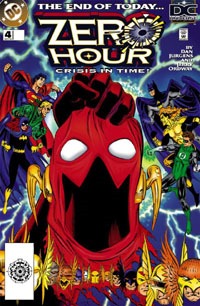
We open on the Time Trapper being killed. Knowing the end of this story and 20+ years of DC history since, it makes total sense who the villain of the piece is from these pages, though I recall being entirely clueless at the time. We then jump around quite a bit as pieces are moved into place, both for this core series and to set things up for tie tie-in titles for the first week of the event. Metron finds Darkseid and urges him to act. When that fails, he leaves on his own to seek allies elsewhere. Meanwhile, the Joker finds himself facing Batgirl, and then an equally-surprised Batman and Robin who don’t know who this young woman is. The Linear men become aware of a disturbance in Time, so Waverider and Hunter (with no reference at all to Sum: Zero–the Prelude to Zero Hour from Showcase ’94 #s 8-9) are dispatched to investigate. They arrive in the far future just in time to see The Flash–Wally West–die trying to shut down the rift eating through Time itself…they escape into the past. Back in the present, Superman meets up with Batman for the first time since before their respective “big events” (Superman’s death/return and Batman’s broken back/healing)…just as Metron shows up. Waverider and Hunter then encounter a young Hal Jordan, himself displaced in time, and try once again to stop the rift, but this time only Waverider gets out, though Hunter is able to tell him to look up a “crisis.” Back on Earth in the present, Hawkman confronts Vandal Savage, and then splits into numerous iterations of himself, confusing Savage. Metron and Superman locate Kyle Rayner, the current Green Lantern, and broadcast a message to the heroes of Earth, informing them of the situation. Metron then confronts the Spectre; Hawkman re-merges with himself as the Justice Society shows up; Vandal Savage disappears, and Waverider appears, bearing the horrible news of this crisis having already claimed its Flash…and Extant gloats.

Given its relative quick point, I’ll touch on the art, first. It’s Jurgens…with Ordway. Fantastic stuff, some of my absolute favorite, particularly given their involvement with the Superman books, this was a line-wide event, but helmed by “the Superman guys” I was already familiar with, AND Superman’s involved, so when this came out, it seemed a natural extension–or expansion–for me, and fit perfectly. Even now in 2016, I love the art, and it just IS. This being my first such event, and these guys on the art, their work became instantly “iconic” for me, and a standard I often hold stuff to even after another 22 years.

Story-wise, this also fit into the Superman books of the time–my core anchor to the then-DC Universe. His involvement here brought me into it (Ditto Waverider), and though at the time I wasn’t all that familiar with many characters, there were enough that I WAS familiar with that it never turned me off. I understood–even then–that this was bringing together a ton of different characters, so I followed along, getting more out of the characters I knew, and rolling with those I did not. Some of the scenes that unfold in this book remain iconic to me both in the visuals as well as story beats–particularly the Flash’s big moment.

We get just enough in this issue itself to grasp the core of what’s going on–rifts in Time are eating backward from the End of Time as well as the Beginning, causing anything from those periods to cease to exist, both ends moving toward the late 20th century. We see characters experiencing chronal anomalies, as everyone is affected from humans to gods and everyone in between.

This issue virtually ignores the prelude bits from Showcase ’94, without even a reference or footnote pointing readers to it, so I certainly didn’t miss it back then, though it gives context for the panel Extant appears in here. Other than that, we’re introduced to the situation, see how it’s affecting things, see various characters face the situation while others notice its effects, a call to action goes out, and though this issue alone provides a lot of story, it also shows us glimpses of things that are expanded on in various tie-in issues. I only remember reading several of the Batman and of course the Superman tie-ins, and this core series and getting plenty from the Event. This time through, I’m reading every tie-in that I’m aware of, hopefully lined up with the weeks they were originally released in (corresponding to the core mini’s issues).

The core series was a 5-issue WEEKLY book…with the entire event, start to finish (outside of the prelude) taking place in ONE MONTH. Blink, and you miss it. Blink twice, and you missed the Zero Month as well. Drastically unlike modern events that can take six or more months to a year to play out, chewing up entire ARCS in a title or filling entire mini-series if characters’ involvement can’t interrupt something in their individual titles. Zero Hour, then a bunch of #0 issues for Zero Month, then the DC Universe continued on.

That I’m about to dive into all of the tie-ins along with the core series and Superman/Batman books is something I’ve wanted to do for a long time. And as a self-proclaimed Official Reading Project, I’ll be sharing my experience in writing, as I intend to cover every issue (including the Booster Gold issue from Geoff Johns).

The clock is ticking…

Zero Hour Revisited – Showcase ’94 #9

90srevisited_zerohour

showcase_94_0009The Secret Origin of Scarface part Two – Call Me Scarface

Script: Alan Grant & John Wagner
Art & Colors: Teddy Kristiansen
Lettering: Ken Bruzenak
Consulting Editor: Dennis O’Neil
Editor: Neal Pozner
Cover: Shawn McManus
Published by: DC Comics
Cover Date: August 1994
Cover Price: $1.95

Much as with the first chapter of this Scarface story, the art’s rather simplistic…but expecting it this time and looking past it not being ‘great’ and just taking it as it is, it works very well here getting everything across that needs to be, at least in not taking me out of the story AS I read, and leaving me satisfied with the story at the end.

Wesker and Woody make good on their escape–though it involves a brick-to-the-face and then hanging of Donnegan, and the murder of a couple of guards. We see Wesker falling prey to whatever madness Donnegan had–as the dummy seems to be the lead and the Ventriloquist following. We also get a sort of explanation for Scarface’s speech thing–his “B” having a “G” sound–as Wesker isn’t that great a ventriloquist.

The story is fitting, and I’m definitely quite satisfied with this “origin” of Wesker as The Ventriloquist, and Scarface, how they came together and all that. I can certainly visualize this being summarized in a one or two page origin–perhaps that’s been done elsewhere already (in Countdown, perhaps?) but that’s mostly irrelevant for now. As a lead feature in an anthology title, it works, was an enjoyable read, and after the first chapter in the previous issue I was actually looking forward to this and trusting that it was to be a 2-part story and nothing longer.

A Story

Writer: Terrance Griep, Jr.
Penciller: Kyle Hotz
Inker: Pav Kovacic
Colorist: Mike Danza
Letterer: Albert DeGuzman
Editor: Neal Pozner

This “middle story” is a brief one, but interesting. Like the Wildcat piece in the previous issue, it’s singular and self-contained; a slice of life sorta thing. We meet Pax, a man bent on revenge against the alien parasites that slaughtered his people–the entire population of his world except he himself. As he narrates his story, it comes to light that the parasites can look like anyone, and we see him take on a group of them, killing them…and moving on. When he’s picked up by a group of “police,” he begins his narration again as we see that his hunt-and-kill mission continues.

I had absolutely no idea what to think of this story at first. At the first page, I thought MAYBE this was Vandal Savage or someone of that nature, given the name “Pax,” but obviously I was quickly proven wrong in my assumption. The parasites appear to be the sort that we saw in Bloodlines–the Annuals event from 1993, which would make sense given this story would have been out just a few months after the end of that event in Bloodbath. And for a one-off story, seeing someone hunting the parasites would kinda show them to be a bigger deal than just the few that made it to Earth and caused the trouble they did.

The lack of expectation going in, of even knowing what the segment was to be about, worked in its favor. The art fits, gets stuff across quite effectively; and has little to be compared to on this read-through. The story itself is ultimately forgettable, but still worth having read it. Reading this in 2016, though, it puts me in mind of 2014’s Armor Hunters from Valiant…as the lone survivor of a planet hunting down parasites like those that destroyed his planet, with singular vision and little regard for the consequences beyond killing the parasites.

Thinking of it as the likes of Armor Hunters actually makes me like it all the more. While I wouldn’t care for any sort of dedicated mini-series or ongoing series like this…as a “random” thing in an issue I’m reading anyway, it’s well worth the several minutes of reading and realization!

Sum: Zero part two

Story: Dan Jurgens
Pencils: Frank Fosco
Inks: Ken Branch
Lettering: Starkings/Comicraft
Colors: Stuart Chaifetz
Editor: Neal Pozner

Once more, the final part of the issue is the selling point, the story I read the issue for.

We pick up on Monarch holding Waverider and Hunter in a stasis field. Though he’s able to get them into the timestream, he lacks the control to direct himself, and hopes to have Waverider use his power to do that–and in the doing he’ll learn it for himself. Things don’t go as planned, and Monarch–Hank Hall–learns a new “truth” of his past and what happened at the end of Armageddon 2001, and since he’s more powerful than he’d realized, and his future self had realized, as Time’s been altered, he decides instead of being Monarch, he’ll be Extant! And stealing Waverider’s Linear Men arm-control, disappears into the timestream. Hunter is suitably cheesed-off that the villain now has the ability to time-travel at will, and Waverider suggests that if this villain can uphold his potential, they stand at the edge of a true CRISIS.

Yep, 9-ish years after “THE” Crisis (on Infinite Earths), a new one is about to unfold.

As with the previous issue’s segment of this story, the art works well, if not being completely to my liking. The story also works, feeding us directly into Zero Hour, and revealing that this story was primarily about transforming Monarch (Hank Hall) into Extant, a sleeker and cooler-looking guy than the clunky Monarch was, but without having to “corrupt” any other characters. This also allows the character to come with built-in, already-established “street cred” AS a villain, extremely powerful and a true threat beyond any single hero’s ability to take him down.

Despite this, I originally read Zero Hour withOUT having read this prelude, and had no problem following along (that I recall), and it wasn’t until I read the collected edition that I got to read this…so Sum: Zero is not absolutely essential…but it’s satisfying as a piece of my completist mentality for this reading project.

OVERALL THOUGHTS

I’m glad I didn’t pay full price for this back in the day, as I would certainly NOT have appreciated the lead story nor the Pax segment…and probably, honestly, wouldn’t even have appreciated the Zero Hour piece. Reading it in 2016 having paid a dollar or less for both chapters, it’s a very satisfying read and well worth the expense and the time. And for reading the entire issue for both of these Showcase comics, I now have a better idea of the “origin” of the Bat-villain The Ventriloquist/Scarface.

It’s an anthology book, with a mix of creators both known and not, and characters that didn’t headline their own series, and all that, and it feels like one. This two-issue “taste” is much more satisfying than I recall the Batman segments of the two issues that tied into Knightfall, though that could be the more than two decades’ additional life lived and my ability to appreciate stuff as a mid-thirties adult than when I was just barely a teenager. I don’t know exactly when, but I look forward at least to the idea of binge-reading the several years’ worth of Showcase ’90s.

Zero Hour Revisited – Showcase ’94 #8

90srevisited_zerohour

showcase_94_0008The Secret Origin of Scarface part One – The Gallows Doll

Script: Alan Grant & John Wagner
Art & Colors: Teddy Kristiansen
Lettering: Ken Bruzenak
Consulting Editor: Dennis O’Neil
Editor: Neal Pozner
Cover: Ted McKeever
Published by: DC Comics
Cover Date: July 1994
Cover Price: $1.95

I know I’ve read the Zero Hour portion of this issue in the collected edition of the event…but until now, I’ve never actually read Showcase ’94 #8 itself as a standalone comic! I was surprised by it, and rather enjoyed the experience overall.

This first story focuses on a prisoner in Blackgate–Donnegan–and how he gets a book on ventriloquism as a “joke” but ends up taking it fairly seriously. He even makes himself a dummy–carved from the wooden remains of the prison’s gallows. He and the dummy form an interesting relationship over the years…which leads to some conflict when a new prisoner, Arnold Wesker is assigned to Donnegan as a cellmate. Wesker is interested in the dummy and appreciates the “show” of ventriloquism. However, Donnegan is quite non-plussed at the perceived intrusion on his space, and commands Wesker to leave his dummy–“Woody”–alone. Wesker’s fascination leads him to investigate, which earns him a beating. Not long after, he seems to be hearing the dummy…even though Donnegan’s sound asleep.

The visuals for this story are rather simplistic, and don’t really do much for me. I recognize the dummy, and Wesker, by prior knowledge of them, and the “iconic” look of the dummy, and Wesker’s glasses. Beyond that, the art’s rather generic and unappealing. Still, it works for the story overall, and doesn’t exactly disappoint me, as I had zero expectation going in. It’s certainly not a “selling point” for me, but since the point of my reading the issue isn’t even this “main feature,” it can have a pass.

Story-wise, I liked this. All these years later and I’ve never consciously known–or at least retained–the origin of “The Ventriloquist” and “Scarface” (Woody). And this being (in part) an Alan Grant story (I don’t recall if he created the character to begin with, but I recognize him as one of the major writers on Batman stuff in the late-’80s/early-’90s) so that predisposed me to enjoy the story, and not write it off as just some throw-away story of a lesser-known Bat-villain. This is part one, and the fact that Wesker isn’t the original “Ventriloquist” (or there’s something a bit more messed up going on) is interesting, and I actually look forward to reading the next chapter.

Wildcat – Brujas y Gatos

Writer: Eddie Berganza
Penciller: Nick Gnazzo
Inker: Ray Kryssing
Colorist: Suzanne Bourdages
Letterer: Bill Oakley
Editor: Neal Pozner

I’m not overly familiar with Wildcat. I know the name Ted Grant, and recognize the character from Geoff JohnsJSA stuff (assuming I’m not mixing THIS Wildcat with someone else). Since I’ve never read anything in particular focusing on the character, I have no real preconceived notions to bring into the reading experience.

This is a short piece that finds Wildcat infiltrating a resurrection ceremony that seems to be–purportedly–to raise someone from the dead. Contextually we learn that the body to be raised is that of Ted’s friend Yolanda–who had attempted to become a new Wildcat…but she was apparently killed by Eclipso recently. (I have yet to read but was aware OF the short-lived Eclipso series that spun out of the Eclipso: The Darkness Within and recall hearing about there being several character deaths in short order toward the latter part of the series–I always remembered The Creeper being killed, but apparently Yolanda/Wildcat was also one). Wildcat observes, and only intervenes when a “fake” Yolanda shows up. He busts the ceremony and the fake Wildcat, revealing the truth and bringing some closure (albeit uber-convenient and quick) to the family of the dead woman.

This is a throw-away story, but recognizing it as a bit of follow-up to what I presume to be a virtually un-noticed otherwise death in a minor, now-forgotten book from the early-’90s, I can definitely appreciate its existence and purpose. At the least, it reminded me that that Eclipso series is out there and I’ve not yet acquired it, though I’ve had an interest in it for a couple decades now.

The art’s slightly over the top in a way, but not bad. I don’t recognize the art team’s names, but it’s not a bad piece. That this short “slice of life” episode IS so short but actually ends without a cliffhanger suggests to me that it’s a one-off piece in this anthology series…so it’s not even long enough for me to develop much opinion one way or the other.

The primary drawback to the piece at all is that it stood between me and the Zero Hour story.

Sum: Zero

Story: Dan Jurgens
Pencils: Frank Fosco
Inks: Ken Branch
Lettering: Starkings/Comicraft
Colors: Stuart Chaifetz
Consulting Editors: Mike Carlin & K.C. Carlson
Editor: Neal Pozner

Vanishing Point–a place beyond Time itself, headquarters of the Linear Men. Hunter finds Waverider reminiscing, and confronts him over the fact that he–Waverider–may have stopped Monarch, but himself wiped out an entire timeline in the doing, making him worse than Monarch ever was. Waverider, though, doesn’t share the sentiment–though he does realize perhaps he should check into things with Hank Hall a bit more…though what he sees disturbs him. When he (and tag-along Hunter) journey to the late 20th century to investigate an anomaly that could be Monarch’s doing, they find him waiting, and themselves quite unprepared for this.

This piece is the “selling point” of the issue for me; the entire reason I picked the issue up to read. I’m pretty familiar with it already from having read the Zero Hour collected volume at least a couple times over the years, but this might be the first time actually reading it as part of this Showcase issue, in this exact format.

Trying to evaluate the art as a standalone thing, I realize it feels just a bit “off” somehow…probably because of not being Jurgens‘ art, or some such. It’s not bad by any means–and both Waverider and Hunter are familiar and distinct, and the imagery we get of Monarch and other elements that ought to be familiar from Armageddon 2001 fit, and convey the story.

The writing is Jurgens, and as a prologue to the Zero Hour event, this fits perfectly into stuff, giving us a bit of story involving these characters just prior to their stepping into that event.

OVERALL THOUGHTS

I thought about “just” touching on the Zero Hour story and “ignoring” the rest of the issue, but figured why not just read the whole thing? And I was pleasantly surprised. I got a chapter of a story fleshing out the background of a Bat-villain that isn’t the bore I might’ve thought it’d be. The Wildcat story wasn’t bad and its primary drawback was that I finished the Scarface story and was a bit surprised to not turn right into the Zero Hour story.

While the issue’s page numbering INCLUDES ad pages, it goes to page 46…which is much longer than “just” 20-22 pages, so even with ads, it’s roughly a double-sized issue for not much more than a standard-length issue would have been at the time. Considering I paid fifty cents or less for the issue, the time it took to read vs. the amount spent makes it an excellent value; I enjoyed the reading experience, and when adding the time spent writing up this post, means that it’s by far one of the highest-value comics I’ve read in quite awhile, holding/being the focus of my attention for so long.

Didn’t Know Then What I Do Know Now

I “returned” to comics in 1992 based partly on an American Entertainment or Entertainment This Month catalog as well as a friend discovering a store that was just for comics (as opposed to a spinner rack in a bookstore or grocery store). 1992 ended with stuff like The Death of Superman, Batman: Sword of Azrael, Robin III: Cry of the Huntress, and Spider-Man 2099 (to name a few). Throughout 1993 I expanded into Marvel after Uncanny X-Men #300, followed the core Fatal Attractions event (at least to Wolverine #75)…and what had been a heavy dose of “dabbling in” comics became a truly actual “thing” for me, in my life.

By 1994, comics were my thing. I was primarily following the Superman and Batman books, as well as having gotten into Green Lantern (with Emerald Twilight and the introduction of Kyle) and a decent run with Archie‘s Teenage Mutant Ninja Turtles Adventures.

But everything was pretty isolated within the given characters’ realms. I knew there was a shared universe (well, the TMNT were their own thing!) but I hadn’t ventured that far out into the deeper waters of continuity and the like.

So ads like the following were lost on me “in the moment” at original publication.

end_of_today_01

I certainly was not “put off” by the ads or anything…but I didn’t know what this ad was for, as it didn’t directly/solely impact anything I was reading. Crisis on Infinite Earths was at best something that I had heard of and read about; and even including the time between my initial, brief run with comics in 1990-1991 and getting back into them in 1992, when this ad was new, I had barely–if even–5 years of “history” with contemporary comics.

So for me, there was no huge hype driving the pending crossover…and though I was aware of it and bought it and such, I don’t recall any particular anticipation for it.

I got the main Zero Hour series, and then basically “just” the tie-in issues in the Superman and Batman titles as well as Green Lantern–stuff that I was getting anyway.

That I’m finally getting around to reading the entirety of the crossover–the core series, the issues I’d read back then, plus all the other tie-ins I’m aware of/can find now–is something 22 years in the making.

Like my issue-by-issue covering of the original X-Men: Age of Apocalypse stuff… I’ll soon be launching into the Zero Hour equivalent.

As I stare down the barrel of a major change to my personal status quo–the largest such in nearly a decade–Zero Hour‘s tagline fits.

The end of today…

Convergence #8 [Review]

convergence008Last Stand

Writers: Jeff King and Scott Lobdell
Pencils: Stephen Segovia, Carlo Pagulayan, Eduardo Pansica, Ethan Van Sciver
Inks: Jason Paz, Scott Hanna, Trevor Scott, Stephen Segovia, Ethan Van Sciver
Colros: Peter Stiegerwald
Letters: Travis Lanham
Cover: Andy Kubert, Brad Anderson
Special Thanks: Geoff Johns, Beth Sotelo, Mark Roslan
Asst. Editor: Brittany Holzherr
Editor: Marie Javins
Published by: DC Comics
Cover Date: July 2015

[Please note that I WILL be “spoiling” this issue in this review. If you have not read it yourself and/or do not wish to know how the issue–and Convergence itself in general–conclude, you’ll want to stop reading; though I have about 2 1/2 paragraphs before I truly get to “spoiler” territory.]

I think I left off about six weeks ago–I’m pretty sure I jumped off after #2, never picking up #3 of this series. And though my enthusiasm quickly, almost totally tapered off…I again found myself curious about how this would wrap up, particularly given recent rumors at certain comic sites, and wanting to see/experience it for myself instead of just reading about it.

Of course, that was not truly worth the $4.99 cover price (at this point, that means I’ve bought THREE $4.99 issues and only one $3.99 issue of Convergence proper, which is absolutely disgusting to me). The cover also is quite generic and basic, not impressing me at all.

The story itself is relatively basic, and I certainly lack context of the past few issues. A group of heroes has gathered, to make their last stand. Someone named Deimos has just been killed by Hal/Parallax resulting in the planet becoming unstable, and its destruction threatens the Multiverse itself. A few remaining time-travelers (specifically Booster Gold, his sister, and Waverider) show up…and their solution is to bring Brainiac back. In turn, Brainiac’s solution is to absorb the temporal energy that’s been unleashed and return the heroes home, while having himself restored and the Multiverse fixed. Part of fixing the Multiverse is preventing its total collapse in the “first” Crisis. And fix stuff they do, and all the worlds are restored, the many many worlds of a Multiverse.

I mention that the story is relatively basic, and that’s in the “heroes are gathered, a last-ditch solution arrives, is executed, and we get page after page of “moments” to end the current series/event while not truly capping things off” sense.

Essentially, it seems that in a way, this means that Crisis on Infinite Earths is given a different ending, in which the final five Earths, at least, do not collapse into one single Earth, and generally that anything and everything that has ever happened in a DC comic has a place in the multiverse and is still out there somehow.

[The way I choose to interpret it is that we’re seeing the creation of a divergent branch OF the multiverse with worlds where Crisis on Infinite Earths, Zero Hour, Flashpoint, Infinite Crisis, etc. all happened or will happen existing amidst worlds in which none of those happened, and so on.]

The issue’s art is a mixed thing, with a bunch of pencilers and inkers involved. Fortunately, though seeming much like a “jam piece,” dealing with multiple versions of characters and various Earths and all that, I didn’t honestly consciously “notice” that overly much…I noticed some differences here and there but mentally wrote them off as nature of the story.

While the series didn’t hold me week to week, knowing now how it ends, I do expect I’ll still be interested in a collected volume–I half considered that it’d “only” be 5 issues to fill in my “gap,” but with DC‘s rather reasonable pricing, that $20 for 5 issues will probably be 2/3 or more the price of the inevitable hardcover of all 9 issues, so I expect to try to “hold out” for that.

Unless you’re like me and just want to get the immediate gratification of “experiencing” (reading) this issue and its place in DC History right now, or have already kept up ith the rest of the series…you’re better off waiting, I think.

This isn’t the worst ending of an event, but I wouldn’t consider it great, either as it seems to throw wide the doors on things than it does close them on even this story in itself. It does set up the new Earth 2 for the ongoing “primary”/focal part of the DC Multiverse (formerly The New 52) and leaves the entirety of DC history open such that it seems “possible” that anything/everything that’s ever been at DC is now “available” to be used in DC comics in general. Whether this ultimately proves to be good or bad, I don’t know.

I can’t say I’m thrilled with the issue in and of itself…but I am glad to have gotten to read this immediately, and be given some small “hope” of interesting self-contained stuff down the line. For the immediate present, though, this serves as a jump-off for me.