• December 2025
    S M T W T F S
     123456
    78910111213
    14151617181920
    21222324252627
    28293031  
  • On Facebook

  • Archives

  • Categories

  • Comic Blog Elite

    Comic Blogs - BlogCatalog Blog Directory

Ultraverse Revisited: Prime #1

ultraverse_revisited

prime_0001Prime Time!

Writers: Len Strazewski, Gerard Jones
Artist: Norm Breyfogle
Letterer: Tim Eldred
Color Design: Paul Mounts
Editor: Chris Ulm
Published by: Malibu Comics
Cover Date: June 1993
Cover Price: $1.95

While I don’t recall offhand if all three books shipped the same week, or what order they came out in…to me, Prime #1 is where it all began…I remember it from that first month–June 1993–and I followed the series itself to its conclusion in late 1996 or so around #15 in its second volume. Whatever the original order, to me, it just feels "fitting" to dive in with Prime #1 to start my journey back into the Ultraverse.

Another thing going for this issue is that it has an audio-drama of sorts, from a one-issue "CD-Romix-Comix" thing where the first issue was chopped up into panels to display on-screen with some quasi-animation–think early "Motion Comics" or such–along with a cast audio track with sound effects and such. Having the AUDIO from that which often makes its way onto my iPod, this issue is one that I simply cannot read at a normal pace–I read it with the voices in my head, the vocal pace of the audio piece unfolding in my head. I can also virtually recite the entirety of the issue from memory, so there are no surprises revisiting THIS issue.

The comic is a lot "bigger," brighter, and "’90s" than I sometimes remember…but that’s something that makes sense, as this came out in 1993–as "the ’90s" were getting into gear–and that was a time with "big" art, non-traditional page layouts, and of course, the (infamous?) rise of computer coloring techniques. Though I know Breyfogle had a significant run with Batman in Detective Comics (including my own first-ever issue!), this series doesn’t look like what I remember of Batman…helping show a range as an artist, being able to tackle different types of material. Prime as a character is big, bold, and really very over-the-top with the huge muscles, and outlandish physique…take your mental image of the biggest, buffest super-hero (other than Prime!), amp that up, and you may well HAVE Prime. This comes into play with the character’s origin, but also helps the character stand out in its own way.

The cover is one of the more "iconic" covers out there, to me…certainly for my own experience with it, as well as being a generic/"iconic" sort of cover before that was totally "standard." I also have long REALLY dug the trade dress for these early Ultraverse issues–with the 3-D-stylized "U" and the issue number/price, publisher (Malibu Comics) in "corner boxes," with the Ultraverse logo as a banner across the top, and a border line framing the entire image, though said image breaks free of any constraint offered by this.

Story-wise, in some ways, this issue goes against my own sensibilities in feeling strongly that first issues need to introduce not only the main character, but also a supporting cast and antagonist, who/what they are and at least hints of motivation, and all that. I suppose this issue gets a "pass" on that for being 25 years old (twice as old as I was when it saw publication), and long since knowing where stuff goes, and all that…so it’s impossible to TRULY judge this by the same standard as I would a new #1 issue released in 2018. But this also comes from 1993, when collected editions were still pretty rare overall, and ongoing comic series issued in monthly form did not have (essentially) companion "graphic novel editions" trailing relatively close behind. So while this first issue doesn’t reveal everything, it’s by no means playing up to some "graphic novel" version.

We open on the first of several main scenes, as we learn a bit about this Prime character by way of others telling of their experiences encountering him. First, a disgraced gym teacher, attacked by Prime and accused of inappropriate interaction with young female students (this was 1993, but still right at home in a way with headlines 25 years later). Then we learn of Prime demolishing a drug house. Finally, he takes on terrorists in Somalia…thousands of miles away! Amidst a shadowy figure interviewing the first two and learning of the latter via tv news reports, we get further world-building and exposition via the tv news/entertainment reports–stuff about Hardcase (who had his own #1 the same month as Prime), a character called Prototype (who would come back into play later), as well as a slight sense of the way the public views these ultra-humans.

As said above, there’s no surprise for me in reading this issue, outside of reminder of how colorful it is, how ’90s it is. I see this issue frequently in bargain bins…I see many of the early Ultraverse #1s in such bins…but especially for 25 cents to 50 cents, I recommend checking it out, whether as an artifact from its time, or to get started on an Ultraverse journey of your own.

prime_0001_blogtrailer

Ultraverse Revisited: Early House Ads

ultraverse_revisited

Here are several early "house ads" for the first few Ultraverse titles, plus the "Ultratorials" from Prime, Hardcase, and The Strangers #1s.

ads_0001_prime

For me, one of the most noticeable differences from ad to print with Prime was the title logo–the lower portion was removed, and the cover of the first issue features only the full, heroic Prime–not the two-stage transformative part next to it.

The text description sorta fits what I remember, in the "hype" sense, but doesn’t feel entirely accurate on the first issue in particular.

ads_0001_strangers

This Strangers ad is the image for the first issue’s cover, and offhand seems like what was printed, albeit with some different coloring, perhaps. And with Malibu‘s coloring department (long-rumoured to have been why Marvel bought the company) it makes plenty of sense to me offhand that that would make for some simple changes, and the coloring (of the background) can make an image look at once familiar yet suitably different like this.

The text definitely fits, though sorta "gives away" the "lost city" bit…but had you asked me before looking at/reading this ad, I would have been able to tell you essentially the rest of it, just not "…with a sorceress from a lost city…"

ads_0001_hardcase

I feel like Hardcase was another logo that changed between ad and print, with a more "basic" and bigger/blockier design. This logo is familiar enough that I want to say it got used on later issues of the series.

This image is completely different from the first issue’s cover, though 25 years later, this would simply be a case of "I didn’t get the variant cover." I like the image in terms of the ad, but it would seem rather boring and "off" to me for what I recall of the first issue itself.

The text piece mostly gives the premise of the series, but I wonder (now) about the timing of stuff for what I recall of the character only having a year "off" from super heroics–is that really time to build a huge film career?

ads_0001_freex

I like this Freex ad–it’s the image I associate with the first issue, and I think I even have a poster of this. I prefer the text being part of the image, rather than a Microsoft Word "text box" dropped onto the image…it feels a lot more dynamic…and memorable!

I do notice a small "text box" but even that seems a bit fancier than the first three ads, and actually does NOT stand out so much. "Life’s tough when you’re a super-power freak."

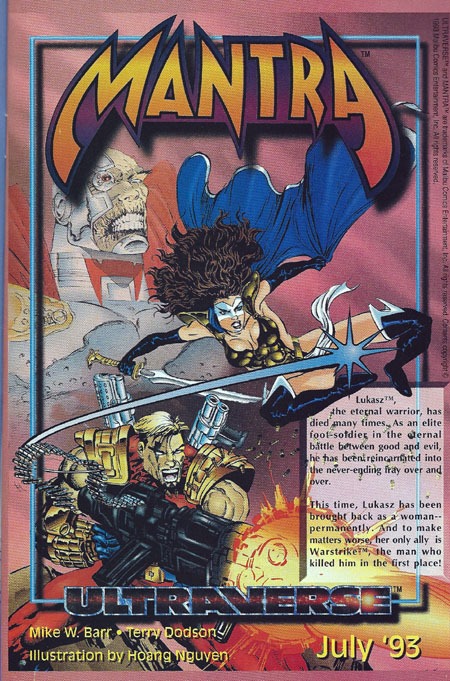
ads_0001_mantra

Mantra is another where the image from the first issue’s cover is used, which I definitely like!

The text box seems a bit much, with two ‘paragraphs’ of premise given…it makes it look a bit more complicated. Of course, I like that this info is provided, as it beats the heck outta just simply giving the image and saying "blindly buy me!" It also somewhat spoils developments in the first couple issues, and as I recall, technically "spoils" the first issue’s cliffhanger.

Additionally, for a "solo title," the cover makes it look like a bit of a team-up book, with Mantra and Warstrike fighting together, and possibly for the shadowy guy in the background (the villain Boneyard). The main character is the smallest figure on the image!

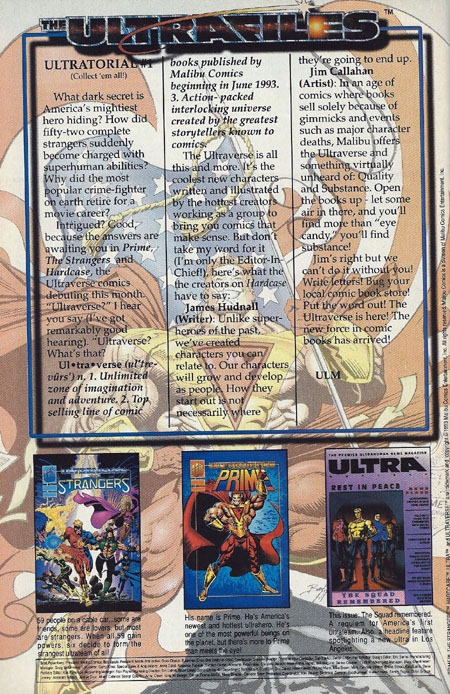
ultrafiles_prime0001

Here’s the "Ultrafiles" page from Prime #1. While I the first part is the same across the several issues, the latter part is changed up to fit the specific issue, with small quotes from the creators of the specific issue.

ultrafiles_hardcase0001

Here’s the page from Hardcase #1…

ultrafiles_strangers0001

…and here’s the page from Strangers #1.

Though I’ve been almost certain that Strangers had been the first of the titles out (granted, this was 25 years ago and I was a 12-year-old kid at the time), that its page showed the covers of the next month’s new #1s has me slightly doubtful.

Regardless, I appreciate that these pages were changed to fit the specific issue–they were not just a one-size-fits-all static thing inserted into each issue.

This is also from a time when the "primary" cover was what was marketed–not the variants. Variants existed–specifically full-cover holographic covers, and versions with silver foil logos–but they were not the marketed versions. They were special "additional" versions! The hologram images I’ve come to learn were actually different from the printed art; but the foil editions are the same exact cover, just with the bulk of the logo as silver foil. The hologram covers are extremely distinctive–you’d know EXACTLY what you’re looking at to see one; and otherwise, the marketing (like these pages and most of the house ads) show you exactly the cover image you’re looking for, on whichever series!

Two and one half decades later, and going through back-issue bins, one can immediately tell what issues are what and the (series) reading order and all that.

ultraverse_early_house_ads_blogtrailer

The ’90s Revisited: The Phoenix Resurrection – Revelations

90s_revisited

phoenix_resurrection_revelationsRevelations

Writers: Ian Edginton & Dan Abnett
Pencillers: Kevin West, John Royle, Randy Green, Rick Leonardi
Inkers: Tom Wegrzyn, Philip Moy, Rick Ketcham, Jeff Whiting
Letterers: Vickie Williams, Patrick Owsley
Color Design: Mike Tuccinard, Robert Alvord
Interior Color: Malibu Color
Asst. Editor: Scott Bernstein
Editor: Hank Kanalz
Published by: Malibu Comics
Cover Date: December 1995
Cover Price: $3.95

This issue was a bit of a challenge to read. In it, much as I hold very fond memories of the Ultraverse, this really drives home the notion that my fond memories precede the Black September event, that they come from the "original" Ultraverse, before it "rebooted" into a "Marvel-Lite" imprint sorta thing. And just looking at the credits, if only from a 2018 standpoint, this reeks of non-priority to the publisher. I recognize several names that SHOULD have meant this was an excellent issue–especially seeing Dan Abnett‘s name as a writer. But when you have two writers, four different pencillers and 4 different inkers, two different letterers, two different colorists…this screams "piecemeal" and generic incoherence.

Story-wise, we basically have these characters from two different universes spouting off at each other, commiserating generically over stuff (the X-Men recognize Black Knight, for one and he them). But once again, there doesn’t seem to be any real INDIVIDUALITY to any of the characters. Night Man shows up outta nowhere and Wolverine welcomes him as if totally expected…just pieces being moved around the board, so to speak. And then for as big a threat as the Phoenix is supposed to be, everyone winds up just throwing their powers or fists at it to drive it through a portal back into its own (the X-Men’s!) universe, and the problem’s solved? If it’s a threat here, surely it’s a threat there…

We get "big" story beats in stuff like Rex Mundi’s "Alternate"–somehow because he–in this universe–did such a perfect job of cloning himself, the Phoenix–brought into this universe from another–subdivides itself to match. We "see" Mantra, and get a moment of her seeing/thinking she’s been "warned" about Topaz, but why does she get the look she does? But there’s zero explanation as to who/what she is, or the relationship…and if nothing’s going to be expounded on, why include it to begin with?

Probably another problem with this comes with reading it now in 2018, after 15+ years of being conditioned to 6-issue (minimum, mostly) story-arcs and year-long mega-crossover-events and the like. As something spanning two teams from two universes, plus so many ancillary characters from one, with a huge, cosmic, universe-threatening entity…it just seems impossible for anything to be done justice. Something like this really WOULD be fairly justified to have AT LEAST one full issue apiece for each of the Ultraverse titles, a couple "main" issues for everyone, and even an X-Men tie-in or few. Not full 3-4-6-issue arcs per title, but at least a few more full-length issues. Everything crammed into just a couple issues after just a couple pages per title…it’s rushed, and sloppy, and overall just generic and mostly incoherent.

As I’ve read these, I’ve become all the more convinced that the beauty and depth and such of the Ultraverse–the "heart" of the Ultraverse–is definitely in its first couple years, its run of titles when they were actually their own thing, before being wholly given over to Marvel and all that.

I had a hard time getting through this issue–I think it took me at least three times situating myself with it to read to get through the whole thing. Where often that would seem a compliment to a well-done, dense comic proving its 2018 "value" of a $4 cover price, this happened for lack of engagement and interest. Really, I forced myself through the issue simply to have read it (and now typing all this, which is far from my favorite sort of review/write-up!)

The cover-art, and the CONCEPT is sound; and the idea of some crossover between the X-Men and most of the Ultraverse, and their facing the Phoenix Force, and it having counterpart/ties within the Ultraverse isn’t all that bad. But this execution of it all is not much to my liking, and really feels like the sort of thing I’d say one is better off passing on. Of course, if you find it in a 25-cent bin–the whole ‘event’, anyway–it might be worth $1 or so to get all four issues; but I’d encourage one to seek out older Ultraverse stuff if you’re just interested in "trying" an Ultraverse title.

phoenix_resurrection_revelations_blogtrailer

The ’90s Revisited: The Phoenix Resurrection – Genesis

90s_revisited

phoenix_resurrection_genesisGenesis

Writrs: Ian Edginton, Dan Abnett
Pencillers: Darick Robertson, Mark Pacella, Greg Luzniak, Rob Haynes
Inkers: Tom Wegrzyn, Art Thibert, Larry Stucker, Bob Wiacek, Philip Moy
Letterer: Vickie Williams
Color Design: Robert Alvord
Interior Color: Malibu Color
Asst. Editor: Scott Bernstein
Editor: Hank Kanalz
Published by: Malibu Comics
Cover Date: December 1995
Cover Price: $3.95

As Marvel publishes Phoenix Resurrection in the present, 22 years ago it published The Phoenix Resurrection through Malibu ComicsUltraverse line. Malibu Comics, which Marvel had purchased in order to keep DC Comics from buying the smaller publisher. And with the smaller publisher in-hand…looking back through this issue at least, it seems Marvel had no idea what to do or have done with the small superhero universe it now had in addition to its own.

This Genesis issue was preceded by a month-long promotion in which each of the 7 then-current Ultraverse titles had a 3-page flipbook segment showing the characters encountering some kinda reference to a phoenix, though taken as a whole that made for a disjointed mess. The seven chapters were reprinted/collected into a single issue in The Phoenix Resurrection: Red Shift.

Getting into the main/actual story of the "event" now with this issue, we get a prologue of the Phoenix Force being discovered by some probe from another universe. Before long, through machinations of the Gateway character, a squad of X-Men find themselves once more in a parallel universe that they’ve become increasingly familiar with (a footnote reference to the Mutants vs. Ultras special issue, itself collecting several previously-exclusive American Entertainment editions such as Prime vs. Hulk, Wolverine vs. Night Man, and All New Exiles vs. X-Men).

While bystanders and news media are focused on something coming from the sun, Ultra hero Prime engages the X-Men in combat, because of course they’ve gotta fight. The source of the aforementioned probe–a mother ship that’s buried in the ocean–reunites with a counterpart in the sun, and brings the Phoenix Force to this Earth, and then tries to drain its energy–its life–causing the Phoenix entity to be driven insane with pain. The entity bonds with Prime as a host body, and continues to fight the X-Men, as other Ultras are brought to the scene. (It should be mentioned that apparently the mutants’ powers are severely dampened in this reality…but that’s a crutch that doesn’t much matter for discussion of this particular issue). Eventually, the Phoenix and Prime are separated, and the Phoenix takes a new host, as the issue ends (to be continued in Phoenix Resurrection: Revelations).

Maybe it’s that I look back on the likes of Prime, Mantra, and Rune with memory of more complex, authentic-sounding stories and characters, as well as the same from the X-Men books from the early/mid-’90s (particularly stuff like Fatal Attractions or the Age of Apocalypse and immediate aftermaths) but this just does not feel like it has much depth, nor is there–even in an extra-sized issue like this–much characterization. It’s like the characters were chosen for the book by "popularity" and "mainstream-ness" (plus, of course, being characters appearing in books that survived into the pared-down 7-book line of Black September-onward), and not really for much else. We have a squad of X-Men and some major Ultraverse characters thrown together, but I get no real sense of depth, development, or motivation. The probe and mother ship have a far-too-convenient means of getting the Phoenix to Earth, Gateway seems nothing but "convenience" personified, and we’re told rather than shown that the mutants’ powers are lessened here. Prime comes off as nothing but some petulant kid–while he IS a kid, he’s lacking a depth I feel like I remember from his own original title. Bishop seems to be present for appearance’s sake, and with the mutants not even really trying to use their powers, there’s no particular point to any specific character’s presence…they’re interchangeable.

With the art, I recognize Darick Robertson and Art Thibert as names if not an actual art style here; but having numerous artists on this single issue doesn’t particularly do it any favors…at least for me reading it in a fair bit of isolation here–perhaps they’re the artists on the main books, in which case I’d welcome that (in idea at least), but just jumping into this issue after the Red Shift collection of 3-page shorts, I’m not thrilled with the visuals. I recognize the various characters–there seems to be an attempt to have them all look a certain way, perhaps using a "house style" or such–but virtually nothing stands out to me. Everyone is for the most part a generic iteration of iconic appearance (for lack of better phrasing). The only real stand-out bit for me was the large image of the Phoenix-possessed Prime (though zero mention or visual reference from the Ultraverse side OR X-Men side of the Prime body being healed/repaired after an obvious significant slash from Wolverine’s claws and Jubilee’s reaction to the green goop).

Ultimately, offhand, I didn’t so much "not enjoy" this as I "didn’t ENJOY" it. It’s cool–at least conceptually–to see the mix of characters thrown together and all. But after 17+ years of having "decompressed stories" that are clearly serialized graphic novels, I definitely am expecting much more depth of character and stuff from two sides like this to be brought out.

This is a definite novelty, one certainly worth 25 cents or so as a bargain-bin purchase, if only for the time it takes to read making it more worthwhile than most anything of its size published in present-day. You can definitely dive into this issue withOUT reading anything before it…the "crossover" stuff from the Red Shift 3-page segments are little but token reference-points thus far, making this a better "starting point" if only for having a big chunk of a single story that’s not jumping to a new setting/character every 3 pages. You could do worse than this issue…but much as I’m down on modern Marvel, if you’re looking for "return of Phoenix" stuff, you’d be better served with the contemporary Return of Jean Grey story in the 2017/2018 Phoenix Resurrection, or in 2012’s AvX event series.

phoenix_resurrection_genesis_blogtrailer

The ’90s Revisited: The Phoenix Resurrection: Red Shift #0

90s_revisited

phoenix_resurrection_redshiftRed Shift

Writers: I. Edginton, J. Smith
Pencillers: J. Royle, P. Peletier, C. Wojtkiewicz, R. Green, B. Murray, R. Haynes
Inkers: P. Moy, S. Moncuse, M. Farmer, T. Austin, G. Martin
Letterers: P. Owsley, V. Williams
Color Design: R. Alvord
Interior Color: Malibu
Asst. Editor: S. Bernstein
Editor: H. Kanalz
Published by: Malibu Comics
Cover Date: December 1995
Cover Price: n/a (American Entertainment Edition)

I remember the Black September ‘event’ back in 1995. Perhaps for its timing–Black September, this new era for the Ultraverse, this reboot/relaunch/renumbering–coincided with my entering high school, so for me my own life was starting a brand new direction and all that. I also remember stuff about this particular trail through the Ultraverse titles post-Godwheel heading into the event, though I missed out on the Ultraforce/Avengers issues, and so dropped in "cold" on the black-cover "Infinity" issues that September (with #1s in October). At the #2s in November, each book had a 3-page "flip book" chapter of this Phoenix Resurrection thing, in much the way Rune had premiered a couple years earlier. Then there were the larger issues Phoenix Resurrection: Genesis and Revelations, and Aftermath…and they led into some other title, Foxfire.

But I don’t recall if I ever got around to actually reading them all, or particularly caring about them all–this was late 1995, and rapidly heading toward one of my "off periods" with comics where I barely kept up with anything for about a year. So reading this now is like reading a whole new thing for me–I was aware of its existence, but have no conscious memory of actually reading the thing. And this Red Shift issue is something I don’t recall being aware of at the time in 1995–I discovered it some years after.

Red Shift is actually a collected edition of sorts: it collects the seven 3-page segments, making up a 21-page single-issue comic. The indicia shows it to be an American Entertainment edition–and its lack of cover price indicates this to be a special issue that would have been available through the mail-order comics company. This issue turns a ten-comic "event" into a 4-issue thing…making for a line-wide event of only 4 issues…something virtually unheard of in present-day, particularly from Marvel!

Marvel had bought Malibu by this point, and though the Malibu Comics logo remained on the covers, there were a number of Marvel characters that had crossed over into the Ultraverse, perhaps most notably Avengers character Black Knight, and X-Men villain Juggernaut. There were a number of other specific-story crossovers, where characters would cross for the story but not as a status quo.

Red Shift feels like what it is, as a collection of 3-page snippets, with numerous visual styles, and nowhere near enough room for any true story to develop, as they’re basically short little vignettes contextualizing each title’s "recent" prior experience heading into the main event story. Had I bought all seven issues specifically for the flip-book/backup, I’d have been sorely disappointed. Though I know the characters from my own prior experience reading Ultraverse stuff, as a standalone issue, this felt like a real mess trying to read it, and I really had to rely on memory of status quo from 22 years ago to have any slight idea what was going on.

The differing art styles seem–especially looking back–to be absolutely very "’90s" in style…with some generic and gratuitous posing, quasi- or wannabe "iconic" images, and so on…nothing overly dynamic or bad, exactly, but nothing great, either. Most of the creative team are names I don’t recognize (though I recognize several, as this would be early work by them before going to higher profile stuff). That leaves things to the characters, who are mostly recognizable, albeit as their relaunched looks, which were less distinctive and striking than their 1993/1994 debut appearances.

Story-wise, again, these were way too short and disjointed to really have any significance or development. Had they been simply 3 pages apiece within a main issue, worked into 3-page-longer-than-usual issues, they might have had more significance, serving as a universe-wide subplot, rather than being isolated out of whatever story was beginning in the respective titles.

All in all, I’m far from impressed by this issue, outside of the novelty of having these disparate segments brought together in a single issue like Rune #0. The art isn’t horrible but isn’t anything wonderful, and the story doesn’t do anything for me and doesn’t really do anything for the characters except provide a slight reference point. If you’re not already into these characters, I’d avoid this issue; there’s almost certainly more to be had in the "main" Phoenix Resurrection issues.

phoenix_resurrection_redshift_blogtrailer