• March 2026
    S M T W T F S
    1234567
    891011121314
    15161718192021
    22232425262728
    293031  
  • On Facebook

  • Archives

  • Categories

  • Comic Blog Elite

    Comic Blogs - BlogCatalog Blog Directory

Zero Hour Revisited – Showcase ’94 #8

90srevisited_zerohour

showcase_94_0008The Secret Origin of Scarface part One – The Gallows Doll

Script: Alan Grant & John Wagner
Art & Colors: Teddy Kristiansen
Lettering: Ken Bruzenak
Consulting Editor: Dennis O’Neil
Editor: Neal Pozner
Cover: Ted McKeever
Published by: DC Comics
Cover Date: July 1994
Cover Price: $1.95

I know I’ve read the Zero Hour portion of this issue in the collected edition of the event…but until now, I’ve never actually read Showcase ’94 #8 itself as a standalone comic! I was surprised by it, and rather enjoyed the experience overall.

This first story focuses on a prisoner in Blackgate–Donnegan–and how he gets a book on ventriloquism as a “joke” but ends up taking it fairly seriously. He even makes himself a dummy–carved from the wooden remains of the prison’s gallows. He and the dummy form an interesting relationship over the years…which leads to some conflict when a new prisoner, Arnold Wesker is assigned to Donnegan as a cellmate. Wesker is interested in the dummy and appreciates the “show” of ventriloquism. However, Donnegan is quite non-plussed at the perceived intrusion on his space, and commands Wesker to leave his dummy–“Woody”–alone. Wesker’s fascination leads him to investigate, which earns him a beating. Not long after, he seems to be hearing the dummy…even though Donnegan’s sound asleep.

The visuals for this story are rather simplistic, and don’t really do much for me. I recognize the dummy, and Wesker, by prior knowledge of them, and the “iconic” look of the dummy, and Wesker’s glasses. Beyond that, the art’s rather generic and unappealing. Still, it works for the story overall, and doesn’t exactly disappoint me, as I had zero expectation going in. It’s certainly not a “selling point” for me, but since the point of my reading the issue isn’t even this “main feature,” it can have a pass.

Story-wise, I liked this. All these years later and I’ve never consciously known–or at least retained–the origin of “The Ventriloquist” and “Scarface” (Woody). And this being (in part) an Alan Grant story (I don’t recall if he created the character to begin with, but I recognize him as one of the major writers on Batman stuff in the late-’80s/early-’90s) so that predisposed me to enjoy the story, and not write it off as just some throw-away story of a lesser-known Bat-villain. This is part one, and the fact that Wesker isn’t the original “Ventriloquist” (or there’s something a bit more messed up going on) is interesting, and I actually look forward to reading the next chapter.

Wildcat – Brujas y Gatos

Writer: Eddie Berganza
Penciller: Nick Gnazzo
Inker: Ray Kryssing
Colorist: Suzanne Bourdages
Letterer: Bill Oakley
Editor: Neal Pozner

I’m not overly familiar with Wildcat. I know the name Ted Grant, and recognize the character from Geoff JohnsJSA stuff (assuming I’m not mixing THIS Wildcat with someone else). Since I’ve never read anything in particular focusing on the character, I have no real preconceived notions to bring into the reading experience.

This is a short piece that finds Wildcat infiltrating a resurrection ceremony that seems to be–purportedly–to raise someone from the dead. Contextually we learn that the body to be raised is that of Ted’s friend Yolanda–who had attempted to become a new Wildcat…but she was apparently killed by Eclipso recently. (I have yet to read but was aware OF the short-lived Eclipso series that spun out of the Eclipso: The Darkness Within and recall hearing about there being several character deaths in short order toward the latter part of the series–I always remembered The Creeper being killed, but apparently Yolanda/Wildcat was also one). Wildcat observes, and only intervenes when a “fake” Yolanda shows up. He busts the ceremony and the fake Wildcat, revealing the truth and bringing some closure (albeit uber-convenient and quick) to the family of the dead woman.

This is a throw-away story, but recognizing it as a bit of follow-up to what I presume to be a virtually un-noticed otherwise death in a minor, now-forgotten book from the early-’90s, I can definitely appreciate its existence and purpose. At the least, it reminded me that that Eclipso series is out there and I’ve not yet acquired it, though I’ve had an interest in it for a couple decades now.

The art’s slightly over the top in a way, but not bad. I don’t recognize the art team’s names, but it’s not a bad piece. That this short “slice of life” episode IS so short but actually ends without a cliffhanger suggests to me that it’s a one-off piece in this anthology series…so it’s not even long enough for me to develop much opinion one way or the other.

The primary drawback to the piece at all is that it stood between me and the Zero Hour story.

Sum: Zero

Story: Dan Jurgens
Pencils: Frank Fosco
Inks: Ken Branch
Lettering: Starkings/Comicraft
Colors: Stuart Chaifetz
Consulting Editors: Mike Carlin & K.C. Carlson
Editor: Neal Pozner

Vanishing Point–a place beyond Time itself, headquarters of the Linear Men. Hunter finds Waverider reminiscing, and confronts him over the fact that he–Waverider–may have stopped Monarch, but himself wiped out an entire timeline in the doing, making him worse than Monarch ever was. Waverider, though, doesn’t share the sentiment–though he does realize perhaps he should check into things with Hank Hall a bit more…though what he sees disturbs him. When he (and tag-along Hunter) journey to the late 20th century to investigate an anomaly that could be Monarch’s doing, they find him waiting, and themselves quite unprepared for this.

This piece is the “selling point” of the issue for me; the entire reason I picked the issue up to read. I’m pretty familiar with it already from having read the Zero Hour collected volume at least a couple times over the years, but this might be the first time actually reading it as part of this Showcase issue, in this exact format.

Trying to evaluate the art as a standalone thing, I realize it feels just a bit “off” somehow…probably because of not being Jurgens‘ art, or some such. It’s not bad by any means–and both Waverider and Hunter are familiar and distinct, and the imagery we get of Monarch and other elements that ought to be familiar from Armageddon 2001 fit, and convey the story.

The writing is Jurgens, and as a prologue to the Zero Hour event, this fits perfectly into stuff, giving us a bit of story involving these characters just prior to their stepping into that event.

OVERALL THOUGHTS

I thought about “just” touching on the Zero Hour story and “ignoring” the rest of the issue, but figured why not just read the whole thing? And I was pleasantly surprised. I got a chapter of a story fleshing out the background of a Bat-villain that isn’t the bore I might’ve thought it’d be. The Wildcat story wasn’t bad and its primary drawback was that I finished the Scarface story and was a bit surprised to not turn right into the Zero Hour story.

While the issue’s page numbering INCLUDES ad pages, it goes to page 46…which is much longer than “just” 20-22 pages, so even with ads, it’s roughly a double-sized issue for not much more than a standard-length issue would have been at the time. Considering I paid fifty cents or less for the issue, the time it took to read vs. the amount spent makes it an excellent value; I enjoyed the reading experience, and when adding the time spent writing up this post, means that it’s by far one of the highest-value comics I’ve read in quite awhile, holding/being the focus of my attention for so long.

Didn’t Know Then What I Do Know Now

I “returned” to comics in 1992 based partly on an American Entertainment or Entertainment This Month catalog as well as a friend discovering a store that was just for comics (as opposed to a spinner rack in a bookstore or grocery store). 1992 ended with stuff like The Death of Superman, Batman: Sword of Azrael, Robin III: Cry of the Huntress, and Spider-Man 2099 (to name a few). Throughout 1993 I expanded into Marvel after Uncanny X-Men #300, followed the core Fatal Attractions event (at least to Wolverine #75)…and what had been a heavy dose of “dabbling in” comics became a truly actual “thing” for me, in my life.

By 1994, comics were my thing. I was primarily following the Superman and Batman books, as well as having gotten into Green Lantern (with Emerald Twilight and the introduction of Kyle) and a decent run with Archie‘s Teenage Mutant Ninja Turtles Adventures.

But everything was pretty isolated within the given characters’ realms. I knew there was a shared universe (well, the TMNT were their own thing!) but I hadn’t ventured that far out into the deeper waters of continuity and the like.

So ads like the following were lost on me “in the moment” at original publication.

end_of_today_01

I certainly was not “put off” by the ads or anything…but I didn’t know what this ad was for, as it didn’t directly/solely impact anything I was reading. Crisis on Infinite Earths was at best something that I had heard of and read about; and even including the time between my initial, brief run with comics in 1990-1991 and getting back into them in 1992, when this ad was new, I had barely–if even–5 years of “history” with contemporary comics.

So for me, there was no huge hype driving the pending crossover…and though I was aware of it and bought it and such, I don’t recall any particular anticipation for it.

I got the main Zero Hour series, and then basically “just” the tie-in issues in the Superman and Batman titles as well as Green Lantern–stuff that I was getting anyway.

That I’m finally getting around to reading the entirety of the crossover–the core series, the issues I’d read back then, plus all the other tie-ins I’m aware of/can find now–is something 22 years in the making.

Like my issue-by-issue covering of the original X-Men: Age of Apocalypse stuff… I’ll soon be launching into the Zero Hour equivalent.

As I stare down the barrel of a major change to my personal status quo–the largest such in nearly a decade–Zero Hour‘s tagline fits.

The end of today…

The ’90s Revisited: Wonder Woman #112

wonder_woman_0112Game Over

Writer/Artist: John Byrne
Colorist: Patricia Mulvihill
Assistant Editor: Jason Hernandez-Rosenblatt
Editor: Paul Kupperberg
Published by: DC Comics
Cover Date: August 1996
Cover Price: $1.95

There was little doubt in my mind of Wonder Woman’s survival…more just a matter of “how” the story would end.

We have a much smaller time gap between issues this time, as we open in the midst of the battle with “Doomsday,” which we do know is not the REAL creature, but more a sort of “clone” being fed power from the machine that allowed its creation. Given the enormity of the situation, and the significance of Doomsday (apparently) showing up, it’s no surprise that we get a guest-bit with Superman…a family moment as he places a tree he got for his parents, right before Jonathan pulls up to share a radio report of the creature’s presence. Superman heads off intending to join the battle, despite his parents urging him not to. While Wonder Woman and Champion join forces against the creature, and even Cassie gets into the mix, stuff at Lazarus’ place comes to a head as the authorities arrive to take him into custody over the situation. His “son” the computer spawns yet another creature that kills on the spot, and finally a last-ditch idea is tried…that resolves the situation, allowing the creature’s defeat (before Superman even gets there), and an almost too-neat wrapup to this 4-issue chunk of the series.

As with the last three chapters, this was solid overall, particularly on the art. I liked that the story “expanded” a bit, and brought Superman into play–it only makes sense that he’d be made aware of Doomsday seemingly showing up again, and would NOT make sense to not even give any time to his reaction, or that of anyone who knows him. This is also placed as being during that time when Superman and Lois were broken up…which gives me a better “consciousness” as to the timing of this issue and why I was so totally unaware of Doomsday’s appearances in the previous issue and this one: this came out while I was “out of” comics, between the end of The Trial of Superman and prior to the Superman Wedding and then the Electric Costume saga.

There’s nothing “new” really to say on the art–the creative credits have been the same across all 4 issues unless I’ve misread something somewhere, and what I’ve said before holds true to this issue as well. Perhaps the fact that we get Byrne drawing the mid-’90s Superman with the longer hair is another plus (adding to what I’d said earlier about seeing Byrne tackle Doomsday).

Story-wise, my only primary complaint is the seemingly over-the-top language spouted by Ma and Pa Kent in the Superman bit–that just seemed so shoe-horned in/exaggerated that it didn’t ring true at all to my reading…despite the fact that Byrne was the one that did the early work on the Kents being alive into Clark’s adulthood and seeing him be Superman.

The end of this issue–and ostensibly the “story arc”–seemed a bit quick and almost too-tidy as a wrapup, with some exposition trying to suggest this could never happen again, Lazarus rather quickly coming around about the truth of it not actually being his son truly in the computer, etc. Echoing comments I made with one of the other chapters, this is very much from the era when it was relatively RARE for a collected volume to be put out, with only the biggest, most sold-out stories getting a volume. This was still single issues as the primary focus…such that I don’t even know what to call this four part story. With issue names like “Level 1,” “Level 2,” “Level 3,” and “Game Over,” I suppose it COULD be called Game Over (and probably would with a modern-day collection put out), but there’s no overall title, of which the names would (with a contemporary 2016 comic) would be “sub titles” within the arc’s title.

For an 80-cent overall cost to me for Wonder Woman #s 109-112, this was absolutely a real treat to read, and leaves me confident in the fun nature of Byrne‘s run on the title, and very much interested in carving out some more time (eventually) to read this series at length…along with the likes of the Wally West Flash series.

If you find these issues–this one, or the previous several–they’re definitely well worth bargain-bin pricing (up to $1ish each), as the four issues at even $1 would be the cost of a single current issue…and this story is more than worth the price of a single current comic. As this is not actually part of some large, singular overall story, one could even conceivably dive in here, with the majority of what you need to know being that Wonder Woman’s engaged in battle with fake-Doomsday, and how things go and get wrapped up. The stuff with Lazarus and his wife/companion even give what would seem to be enough context and exposition to let one “get” the basics of what is–and has been–going on to get to this issue.

The ’90s Revisited: Wonder Woman #111

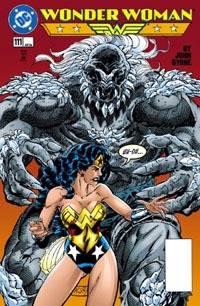
wonder_woman_0111Level 3

Writer/Artist: John Byrne
Colorist: Patricia Mulvihill
Assistant Editor: Jason Hernandez-Rosenblatt
Editor: Paul Kupperberg
Published by: DC Comics
Cover Date: July 1996
Cover Price: $1.95

This is the third issue of a story, and we pick up shortly after where we left off in the previous issue. Doomsday is on a rampage in Gateway City, despite the fact that–to the best of anyone’s knowledge–the creature was hurled into space some time back, never to return to Earth. As the creature tears up real estate, Wonder Woman is brought into the mix–interrupted from the advisory assistance she’s receiving in identifying the substance the fake-Flash and fake-Sinestro were made out of. Even realizing this is the creature that KILLED Superman, Wonder Woman doesn’t hesitate to engage it in battle. While taking her lumps, Champion joins in–though he takes a Supergirl-like hit that takes him out immediately. Seeking to aid her mentor, Cassie retrieves the Sandals of Hermes as well as an unknown artifact and goes to Wonder Woman’s aid. When she’s hit–and nearly killed–it distracts Wonder Woman enough that the beast gets the upper hand, and it looks like this might be game over for our heroine.

Three issues into the story and I’m enjoying stuff…and actually had to “force” myself to NOT dive straight into the next issue. I’m enjoying this story, the art’s good, and I just want to get more of everything. See more of Wonder Woman in action, see more of Cassie and get details of her background, as well as see more of the rest of the supporting cast–Cassie’s mom, Mike, Champion, Wonder Woman as Diana NOT in action…three issues in and this is simply flat-out an enjoyable book!

I had no idea just from the cover what the context of Doomsday’s presence was, but now having read the preceding issues and this one, the creature is a construct created by a computerized process controlled by the “consciousness” of someone’s son. The “clones” are created and programmed, and then let loose on the world, though Kris–who apparently died, but his consciousness was “saved”–can see through the constructs’ eyes. Even though it’s a “fake,” this Doomsday is quite powerful, and not “just” some run-of-the-mill villain, showing up and totally diluting the character. Flash-forward twenty years to present day, and the character is just another of Superman’s rogues–like Darkseid or Mongul. But in 1996, this was before The Doomsday Wars, so Doomsday itself was still an extremely rare villain to actually (or seemingly-actually) show up.

I like the cover (obviously), even though Doomsday is a bit “off” in appearance. This fits with the story, though, and so I can forgive it quite easily. There’s also something rather gratifying about seeing John Byrne handling the character–both from the writing side, and even moreso from the art side, as so much of the Superman mythos at the time of the Doomsday! / The Death of Superman was still closely, tightly tied to the foundation work laid out by Byrne during his tenure on the Superman titles.

This story started with level 1–The Flash, a hero–apparently accidentally causing damage. It continued to level 2 with Sinestro, a villain–causing damage but not outright killing anyone. Then on to level 3 with Doomsday and untold damage and destruction and death. Wonder Woman is facing one of the most powerful things she’s ever faced, and this issue ends trying to convince us of the bad place she’s in…but it’s a comic, it’s #111 where I know the series passed #200, and I don’t recall any other major “Diana-gets-replaced” type stories, so it’s a given she survives. Still, she and her fellow fictional chracters don’t know that as this ends, so it’s on to the next issue to see what comes of this build-up!

And once again, as noted before…EVEN THOUGH this is the third issue of an arc, it still reads like one could pick this up and be no worse off than I was reading the first part of the story. You’re thrust into the action, get a bit of context and new action, and a cliffhanger to lead to the next issue. One story, but each issue could pretty conceivably be someone’s first without them being as totally lost or “coming in mid-story” as one would be picking up the third issue of a present-day arc.

The ’90s Revisited: Wonder Woman #110

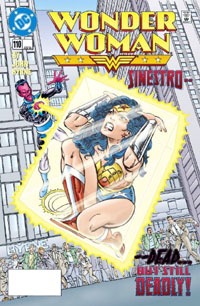
wonder_woman_0110Level 2

Writer/Artist: John Byrne
Colorist: Patricia Mulvihill
Assistant Editor: Jason Hernandez-Rosenblatt
Editor: Paul Kupperberg
Published by: DC Comics
Cover Date: June 1996
Cover Price: $1.95

This is only the “second” issue I’ve read in this particular set of issues, but I’m quite enjoying the title. Where the previous issue appeared to guest-star The Flash (only it turned out to be a fake), this issue has an appearance of Sinestro–who at this point in DC‘s continuity was dead, his neck snapped by Hal Jordan just before he went all Parallax and such.

We open on Sinestro/not-Sinestro carving up the city, trying to get Wonder Woman’s attention. Once he has her attention, they battle–or moreso, Wonder Woman battles him, and he just keeps on keeping on…at first seeming like a joke, then an actual-true threat. Eventually, it appears that Wonder Woman’s defeated, and a new guy–Champion–shows up, saving her…though he gets the same result from “Sinestro” as Diana had last issue with “The Flash” as we see that this is just some sort of construct that can self destruct into dust. While Champion (who has himself a back-burner subplot brewing that surely leads to something bigger down the road) and Diana puzzle over the similarities in the Flash attack and now Sinestro, as readers we’re given the inside scoop, as the scene shifts and contextual details are revealed…explaining the fakes’ presence and setting things up for the next couple issues.

As with the previous issue–Wonder Woman #109–I definitely enjoyed this issue. The story and art both worked well in and of themselves, and especially as a cohesive whole. With the same creative and editorial team as the previous issue, this definitely FELT like the next issue. No major changes, no weird oddities…it’s just the continuing story.

Perhaps by comparison to contemporary comics, though, this issue does NOT pick up 100% EXACTLY from the previous issue…it picks up as a “next chapter” without being merely the next chunk of story in a larger graphic novel being ‘serialized’…and I actually like that. I’m all for the singular story of a graphic novel…but for this being a “single issue” I like that–even as a continuing story–it maintains its identity AS the single issue.

The story in this issue fills us in as readers much more than the previous issue…this is where comics worked quite well in the ’90s as both ongoing sagas and having stories that can be collected into a “graphic novel” or such. We (I) had no idea any background on stuff in the previous issue–The Flash simply showed up, turned out to be a fake, and we’re left to wonder what the heck’s going on. THIS issue gives us the context and such on where not only The Flash but also Sinestro came from…and goes beyond that to show us the genesis of the threat for the next issue, serving as setup and cliffhanger, and getting to the last page left me quite ready to get to the next issue. Of course, it wasn’t surprise, as it’s the cover of the next issue that grabbed my attention to begin with.

Even though this is Level 2, a second chapter of a story (though perhaps not quite as solid/singular a story as I’d thought–though it plays into the genesis of these back-from-oblivion characters), one could conceivably pick up this issue and be just as good as starting with the previous issue. You get the characters, some context as you go through, and editorial notes to point you where to go for a bit more expansion of stuff touched on here.

It’s also EXTREMELY REFRESHING that there’s just the one cover, it’s (presumably, since there’s no separate cover credit provided) by the interior artist, so fits both visually AND exaggerates (slightly) a scene that actually appears in the issue, and is not merely some stock or “iconic” image that could be interchanged with any other cover.

First issue, Second issue (in this present read-through, it’s MY second), or just another issue if one is reading a run, this is a strong, solid issue well worth the 20 cents I paid for it!

The ’90s Revisited: Wonder Woman #109

wonder_woman_0109Level 1

Writer/Artist: John Byrne
Colorist: Patricia Mulvihill
Assistant Editor: Jason Hernandez-Rosenblatt
Editor: Paul Kupperberg
Published by: DC Comics
Cover Date: May 1996
Cover Price: $1.95

This is one of those ’90s issues that–while revisiting “the ’90s,” is a new-read for me. I’ve dabbled here and there through the years with this book–getting the odd issue because Superman’s on the cover, or something tied to a comic book course in college, or some cover grabbing my attention or there’s a chapter of a crossover I’m following. I jumped on the book toward the tail-end of Rucka‘s run in the lead-up to Infinite Crisis, and then followed for a few issues shortly after, but never stuck with the book for all that long. So while I can’t recite lists of characters–particularly the supporting characters–I’m at least “loosely familiar” with who Wonder Woman is, that the exact “who” she is has shifted a bit through the years, and I know OF some of the major story beats of her series.

So this issue opens with a flight passing over Gateway City, where the Lexair passengers are surprised at the random sight of a girl flying with winged shoes. As readers, we quickly learn that this is Cassie Sandsmark and those are the Sandals of Hermes, and she’s not exactly well-practiced in their use yet. Wonder Woman flies after, and the situation is soon resolved as Cassie figures out–a bit–what she’s doing, and the two get back safely to the apartment Cassie and her mom live in. They then prepare for an evening–Cassie is under Wonder Woman–Diana’s–care, and Diana has a “date” that’s not a date. Unfortunately, the Flash shows up and causes a lot of destruction to the buildings along the street the restaurant’s on and more than a little trouble for Wonder Woman. This isn’t Wally West, though, and when he bursts into dust, no one has any idea what he was or why he was there…leaving Wonder Woman with a mystery on her hands.

I bought a 50-issue run of this series, and one cover that REALLY stood out to me had some iteration of Doomsday on it, which had me quite curious–it’s not an issue I was ever consciously aware of back in the day, nor was it something I knew of AS a Doomsday appearance. Fortunately (or not, depending on perspective) I noticed the “title” of the issue included a “3,” so I checked the previous issue–that had a “2,” so I went back another issue–this one, #109–to find the “1.” I have no idea what happened immediately preceding this issue, nor do I recall what happens after. I’m nearly entirely certain this is AFTER “the Artemis” stuff when Diana ceded her role as Wonder Woman, so she’s “back in the role” now and things are moving along at a good clip.

Story-wise, we’re dropped right into the action, with no immediate context–just story. Being somewhat aware of stuff, I followed along without any trouble. I did not open the issue expecting to “know everything,” and so I was not disappointed. It’s like watching an early episode of some tv series from SEVERAL seasons earlier. I’d forgotten Byrne‘s run on the title, or that it was this early–what I DID remember made me think he’d started on the book more in the early 2000s, so that shows what I know.

Visually, I really enjoy his art here. It works very well with the story, and both Wonder Woman herself and the Flash look good…though through no fault of the art, Cassie does NOT look like I think of her from Geoff JohnsTeen Titans run…which makes sense, as this is from 1996, predating Young Justice by a couple years, and Young Justice itself ran several years before Teen Titans.

All in all, for an issue I had not planned to read, but ended up reading for momentary/immediate ‘context’ to the issue that actually grabbed my attention, I really enjoyed this, and look forward to progressing a couple more issues to the one I actually originally planned to read. This also bodes well for my enjoyment of the run, and of (eventually) filling in the gaps in my Wonder Woman run from the Perez “reboot” through Infinite Crisis.

The ’90s Revisited: Uncanny X-Men #308

uncanny_xmen_0308Mixed Blessings

Writer: Scott Lobdell
Penciler: John Romita Jr.
Inkers: Dan Green, Al Vey
Letterer: Chris Eliopoulos
Colorist: Steve Buccellato
Editor: Bob Harras
Published by: Marvel Comics
Cover Date: January 1994
Cover Price: $1.25

This issue brought back a number of fond memories, as well as a new feeling as I “noticed” the art rather consciously this time. Having this issue relatively on-hand for this reading is something I must credit to fellow blogger Chris Sheehan, whose comments/discussion of the issue prompted the purchase and encouraged making the time for the re-read. It was his post that prompted me to re-purchase the issue (for the convenience of immediate availability in print without digging through umpteen unorganized longboxes to locate my original copy).

For a single issue, there’s a lot packed into so few pages. Essentially, though, we have Scott and Jean–Cyclops and Phoenix–walking the grounds outside the X-mansion. For once, there’s no overt threat, no villain interrupting, the world-at-large doesn’t need immediate saving, etc. Just a young man and woman spending time together, enjoying cool fall weather (well, Thanksgiving Day) and doing so amidst a larger group also living on the premises. So we get a bunch of “moments” between characters…and while the couple reminisces, they also come to a decision about their future.

This issue is one of a handful of X-Men comics I recall from the early/mid 1990s where we basically just have the characters hanging out at the mansion, interacting with each other in down-time withOUT having to deal with some villain or crossover or whatever. And reading this in 2016 where every story is written for the trade, and every trade is part of some big event and every event leads into the next with no time between…this issue is highly refresshing. There just aren’t issues like this anymore (at least not from Marvel/DC!).

The story itself is very much what I prefer in comics, giving us the characters, “quiet” “moments” and generally giving us a glimpse of what these characters do, how they might interact when not in the midst of fighting for their survival. We get to see them presented as actual people…which makes them that much more truly relatable (at least, to me!).

I remember thoroughly enjoying this issue over 20 years ago…and I enjoyed the story now. Unfortunately, while I don’t recall noticing the art–back then, if I did it didn’t throw me–but this read-through I REALLY consciously noted the art…and between this and bailing on a Superman story some time back for so disliking the art, I must conclude that as a general thing I dislike Romita Jr.’s visual style. There’s something to the style–sometimes a sense of sketchiness, other times something to faces and lips particularly that just doesn’t work for me and proved flat-out distracting to me, taking me out of the story itself. Which, while a complaint that I have, myself, is not to suggest the art is bad…it’s just definitely not to my taste, and it now being a conscious thing, it’s something I can watch out for.

And then, regardless of the linework and such itself, I had consciously forgotten (but hey, deja vu or such!) how much I dislike the flipping and flopping one must do to read certain ’90s comics, when the artists played fast ‘n loose with the “traditional” comic page and layouts. Some pages read fine, but rather than just varying panels across one or two pages, where one can just page through the issue with a single physical orientation and be fine…here, we’re given some instances with a double-page piece where you have to turn the comic sideways for a top-to-bottom experience with the issue physically turned sideways; others where the issue must be turned on its side for a then-typical left-to-right experience, and so on. Rather than being able to just lay the issue flat and page through, reading, while say, eating a bowl of cereal as breakfast it requires an active, physical experience of manipulating the book, which gets distracting and kicks one out of the story.

All in all, though…this is an excellent X-Men comic that I paid less than $4 for, and got so much more from it than any $3.99 new comic I can think of. If you know your X-Men and enjoy such stories, or have never read this, I’d urge you to give it a shot, if you can get the issue for (or less) that $4. If you find it in a 25-cent or 50-cent bin, all the better!

The ’90s Revisited: Superman #112

superman0112Superman’s Ex-Girlfriend Lois Lane

Writer: Dan Jurgens
Artists: Ron Frenz and Joe Rubinstein
Lettering: John Costanza
Colorist: Glenn Whitmore
Color Separations: Digital Chameleon
Editors: Mike McAvennie and KC Carlson
Published by: DC Comics
Cover Date: June 1996
Cover Price: $1.95

This issue originally came out during a year or so that I’d stepped away from (Superman) comics. For whatever reason(s) I recall basically leaving off with the end of The Trial of Superman, checking in briefly for the Wedding Album issue, and then returning for the start of the "Electric Costume" stuff. So I’d actually missed this whole half-year/however-long "arc" where Clark and Lois had broken up.

And I guess that’s the thing for this issue: it kicks off the "breakup" arc, and the cover caught me this time about the way it did fifteen or so years ago when I originally filled that gap in my runs on the Superman titles.

Superman deals with an attempted prison break, and then he flies Lois to Mt. Fuji for some alone time to talk about where they’re headed. Unlike the previous time they did this, there is not a happy resolution, as Superman is pulled away to save lives, and Lois’ "point" is essentially proven–that Superman is "on call" more than even a doctor or fire/policeman, and "belongs" to the world more than he ever can to one individual.

The issue’s art is good overall, though the "tease" from the cover constrasts sharply with the bulk of the issue’s art. Reading this issue out of context and as a one-off thing, I’m not overly thrilled with the art compared to plenty of other instances I’ve loved art on a Superman book. However, that’s personal taste in general and not reflective of the quality of the art. This brings back plenty of memory for me of this period in the Super-titles, when they were basically a weekly book with a rotating creative team. There’s no "previously…" page, but as a weekly ongoing thing, there wasn’t really much need for one…I suspect one would have been reading ALL the Super-titles or none; as one of the former, I can’t imagine being able to stick with any single Superman title without the others.

Story-wise, this is a Jurgens issue, and by his name alone I’m pre-disposed to like this, given I tend to really enjoy any/all stuff he did with Superman (and to a degree, still does). This issue certainly is not a chunk of story totally in a vacuum for me–I am very much aware of (roughly) where this is situated in stuff–shortly after The Trial of Superman–and recalling the months-long arc of Superman and Lois "separated" and such, so I don’t have that sense of "what the heck was just happening???" heading into the issue, nor do I have any sense of "what comes next?". That we get some pages of Superman/Clark and Lois talking about things, a sense of what both are feeling, and (Clark especially) going through, this is a heartbreaking kinda story if one appreciates the characters and continuity from the mid/late 1990s.

The cover is what grabbed me for this particular purchase, and the memories it evoked–both with having part of the original image from Superman #59, as well as the first time I’d read this particular issue.

All in all, this was very much worth the 25 cents I paid, for the convenience of an immediate re-reading. As with too many comics I presently own, this was a "convenience purchase," as I already own the issue at least once if not twice over, and would just prefer at the moment to pay the 25 cents over digging through umpteen boxes to try to find it and pull it. (Plus, doing that is something different than grabbing a "random" ’90s issue out of a quarter bin.

I’d love to do a full, large-scale reread of ’90s Superman issues…but for now, I’ll content myself with sticking to occasional quarter-bin finds like this.

The ’90s Revisited: The Flash #142

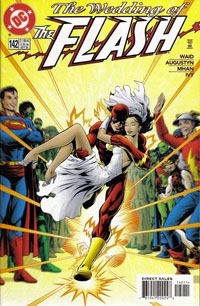
flash0142Get Me to the Church On Time

Writers: Mark Waid, Brian Augustyn
Pencils: Pop Mhan
Inks: Chris Ivy
Letters: Gaspar
Colors: Tom McCraw
Assistant Editor: L.A. Williams
Editor: Paul Kupperberg
Published by: DC Comics
Cover Date: October 1998
Cover Price: $1.99

This is one of those issues whose cover served as an extremely powerful selling point: “The Wedding of The Flash.” OK. I knew Wally and Linda were married…and that it happened SOMETIME before #200, as that was about the time their kids were born, and I was pretty sure they’d been married awhile prior. So spotting this in the quarter bin without any significant “run” to grab, I still figured it would be a good one-off/isolated issue to read.

We open on Wally dealing with Kobra and his crew, and find he’s got a very personal stake in dealing with the current situation: the terrorists are quite inconsiderate, after all, attacking on his wedding day. Linda and Wally put the last-second finishing touches on wedding plans as Linda’s family arrives. While things get into motion for the wedding, Wally can’t quite shake the feeling that something’s wrong or forgotten. The Justice League arrives, and there’s still no villain attack to disrupt things…as Wally and Linda get a moment to confirm they’re going through with the wedding. As the couple prepares to deliver their wedding vows, Wally realizes exactly what he’s forgotten: writing his. Of course, he doesn’t need to write them–he just reflects quickly on their time together, what they’ve been through–and he’s good. As he slips the ring onto Linda’s finger, there’s a flash of light, and he’s alone with no recollection of Linda’s existence nor that they were at the altar to be wed…while a mysterious figure looks on as Linda screams for help.

As said, the issue’s cover grabbed me. This is “THE” wedding issue. Great, ok, cool. Regular-sized, nothing fancy, just a one-issue key moment, something that happens, but while the same length as any other moment in time, is still one of those key moments one can go back to. Right? And being so used to covers “spoiling” otherwise ‘surprise’ villains or guest-stars, giving away what the issue is about (yet, the cover DOES have to “sell” one on buying the issue if they aren’t already planning to, and I’m certainly guilty of disliking generic, unrelated covers)…I figured I knew what this issue was, and was just going through the motions reading/enjoying the story, but I wasn’t expecting to be surprised. But surprise me it did, and now I very definitely want to read more.

The story itself is very good, mixing “regular” super-speed action letting us see the Flash do what he does, and that not EVERY threat has to be spread across exactly six issues of formulaic structure for a graphic novel collection. Some threats can be handled in a few pages to move the story along. Also signifying this being from an age when there were no routine collections of every half-dozen or so issues, the credits page is worked into the story itself somewhat cinematically–or at least, in a “tv” sort of fashion…showing the Kobra attack to be mere prologue to fulfill our expectation of the Flash in action in-costume and allowing the rest of the issue to focus on Wally, Linda, and co. for the wedding itself. Working other key characters in–like Impulse and Nightwing were nice touches, and though I’m more aware of than familiar with Bart, I appreciated the bit with him and seeing dynamics of “the Flash Family” that I’ve often read of but read very little of myself as yet.

The art is good, and really never left me wondering. It’s not my favorite visual style, and is rather “isolated” here as I’ve not read any significant runs on this title in probably almost a decade. I’m sure I’d appreciate it more in context, and assume it’s consistent with surrounding issues. Where varying visual styles play on actual memory for me with the Superman family of titles, I don’t have that for the Flash, which for every issue of the title I read makes me further regret never jumping in back in the ’90s when these were fresh, current, ongoing episodes of the character.

Despite mentioning “isolation” above in regards to finding this issue and how I see the art on it…the issue on the whole is not the quasi-self-contained or isolated unit I was expecting. I thankfully never got the sense that I “should have” read the previous issue to “get” what’s going on here, so it’s easy to jump INTO…but it certainly doesn’t have a hard-stop point to conclude, and successfully leaves me eager to read more, to find out who the mystery-villain is, to see how Wally and Linda get out of this mess…find out if this truly IS “the wedding issue” or if that “moment” occurs down the road in another issue, etc.

For a one-issue quarter-bin find, this issue was more than worthwhile, and I thoroughly enjoyed it, and would (in retrospect) gladly pay several dollars for it (though for bulk/quantity I’d prefer to get to load up on the series from quarter-bins!).

The ’90s Revisited: The Flash Plus #1

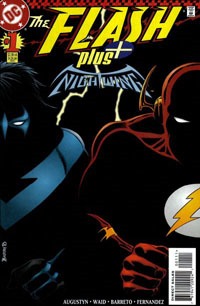
flashplus0001nightwingThe Flash + Nightwing: Doorway to Nightmare

Story: Mark Waid and Brian Augustyn
Pencils: Eduardo Barreto
Inks: Gerry Fernandez
Letterer: Gasper
Colorist: Ian Laughlin
Assistant Editor: Jason Hernandez-Rosenblatt
Editor: Paul Kupperberg
Published by: DC Comics
Cover Date: January 1997
Cover Price: 2.95

I’ve seen a number of these Character Plus+ issues through the years…acquired some myself, even…though I don’t know that I’ve ever actually gotten around to reading any. But being in a Flash mood recently, and this being extra-sized as well as knowing it “had to” be more of a one-shot, it was something I knew immediately would be well worth a quarter, fishing it out of a quarter bin.

Wally and Dick are headed out on vacation. Dick’s a bit peeved that Wally yet again failed to do the planning for their vacation, so he had to make all the plans/arrangements. And Wally–impatient as always–is not happy being stuck in a car to make their way to a destination rather than being able to simply run under his own speed. The two arrive in New Orleans at a haunted house/attraction…and though Wally couldn’t see how there’d be anything special to it, the two soon find themselves up to their necks in trouble. They ultimately uncover plans of an alien invasion and must work together to stop it, beat back existing aliens, and save the world.

…Which is a really simplistic summation of the issue, considering its extra size. But I’m not writing this as a wiki piece of the issue–this was yet another of my embracing a ’90s comic and enjoying it.

With The New 52 having done away with the DC Universe I grew up on several years ago, and Wally being sidelined for years before that, I’d forgotten about the friendship he and Dick shared. Both started out as sidekicks (Robin and Kid Flash), both “graduated” into their own identities–Dick as Nightwing, Wally embracing and living up to his part in the Flash legacy), both are now (at this point in the continuity) adults, and there’s that sense of history and friendship with them…at least from my knowledge of the characters.

The cover is rather generic…yet I definitely enjoy it. I like the shadowy effect with mostly-black, but the lightning in the background showing us key parts of the characters and their costumes so we know who they are. I’m pretty sure genuine lighting doesn’t work that way in actuality…but the effect for this image is plenty cool enough for my eye! I also like the quasi-“grid” effect at the top…whether it’s supposed to be part of the logo or not, it reminds me of classic DC covers in a very subtle way.

The art on the interior is quite good, and I enjoyed it. It was solid, conveying what needed to be conveyed, and never particularly took me out of the story; there were no pages that left me curious about creative human anatomy or if I missed something, and so on. Truth be told, I actually hardly noticed it, which is how I’d prefer: I should enjoy the story in general, and not be relying on the art to carry a poor story nor be taken out of a good story by poor art. I’m not yet familiar enough with this period of The Flash or Nightwing to know offhand if Barreto is the “regular” artist for either character…but while specials and annuals can often have the “look” of being just some random story or fill-in with a non-series-regular artist, this issue did not have that feel for me.

That this issue IS basically a one-shot and not part of a crossover, longer story, event, or so on nor an Annual for either title, I don’t think we’d get something like this today. A single issue playing well within what I’m aware of continuity-wise with both characters, yet doesn’t rely on an individual/ongoing story for either nor require reading of both titles…and lacking a specific-arc tie-in and not ending with a lead-in to some other story…this is a unique piece of history, and an issue well worth its cover price.

Some of the quality probably does come from this being written by Waid/Augustyn–names I’m starting to notice repeatedly cropping up together, though I was already aware of Waid‘s significant (and highly-praised) run on the Flash title. This one issue gives us a good beginning, middle, and end; as well as giving insight into both characters, while sticking primarily with the Flash (Nightwing IS the “plus” after all, not the headlining character).

In an age of $4 comics, where I got to buy and read this for 1/16th that price, by default the issue is very much worth what I paid for it. Even at full cover price, though, this issue would seem to me quite worthwhile compared to a modern issue, and “experiencing” the quality of the story from nearly two decades ago for myself continues to build my interest in reading “classic” Wally West Flash stories, and put shame to the notion of all ’90s comics being crappy stories and periods for characters.