• March 2026
    S M T W T F S
    1234567
    891011121314
    15161718192021
    22232425262728
    293031  
  • On Facebook

  • Archives

  • Categories

  • Comic Blog Elite

    Comic Blogs - BlogCatalog Blog Directory

Showing Off the Shelves: Superman (November 2016)

My collection is constantly growing and shifting, with gaps filled in here and there, a new/superior or preferred edition replacing another, and so on.

I have a large DC collection overall, though primary within that are my Superman, Batman, and Green Lantern collections. I think from there it drops down to The Flash and then the remainder of DC stuff and events.

Today, I’m showing off my updated Superman collection!

superman_shelves_early_november_2016_a

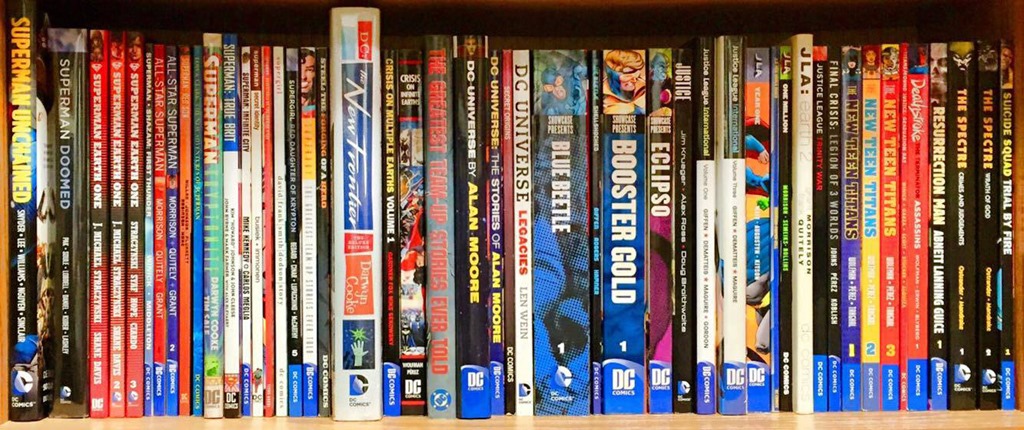
I start the section with the two Archives volumes I have, and then other general/history-spanning volumes. Then the Superman Chronicles of the Golden Age stuff, then the Showcase Presents kicking off the Silver Age/Middle stuff; the "themed" volumes, then the Superman vs. _____ books; several other collections, to Whatever Happened to the Man of Tomorrow? Kicking off "my" Superman we have the World of Krypton and The Kents, both (to my understanding) taking place before we jumped in with the Byrne reboot. Then For All Seasons as a general beginning/Year One/Origin thing. Next, the Man of Steel series collecting the entirety (I believe) of the Byrne run. I have stuff as much in order as possible from there; roughly publication order, working within existing structure.

superman_shelves_early_november_2016_b

We quickly get into the Death of Superman stuff, and the few volumes of stories after, before jumping to the weird semi-complete-ish (sorta) run of stuff from 1999-2001ish with the numbered Superman volumes (and Emperor Joker) to Our Worlds at War, the "new" "origin" in Birthright, and then stuff from around Infinite Crisis and into the New Krypton era, Black Ring, skipping the New 52, and I’ve got the Superman: Lois and Clark volume here. I have my Death and Return of Superman Omnibus as a "divider" to other quasi-miscellaneous stuff–the Superman: Doomsday tpb, the Gil Kane and Jose Luis Garcia-Lopez volumes, then what I have of the various Superman/Batman collections.

While I’ve no significant interest in the older, incomplete "omnibus" that had a lot of the Death/Return stuff, I do also have my original volumes collecting the stories, including several editions of the Death of Superman volume itself–the original edition, the updated edition, and the hardcover edition they put out "recently" for the Book/Blu-Ray/Digital combo packs.

superman_shelves_early_november_2016_c

Spilling onto a third shelf, my two Superman hardcovers from the New 52 era–Unchained and Superman: Doomed. From there, the Earth One volumes, All-Star Superman, and other semi-isolated volumes into Supergirl and Superboy stuff, before getting into general-DC Universe stuff.

superman_shelves_early_november_2016_figures

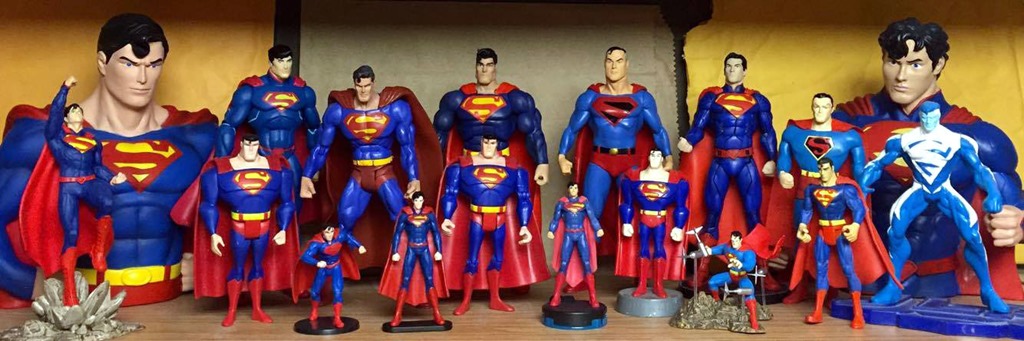
And while showing off "the Superman collection," I can’t leave out the shelf of 3D depictions of the character!

Of course, this is a "snapshot" of the collection at present–I have several figures packed away from moving; and several paperbacks have gotten shuffled around and pulled and not re-filed to read…and there are plenty of others I’d like to get as able.

But for now, November 2016, this is the core of my bookshelf-able Superman collection!

According to Valiant, the Comics Industry Isn’t Built for Comics to Have Only 1 Cover Per Issue

I’m rather dismayed at information I was given–by an industry professional–over the weekend.

I rail against variant covers, as probably any reader of this blog knows. But now I have it from a major figure of a fairly major publisher that apparently, the industry is NOT BUILT FOR NON VARIANTS.

Saturday, I read an article on Bleeding Cool about Valiant‘s latest stunt–a game of collect-and-clip-coupons-to-mail-away-for-a-super-special-limited-edition isue–and I tweeted a comment referencing the Valiant language of the stunt being a "tribute" to the 1990s coupon promotions:

//platform.twitter.com/widgets.js

Not long after, to my surprise, I received a response:

//platform.twitter.com/widgets.js

I followed up, as that answer does not sit well with me AT ALL:

//platform.twitter.com/widgets.js

I continued:

//platform.twitter.com/widgets.js

And I received these followups:

//platform.twitter.com/widgets.js

//platform.twitter.com/widgets.js

//platform.twitter.com/widgets.js


I am not, myself a publisher; I am not involved in that part of comics. All I know is as a fan, a customer, someone who BUYS comics, and has been REPEATEDLY "burned" by the use of variants and stunts involving the intentional screwing-over of longtime fans in interest of a short burst.

I think it’s a bunch of crap that the industry "is not set up for that" [doing only 1 cover per issue].

THAT ALONE shows me the short-sightedness and HUGE PROBLEM with the comics industry. For a publisher to feel that they CANNOT POSSIBLY go with ONLY ONE COVER for a SINGLE iSSUE of a serialized comic book?!?

Does that mean that the material is NOT QUALITY, and can ONLY sell well enough to BE published by forcing people to buy MULTIPLE COPIES of an issue? (Why not just double or TRIPLE the price, and insert an extra full-page image and 3 more ads in the back?)

"Trying 1 cover with Mirage" suggests (to me) a lack of commitment. It’s not like that’s a top-tier primary character from the publisher…so it’s not going to sell as well ANYWAY as, say, a more recognized property like X-O Manowar. So it’s tried with one issue (or 4 or 5, the entire mini-series?) of one series. That’s hardly lengthy enough to get the idea out there that quality stands on itself instead of just not selling as many copies as a bigger title that IS using variants.

IF variants were truly limited solely to A/B 50/50 1:1 individually-orderable status, I still don’t like them, but those sorts I can sort of overlook. But it’s the ratioed variants that cause me the most frustration; the 1:10 and 1:25 and 1:50, with the worst offenses getting up into 1:100, 1:500, 1:1000 levels, to list a few (and without getting into specific Marvel numbers/hoops I’ve seen referenced, say, by Brian Hibbs in his Tilting at Windmills columns)

But both Valiant and Boom! have earned my ire (and specific avoidance + loss of existing purchasing in protest) over the variants and ratio-based shenanigans.

I just have a really hard time getting my head around the notion that the industry is so ****ed up that supposedly it can’t support comics being published and standing as themselves, without Every. Single. ISSUE. having at least one variant!

I guess I’ll be "interested" to "see" what "initiative" is being done for X-O Manowar, though at this point, it being Valiant, the publisher that is going back to making people clip coupons out of an issue and pay to mail those and shipping expenses to receive some "special edition" issue, and the publisher that sought to force longtime, loyal customers into being Valiant salespeople if they wanted to keep up with the "full story" of the comics universe…I can’t say I’m expecting all that much.

Given I’ve seen numerous comic shops with multiple longboxes full of nothing but "variants"–an ENTIRE IN-STORE CATEGORY–obviously (to me, experientially) that means it’s NOT LIKE they’re ALL SELLING. SOME people MAY "like them," but not enough people to buy them all!

And *I* think that if publishers would just give the darned things A REST and STOP IT for several months, take the "hit" of "lower profits" for the short-term, it might avoid as much likelihood of a bomb-out like the ’90s.

That the entire viability of a publisher is predicated on variants, as if it’s an unconscionable loss to not use variants on every issue, makes me an official subscriber to the notion of the industry being in trouble.

But hey, that must mean that I am just old. That I am not the target audience. Comics are no longer for me if I’m not willing to change and embrace the trend(s), right?

Well, dear publishers (not just Valiant), where IS the mythical "new audience," the huge influx of "new readers" and such? When comics are among the worst value in entertainment, frustrating the people who overlook that week in and week out is (to me) not the best of plans.

harbinger_renegades_coupon

The ’90s Revisited: Lord Pumpkin #0

ultraverse_lord_pumpkin_0000The Return of the Great Pumpkin

Storyteller: Dan Danko
Illustrator: Aaron Lopresti
Finishers: Gary Martin, Aaron Lopresti
Letters: Gail Beckett
Color Design: Micky Rose
Interior colors: Foodhammer! with Sharleen Gaertner
Editor: Roland Mann
Published by: Malibu Comics
Cover Date: October, 1994
Cover Price: $2.50

Happy Halloween! For this day, I figured I’d post about one of my favorite "Halloween-themed" characters… Lord Pumpkin! (Even though this totally jumps the gun on an "eventual" Ultraverse reading project).

And why not just cover an entire issue devoted to the character as my means of doing so?

Much as I enjoy the character/concept (if only for the sheer visual ridiculousness), I still have a huge blind spot in terms of concrete comic knowledge of the character and events involving him, outside of a slight memory of the character being featured on the Ultraforce cartoon series, and sharing a "flipbook" for three issues of NecroMantra before the two characters’ stories collided in NecroMantra #4.

But that gets ahead of things a bit.

This issue opens with a pumpkin-headed (or rather, Jack O’Lantern-headed) character arriving on Earth, seemingly with no memory of who or what he is. We then flash back to the GodWheel where we witness a band of fighters seeking to take down the Pumpkin King. On Earth, we see the character essentially "enslaved" by a traveling carnival, and befriended by a young boy. Another player enters the scene, looking to stir up some mischief, providing the boy with a special candle for his pumpkin-headed friend…which leads to a sort of awakening. Ultimately, we see the fate of the fighters and their simultaneously doomed attempt on the evil king’s life as well as said attempt’s impact on Earth, and we see our abused character exact a certain key revenge for his imprisonment…while getting some foreshadowing for the sinister, recurring nature and visual iconography of Lord Pumpkin.

To the best of my un-confirmed, un-researched knowledge, this issue was a one-shot, providing us with a Lord Pumpkin-centric story giving some background on the character–where he came from, who/what he is, and all of that…an "origin story" of sorts. (Yet with the aforementioned NecroMantra flip-book, and a Limited Special Edition variant, one can functionally have Lord Pumpkin #s 1-4 in addition to this #0).

I enjoyed this well enough as a standalone special. We’re introduced to the character, given some background, witness some developments that’ll likely factor into the character’s position as a villain of the Ultraverse, and get a conclusion (while stuff’s left open for later stories). While the character concept is rather ridiculous–a villainous Jack O’Lantern with a human body?–it works, and I am more than willing to suspend disbelief regarding the character. Of course, certain factors that one might question with the character–particularly the pumpkin-for-a-head–is actually dealt with in context of the character/story, and makes for an interesting element for the "villain is seemingly killed but we still know he might be back" trope.

Story-wise in itself, I’m not overly impressed…but then, for a single-issue self-contained thing with a character I recognize more than I "know," and lacking other immediate/conscious context, I don’t supposed I should be. Still, it’s a solid issue and a complete story in itself…serving both as a one-off tale and situating the character within the then-current Ultraverse line.

Visually, I really dug this. The art seems at once simplistic in a way, yet rather complex…and looking at it, it just feels like an Ultraverse comic. It does not look out of place for what memories I have of the line. I was rather interested at realizing Lopresti did the art here, recognizing his name from later Marvel and DC stuff, and not remembering that he was involved in at least this issue of the Ultraverse.

ultraverse_lord_pumpkin_0000bAlong with the "main" cover, there’s a cool variant (I can’t believe I just said that, but I’ll get into the subject of Ultraverse variants in another post) that is also quite fitting for Halloween, and I’m glad to have BOTH.

While not AS "special" as, say, a mail-away special (Ultraverse Premiere #0, Rune #0, The Solution #0) this is still a worthwhile issue to get if you come across it in a 25-cent or 50-cent bin. It stands alone as a self-contained story, but should provide additional complex if you’ve come across the character in other issues…and sets the character up for appearances in later Ultraverse comics (there’s an ad in this issue for the GodWheel mini-series that Lord Pumpkin gets a role in).

I found it rather fortuitous the timing of going through my Ultraverse comics and realizing I had just the time to get to this issue for Halloween.

Sad thing (to me)? I wasn’t yet 13 when this issue was new…yet with an October 1994 cover date, this issue is now 22 years old!

The ’90s Revisited: Wildstorm Chamber of Horrors #1

wildstorm_chamber_of_horrors_0001Warblade
Story: Ron Marz
Layouts: Bernie Wrightson
Finished Art: Alex Bialy
Colors: Lee Ann Clark
Computer Color: Ominous Color

Lord Emp
Story: Steven Grant
Art: Trevor Scott
Color: Gina Going
Computer Color: Quantum Color

Tapestry
Story: Merv
Pencils: Jason Johnson
Inks: Chris Carlson
Color: Monica Bennett
Computer Color: Ominous Color

Savant
Story:
Jeff Mariotte
Pencils: Tom Raney
Inks: Al Vey
Color: Gina Going
Computer Color: Ominous Color

Framing Pages
Pencils:
Aron Wiesenfeld
Inks: John Beatty, Alex Garner, Al Vey
Color: Monica Bennett
Computer Color: WildStorm Effects, Ominous Color
Production: WildStorm Effects

Letters: Chris Eliopoulos
Cover: Simon Bisley
Pinup: Jeff Rebner & Richard Friend
Editor: Jonathan Peterson
Editorial Coordinator: Amy Zimand
Cover Date: October, 1995
Cover Price: $3.50

Well, that’s an extremely long list of creator credits for this issue! For purposes of this post, I suppose that’s my fault, as I’m not breaking them up for individual-segment thoughts on writing/art/etc. Because while I read the issue, I quickly realized it’s a collaborative one-off piece…essentially a bunch of characters coming together, hanging out, exchanging stories while doing so…and different creators handling the different parts that are then stitched together into this single comic book.

I found this issue in a quarter-bin, and the main reason it even caught my attention was the "generic" Wildstorm in the title…then drew me in with the Chamber of Horrors bit. Hey, Halloween is almost here, and I haven’t acknowledged October. So I’d thought ok, I’ll get this issue, and maybe read it in time to do a post before Halloween. So here we are.

I know the "high points," or the "bullet points" of Image in the ’90s…and largely consider (personally) that most of what gives "The ’90s" a bad rap in comics IS the Image stuff. And while there’s some nostalgia for me, I’ve yet to really dive in and erase the blind spot so much of ’90s Image still has for me. That said, or as such…I’m not all that familiar with characters in this issue…very few by name, just looking at them. I recognize a few, and a couple others sort of look familiar…but this is a jam piece I fail to appropriately "appreciate," I’m sure.

This issue is–as said–a "jam piece," with 5-6 "creative teams" involved in multiple segments that collectively make up the issue. At its core, characters come together and wind up in their own space at a party, but outside of "authorized space" at the museum that’s hosting them, and are free to tell stories amongst themselves that would not work for a general public. So the characters swap stories about horror situations they’ve found themselves in–from dating/making moves on a body possessed by spiders, to experience with the Salem Witch Trials, to a mirror that led to horrible versions of what should have been one’s best dream.

As a whole, this issue was entertaining enough. Reading it, I simply breezed through–I noticed the visual changes, but the story overall seemed relatively seamless…or at least, nothing jarring that didn’t mesh with the other parts. As said, I’m not familiar enough with any of these characters or individual series to come to the table with any real expectations, so stuff really just "is."

The art’s not bad in and of itself…though I really "see" a lot of ’90s Image in the stuff (considering this IS "’90s Image," that’s to be expected!). For a 25-cent purchase that I had zero real "expectation" for going in…I honestly enjoyed the issue, and it was worth the purchase and reading. Despite the title, and the cover, other than it incidentally being the characters gathering around a Halloween party, this could be "any time," just messed-up situations or "out there" stuff.

I never knew this issue existed, nor sought it out. I wouldn’t say it’s really anything to go to great lengths to acquire…but it’s worth a 25-cent purchase/read-through, and can serve (at least visually) as a sort of "sampler" of stuff being put out at the time.

There’s an ad in the back of the issue for a $30 "chromium" poster version of the cover…which makes me wonder if there might be a "chromium" version of this issue out there somewhere. If there is, I obviously haven’t seen it. The cover image gives me a bit of deja-vu…so perhaps I’ve seen it before without consciously taking it in; maybe I’ve seen the poster; maybe just the ad. (Or perhaps there’s some promotional trading card from Wizard with this image on it that I’ve seen).

Though titled Chamber of Horrors…you could definitely find worse horrors than this issue.

The ’80s Revisited: Crisis on Infinite Earths #12

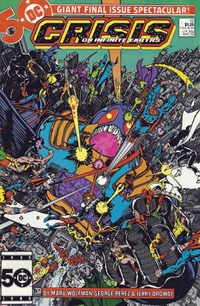
crisis_on_infinite_earths_0012Final Crisis

Writer/Editor: Marv Wolfman
Co-Plotter/Penciller: George Perez
Embellisher: Jerry Ordway
Letterer: John Costanza
Colorist: Tom Ziuko
Published by: DC Comics
Cover Date: March, 1986
Cover Price: $1.25

This is a large, convoluted issue with way too much going on to really summarize and address in any great detail in the general length I allow myself, and to do so without having to go into a lot of detail. Essentially, an infinite multiverse has been condensed down to one universe, though a bunch of heroes from parallel universes remain, having been outside time when that consolidation occurred. They’re split up to address issues on multiple fronts…namely the Anti-Monitor. Said villain just refuses to go down and STAY DOWN, rising multiple times from seeming defeat. In the course of this, a number of elements get loosely addressed, we have some characters killed off, others get a sendoff, and others simply get brief appearances with loose/quick details "setting stuff up" for moving forward (such as Wally learning of Barry’s death and becoming Flash instead of Kid Flash).

While I tend to like and appreciate Wolfman‘s art, and certainly enjoy Perez and Ordway both, reading this issue was a chore. I first read it about a decade ago–sometime around Infinite Crisis, if I recall correctly–having "finally" sought out the collected volume to actually read the "original Crisis" for myself given its 20-year anniversary had cropped up with a "sequel" of sorts (yet, amazing to consider yet another 10 years have passed and we’ve had a 30-year anniversary edition!).

Given what it is, and dealing with an entire universe and wrapping up stuff from a year’s worth of issues and all that, I have no real problem with the story…it’s just dense and seems like it has a huge amount of ground to cover in its limited pages despite being an extra-sized issue.

The art, of course, is fantastic–Perez and Ordway teamed up? Doesn’t get much better than that!

The creative team as a whole packs a heckuva lot into this, which I do like; but I can only imagine what I’d feel about it if it were a brand-new issue in 2016.

While we do have the "ultimate defeat" of the Anti-Monitor in this issue and a bit of an epilogue explaining a few things, overall this issue itself caps off the series, and I feel like I missed a lot by not reading the previous couple issues, and lost the scope or "epic-ness" of the story jumping in on this alone. As the story has been a "complete, full story" for three decades, I don’t think I’d recommend this as something to just sit down and read as an isolated issue. It’s sort of neat to flip through and see just the isolated chapter rather than the final segment of pages in a collected volume…but I think Crisis works much better read as a whole than just grabbing an issue.

For a 25-cent issue, it’s not a horrible read…but there’s certainly a lot of nuance that I am not picking up on given the decade’s space between this and when I last read the earlier issues.

Old-School Variance: Superman #75

I’ve often referenced it, but rarely had actual "live" photographic example to illustrate the point.

I do not consider 1990s "Collector’s Edition" and "Newsstand Edition" comics to be variants. Technically, I’ll give you that they are variants–one issue with two (or more) different covers.

Perhaps it’s that typically there would be two covers, and two covers "only" in such cases. There was also the notion of the selling channel–one version was intended for the "direct market" (comic shops) and the other for standard newsstand distribution. Also the fact that they were equally orderable by a shop–no "regularity" of 1:10 or other worse "ratios" on ordering and the other ridiculousness seen today. (special cases such as "platinum" or "gold" editions could be an exception, but those tended to seem truly "special" compared to 2016 1:50 or 1:100 or 1:500 or 1:1000 ratios!)

Back in 1992, there was the cover image. This is what people were looking for. They’d seen the image on tv, in the newspapers, in magazines, etc…so this is what they were looking for; and it was the content of the issue, the "event" of the story that was key, not which of fifty dozen alternative covers you had.

superman_0075_all_4_printings_newsstand

The variance (as opposed to variants/multiple editions) of the Superman #75 covers is due to the multiple print-runs. You have your standard first print; and then for later printings, rather than taking interior art or additional artists, the color of the Superman logo and text The Death of Superman! was changed, and a small Roman Numeral was added to the cover copy to clearly indicate which printing the issue was. (I recently came across at copy of The Killing Joke that I had and couldn’t find anything saying which printing it was…I finally realized/remembered that which printing is indicated simply by the color of the book’s title and the cover price). That’s part of why the issue(s) are so clearly "iconic" and memorable…they’ve not been diluted by umpteen hundred different images for just one issue.

It’s occurred to me that there’s likely additional variance–the UPC box. In my photo here, the first print has an actual bar code…while printings II, III, and IV have the creator credits (these are direct market copies of the "newsstand edition.") I also make a distinction there–bar code vs. not–I consider the same. I’m not actually sure if the later printings have a version with the bar code, or if the later printings were comic-shops-only (newsstands perhaps having gotten the first printing only, and anyone else had to go to the direct market?)

Anyway…the ultimate point of this post is the photo; that these are 4 different versions of the same edition of the same issue, just produced as separate print-runs. Yet same cover image, still instantly recognizable as the same issue, despite not all being printed at the same time.

The ’70s Revisited: Action Comics #428

action_comics_0428Whatever Happened to Superman?

Story: Cary Bates
Art: Curt Swan and Murphy Anderson
Editing: Julius Schwartz
Published by: DC Comics
Cover Date: October, 1973
Cover Price: 20 cents

The Plot to Kill Black Canary!

Story by: Elliot Maggin
Drawn by: Dick Giordano
Edited by: Julie Schwartz

GBS has had a new satellite launched. Superman flies into action to stop a fire raging far above easy reach of firemen, and conveniently (and extremely quickly) locates and flies in an iceberg, melting it with his heat vision to put out the fire. But the world sees just a storm cloud and rain. As Superman investigates this phenomenon, he becomes aware of the fact that everyone believes Superman hasn’t been seen in ten years–even going so far as to (as Clark Kent) do a shirt-rip on live TV…but all anyone sees is Clark revealing an undershirt. Of course, the real villain turns out to be Lex Luthor. Luthor mouths off, revealing his plan when Superman poses as a newly-assigned inmate occupying the "empty cell," convincing Luthor he’d been double-crossed and had himself been "forgotten." All’s well that ends well, right?

Meanwhile, in the Green Arrow (and Black Canary) portion of the issue, we see Ollie on the phone, declaring "Listen, Trump–when Ollie Queen says his Public Relations Agency will make your motorcycles sell…they’ll sell!" He then springs into action, recruiting Dinah Lance (aka Black Canary), and convinces her to participate in a stunt for a commercial. Later, Ollie’s made aware of a planned attempt on Dinah’s life, so he goes back into action and saves her (though she’s not at all happy about it, as he should’ve just told her what was going on). Again, all’s well that ends well, right?

Visually, this issue simply "looks like" one of Grandpa’s comics. And I’m pretty confident that that literally is what this one is–one of Grandpa’s comics, from back in the day, that somehow got mixed into stuff that wound up in my family’s garage, where I found it recently.

And that obviously makes sense–Curt Swan? Murphy Anderson? Dick Giordano? Big names I recognize from the time period and associate (particularly) with DC Comics; Swan all the moreso with Superman. And of course, I recognize the other credited names as well from the time. For where I’m at, the credits read like a roll call of classic creators, all of which have a good name to me when it comes to comics.

I’m not the fondest guy when it comes to pre-Byrne Superman comics–I was introduced to and grew up on the post-CoIE Superman, and hold that as my favorite to this day. But I also have plenty of fond memories of laying on a bed, having pulled out many of Grandpa’s comics from a cabinet, literally surrounded with more comics than I could truly hope to read in the limited time(s) I had there. For the 8-9-year-old-Me, that was a key time for me, when Superman comics were just Superman comics, and I had no clue who any of the creators were, never noticed any of the credits, and hardly even noticed any numbers or saw much distinction, say, between Action Comics or Superman or such…they were just titles on a cover, and I don’t recall ever sorting the comics to put them into numerical order or systematically reading through any given title. I just looked for the coolest-looking cover, or whichever character(s) I was interested in reading at the time.

So, I can definitely say that this issue held up to that. It’s not the craziest or silliest or most out-there story. It’s–as many such were, and particularly compared to modern post-2010 comics–a highly-compressed story. Thirteen or so pages, and I could easily see how this would be grounds for a six-issue (at least) story nowadays*.

(*As a de-compressed story, I figure the first issue would include a bit more detail of Superman doing super-feats and perhaps a bit more foreshadowing with the satellite and such, and likely end with an initial revelation/question like "What are you talking about? Superman’s been missing for TEN YEARS!"–To Be Continued. We’d then get several issues of Superman investigating the phenomenon while performing further super feats and being increasingly stressed at not being "seen" as Superman; we’d get details of it affecting him in private life, and possibly relationships with others, as he starts questioning his own sanity. There might even be one-shots or a JLA mini-series to see how other characters are reacting to a world seemingly without Superman; how their attitudes toward the hero gig are affected by believing Superman’s been missing for a decade, and so on; and maybe even a couple new characters introduced that are trying to follow in the legacy of the "missing" hero.)

As-is, it’s fast-paced, introducing the problem, exploring it, and resolving it, with little deep exploration of the implications of stuff, and we’re done start-to-finish in just this issue, half the issue.

The Green Arrow piece looks remarkably good…though I guess I shouldn’t seem surprised (yet, I was!) The character looks exactly as I like him, with the hat and goatee and such. I looked up the dates, because it felt like the Ollie from the Green Lantern/Green Arrow run, but I suspect this was from just after or near the end of that run…this being 1973, while that run started in 1970.

The GA story itself is rather simplistic, and seemed a little heavy on pushing whatever dynamic it is with Ollie and Dinah. Being such a short story and characters I’m less familiar with from this time, it’s a bit short to try to dig in and analyze much…suffice it to say I wasn’t enamored with it as a singular, stand-alone story. It seems like something that would read better in a group of stories for longer context. Of course, there’s also the fact that it was a Green Arrow story when I set out to read a Superman comic. That said, I was quite grabbed by the opening with Ollie yelling into the phone to Trump.

THAT Trump.

The Liberal Oliver Queen, Green Arrow, enthusiastically doing business for Donald Trump.

What a difference 40+ years makes, right?

All in all, this issue was an enjoyable read, and a nice trip down memory lane. I’m glad to have read the issue, for myself. I’m awed at considering the timeframe, that the cover references 35 years of Superman, and here it’s been another 43 years since then…this issue is from less than HALFway into its run and Superman’s existence and all that.

Other than the Trump reference in the Green Arrow/Black Canary piece or interest in the actual reading experience of the Superman story given my lack of brevity discussing the issue, I don’t really see or know anything of this issue to make it singularly a stand-out issue or to overly differentiate it from any other issue from the early-’70s with the creative teams. Still, it’s not a bad issue, and if you find it cheaply, it’s not a bad one.

Way to Miss the Point, Amazon!

I’ve been in a fair bit of a "fight" with Amazon for nearly a week, now, this time around.

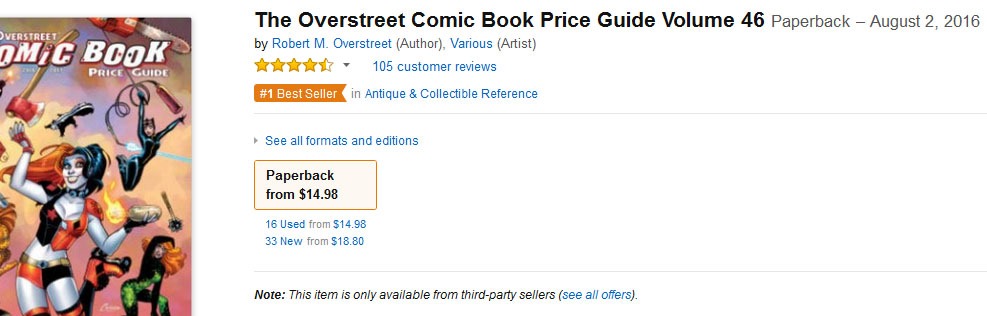
On Monday, September 26th, 2016, I placed an order for the newest Overstreet Comic Book Price Guide (Vol. 46). I don’t usually buy these, certainly not as an annual thing, but the other one I have is from mid 2011, PRE-New 52, and I figured I could handle one every half-decade or so in terms of owning.

More specifically to be able to know "Guide Value" for various books that I’d be interested in as I look toward the "back issues" side of things on an increasing basis…and unfortunately, far too many comic shops don’t bother to "price" their stock, leaving the poor customer unable to actually KNOW what price they’ll be quoted at the counter, and surely impacting what they’ll try to or consider buying. Buuuut that’s a topic for another post.

amazon_open_box_01     amazon_open_box_02

Anyway. I am an Amazon Prime customer. That means that I pay the annual fee, to be a part of Prime, and I do so for the physical shipping, to get stuff shipped "free" with 2-day/ASAP shipping. It may be labeled as or considered "free," but it is paid for by paying for the year TO BE a Prime member.

Nowhere that I have seen or heard of, does it include anything regarding some sort of "lesser" form of shipping as a result.

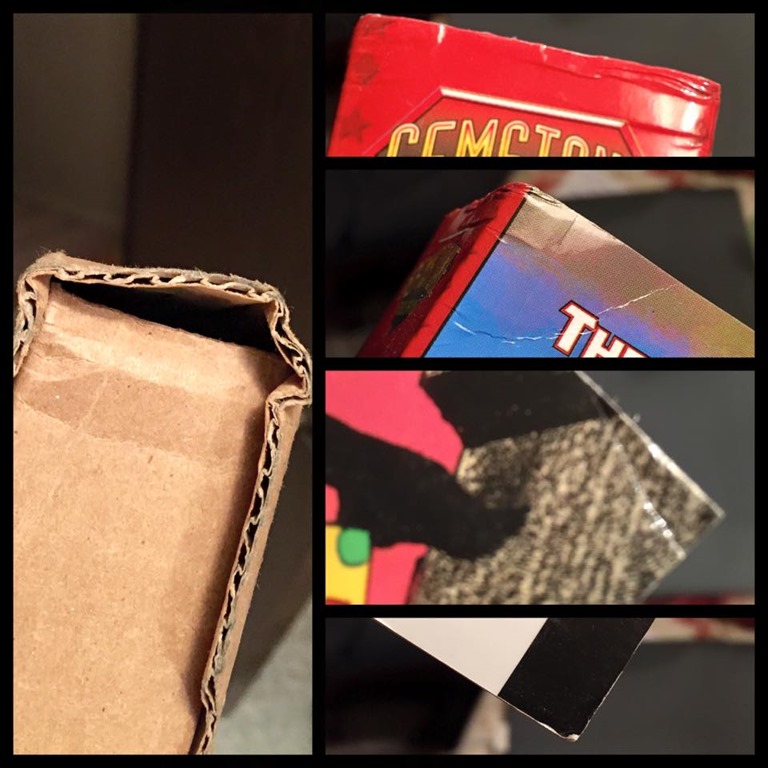
So, order placed on Monday, 9/26. Item arrived Wednesday, 9/28. The book’s damaged because it is over 1150 pages, very thin paper, and heavy. Since it was NOT packed to remain immobile…it slid around and was damaged in transit (beyond any damage prior). I requested a replacement immediately.

The first replacement arrived two days later, 9/30. This one was in the same sort of mailer, but with gaping wide openings (it was NOT properly assembled) and I could see daylight THROUGH the thing as well as clearly see the book contained within. Which was, of course, damaged in transit.

overstreet_46_third_time_damages_againI immediately requested another replacement, once again citing the damage and leaving "packaging feedback" about the issue with "heavy book + room to move = damage" and waited.

The second replacement (3rd copy) arrived the next day, 10/1. The mailer was slightly better-assembled, but I could still check out the book without even opening the package…and the book was damaged. I requested yet another replacement.

Meanwhile, I’d separately ordered a Green Arrow tpb, which arrived separately on Saturday. That one was in a flimsy yellow bubble envelope a good 50-75% larger than the book…and with no inserts or markings, it was folded and stuck into the mailbox. (So it earned a replacement-request as wel!)

The second copy of the Green Arrow book arrived the same way–overlarge flimsy envelope, folded and stuck in the mailbox.

It was then that I realized I had not seen any notification of the replacement of the Overstreet book being on its way…it was still held up in some hold status, apparently for my having requested multiple replacements.

amazon_missed_the_darned_point

When I contacted them about it, through their site, through their process, as a question on the item checking on "Where’s my order"–I was told that they would issue me a refund, please send the other books back.

To which I complained that it is not a satisfactory resolution–I’m now out a week of time (I could’ve bought the book from two different bricks-and-mortar stores and had a satisfactory CONDITION copy long before this). And to make me do the administrative thing of juggling receipt of packages and re-ordering, and then my own printer/ink/paper and gas to drive packages to a drop-off, and after 8+ days be back at square one? NO!

Their response to my continued explanation of the situation and emphasis on the fact that the book keeps arriving damaged because they refuse to use packing material and a proper sized box?

They made it entirely (temporarily) unavailable for sale "while they investigate the issue."

HELLO! 1. use a box 2. put packing peanuts or crumpled paper or several air pockets or foam or stick it between a couple sheets of cardboard, shrink-wrap that and toss it in the box, where the book itself will stay put, and any banging/beating suffered will be by the cardboard and not the book that I have paid for.

Halting their sale of the book entirely is so totally, completely missing the darned point!

Supposedly they’ll "resolve the issue" within 7 days; I can only imagine they’ll find that their stock is in undamaged condition (it’s getting damaged in transit for their inadequate packaging process).

Meanwhile… wonder if any of those 3rd party sellers will jack their prices up significantly, thinking the thing is outta print?

And my apologies to anyone else who might’ve been planning to order this from Amazon right now and using Prime shipping. It seems I’m the reason the book is (temporarily) not available for purchase through Amazon itself at the moment.

Weekend Ranting (October 1st Edition)

Though I’ve been sticking to Monday to Friday posting, I’ve had some thoughts increasingly building up that haven’t quite been making it into standalone posts. So, here are some things that’ve been on my mind lately.

And remember–this is just me, some random guy who has been "into" comics for 28 years, blowing off some mental steam.

destruction_of_coast_city

  • Marvel‘s doing Artist: TBA variant covers. and Super-secret Artist 1:1000 variant covers. And ridiculous needs-an-app-and-loads-of-entered-data-to calculate-eligitiblity variants. Y’know…bad enough, doing variants AT ALL. But if you don’t even have the artist(s) lined up and so you’re announcing variants MERELY for the sake of VARIANTS…you suck! Back in 1992 in one of THE doorbusting-est instances of a comic going on sale, I have the number "750" stuck in my head as the number of copies of Superman #75 I heard was ordered at ONE shop. Launching a continuation of a (now) year-old mini-series and having a 1:1000 cover? What the heck?!?
  • Marvel hyping a new Star Wars series…but it’s Star Wars: Classified. Look…either you bite the bullet and SPOIL some sort of surprise-ending to something, some otherwise "surprise development," and you just take the backlash OF spoiling something, by soliciting some spin-off series. OR…give it a rest! Give it a break! Let the series or event or whatever CONCLUDE, and THEN solicit/hype the Next Big Thing. Yeah, you’ll have a 2-month gap, but if people are really, TRULY clamoring for it…allow some time for ANTICIPATION to actually build. For some finality of something before to sink in. To get the word out that hey! There’s actually more coming, that’s not the end of everything. Just the end of a story!
  • Variants, PERIOD, are no longer special. Regardless of my personal dislike of variants, I can at least accept/acknowledge the choice to use them for "special occasions." Say, a #1 issue, or the start of some new storyline (oops, if we’re talking Marvel, that’s one and the same!) or some other big deal. But when every single issue of every single series seems to have a MINIMUM of two different covers, then there is NOTHING SPECIAL about them. It’s actually MORE SPECIAL and UNIQUE to find any comic for which there is ONLY ONE PUBLISHED COVER. I mean, How freaking ridiculous is that?!?
  • #1 issues are the same way. When there are 3-4 #1s for an otherwise "ongoing series" in the course of 2-3 years; when it takes a combination of 3+ "series" just get to 60 issues… it’s not special. Either that #1 indicates a to-be-short-lived mini-series which will be far preferable in a collected volume…OR it means that I have absolutely NO REAL IDEA what issue I would go back to if I wanted to read something immediately preceding it…since despite this #1 on the cover, I can lay decent odds on it being functionally a #10 or a #29 or some such, being the next issue published with a title and creative team and no greater gap in publication than any other issue-to-issue time (#3 to #4, #27 to #28, etc).
  • The constant cycle of events…particularly the line-wide events. And I’m looking primarily at Marvel on this. Hardly halfway into Secret Wars (Summer 2015) they start the hype/push for a big round of renumberings/relaunches. But the event is "delayed" and the relaunches go out anyway. Then, by the time that event book finishes, they’re already starting the hype on the NEXT event, Civil War II (Summer 2016). And then prior to THAT event even finishing, they’re already rolling out…ANOTHER ROUND of renumbering/relaunches! With delays and such, didn’t Secret Wars functionally run at least 8 months? Add to that what I believe is functionally at least 8 months of Civil War II, and even IF there was a whopping four-month gap between the two, you have 16 out of 20 months with an ongoing major event story! (80% of your time with ongoing events).
  • I got suckered on it twice when Marvel kicked off their new Star Wars line, paying the inflated $4.99 cover price for a #1, though in my own defense, I checked to make certain subsequent issues were "regular price" at $3.99. Star Wars, though. Bigger deal, something special, allegedly-extra-sized issues, big splash, whatever. But the move to it seeming virtually standard that a #1 will be $4.99 or $5.99?!? You’re already losing me on yet another freaking #1 issue…but then you want to have it $2 above a DC #1 if not TWICE AS MUCH as a DC #1?!? Fool me once, shame on you. Keep it up, I see what you’re trying to pull, and even something I’d otherwise BE interested in or consider supporting on principle, you keep me away. (Spider-Man: Renew Your Vows)
  • Convention Exclusives. There’s that saying of "leaving money on the table," right? And while I can "get" and "appreciate" marketing psychology and stuff for supply and demand and hyping stuff up…when you create product SOLELY to sell at a convention when you KNOW DARNED WELL that there are NUMEROUS people that will NEVER BE ABLE TO ATTEND a convention (and that numerous people BUYING your product AT the convention are doing so SOLELY to "flip" the product on the secondary market)… it sucks. Just make stuff available to people who will pay. Sell it through your site. Take pre-orders and produce to that. SOMEthing.
  • "Convention book stock." I get that part of dealers going to conventions involves selling to audiences they don’t usually have, with probably hundreds if not thousands of bodies that have never/will never set foot inside their actual store…but bringing stuff to the convention gets product in front of eyes and likely sales otherwise not possible. BUT… to me, it seems like "everyone" tends to have the SAME STUFF. Virtually EVERYONE has bins and bins and BINS of Marvel Premiere Edition hardcovers, typically $10/ea (having had $19.99, $24.99, or $29.99 cover prices). Very little DC product, period, and typically not in flat-price bins.
  • "Convention singles stock." Recent comics marked up $1 from cover price (new/last few weeks’ issues, with SOME at cover price if there’s been no real "hype" or such). $1 bins of overstock from the last 5 years. MAYBE discounted stock from a few years prior, virtually nothing from the 1990s, and virtually no 50-cent or 25-cent bins with any sort of "runs." When there ARE 50 or 25 cent bins, nothing is remotely in order, it’s all just a mash of stuff thrown together. A convention is basically a one-time thing: I get to look at the boxes NOW, and that’s it. Not worth the hassle…compared to a shop with a regular stock that I can check back every week or so for new stuff or decide that yeah, that bunch of Action Comics issues? I’ll snag those and then see what’s missing and go from there.
  • Final thought for now: Communication is key. If you’re running a convention and accepting applications for press passes, and state that someone will be in touch "within a few weeks of the show," that implies "a few weeks AHEAD OF the show." Two days ahead of the show, I realized 1. hey, the show is THIS WEEKEND and 2. I never DID hear back from them, guess I didn’t qualify for a press pass. So, I went back to check admission prices and such–maybe I’d want to go anyway. But Given that I’d be going alone, simply as me/myself, AND paying admission and facing the above couple points? I decided it would NOT be worth my time/hassle/etc. 4:50pm the day before the show I finally get a response…but I’d already planned my weekend as NOT including the show. C’est la vie.

Zero Hour Revisited – Zero Hour #0

90srevisited_zerohour

zero_hour_0000Zero Hour

Story and Layout Art: Dan Jurgens
Ink Art: Jerry Ordway
Letters: Gaspar
Colors: Gregory Wright
Asst. Editor: Mike McAvennie
Editor: KC Carlson
Published by: DC Comics
Cover Date: September 1994
Cover Price: $1.50

Here we are, at last–the final issue of Zero Hour itself. We’ve seen time anomalies pop up, and worsen. We’ve seen heroes discover time is being destroyed in the past and the future, working toward the present. We’ve seen the emergence of Extant, and the fall of the Justice Society. We’ve had dozens of tie-in issues where few have directly been part of this core event, though a fair number have danced on the edges. We’ve seen Hall Jordan–former Green Lantern, now Parallax–revealed as the sentient, actual manipulator of things as he seeks to wipe the slate clean after his own trajedies. The heroes have failed, all time and space has been destroyed, and a handful of heroes pulled outside it all, while another small handful remains with Parallax.

Hal prepares energies for the re-creation of the universe, of all existence. His way will see many worlds, and all wrongs will be set right. There will be the Earth everyone knew, minus stuff like the Coast City disaster. There will be a world that Batgirl remembers, in which she was never assaulted by the Joker. Even Extant will have his own world to rule over. Everyone will be happy. This is opposed–how can Hal be God? Waverider and his group of heroes attacks, disrupting Hal, and ultimately–after quite a scuffle–the universe IS reborn…but it unfolds "naturally" withOUT any one entity controlling it, tweaking it. As such, events unfold mostly as remembered, but here there are no alternate timelines, so everyone, everything is folded into one single chronology. The potential time-loop is closed, and all it costs is Hal Jordan and the young Kyle Rayner…while Green Arrow is wracked by the guilt of losing (having had to try to kill) his best friend.

For some reason, the phrasing "the universe is born old" sticks out to me, reading the issue. That may be random or personal and get into stuff I’m not really going to get into in a comics blog, but it’s a key phrasing to my reading.

A lot happens in this issue–look a couple paragraphs above, and that feels like scratching the surface. And yet, it’s a simplistic issue. Time is restarted; Hal wants to tweak it his way, but he’s stopped and so it restarts and unfolds naturally, so it’s similar to before, with small adjustments that functionally "explain away" continuity glitches and timing and such; shuffling a few events here and there to mash into one specific timeline.

We’re left with the notion that anyone that died via entropy or the time fissures has been restored…while anyone who died "outside of Time" (such as the Justice Society) remains dead. Victory, but at a cost.

The art and visuals remain excellent here with clean, crisp pages and dynamic layouts and (to me) iconic scenes playing out.

I don’t know if I’d recommend this as a stand-alone issue out of context of its other issues, but in a way it does work as a singular thing. You open on nothingness, and from that, Hal and his group; the opposing group, we see the FINAL final battle, the villain defeated and the universe restored…and a hint of what’s to come, as well as a fold-out timeline laying everything out for now and moving forward into the rest of 1994 and beyond. So it works as an artifact of sorts, as seeing the end of the story. And if you’re actually going to read it–whether re-read or you’ve never before read it–it’s definitely worth getting if you come across it. But it’s even better if you can snag all five issues–4/3/2/1/0–and read this core story even without any of the other tie-ins!


Going beyond the issue itself and expanding on stuff…

This is a really effective issue and makes me think. There’s a part where Hal smiles, explaining he just wants to make everything right, he wants everyone to live, where I wonder if the intent was to go for a "creepy" smile, or a "mad" smile, as if Hal’s insane. Personally, I have always–and again this time through–found myself wondering ok, why SHOULDN’T he be able to fix things? He’s not talking about recreating a universe that he RULES, or subjugating entire populations, or ending his actions with half the living entities dead, or stuff like that. He’s not targeting any particular people to wipe them out–he’s not even talking about killing Mongul. He just wants a universe where wrongs are set right, and Coast City never blows up.

Yet the argument opposing him makes sense–who is HE to singularly dictate events? Things happened for a reason, and need to remain that way, or Time WILL be altered. So really, my heart hurts for the guy, on the surface, and without considering that he was willing to wipe out the entire universe (he was gonna put it back…). And in the end, all the ramifications and little detailed points are far too numerous to address in a blog post.

I buy into this. I didn’t get into comics until about 2 1/2 years after the original Crisis. While I’d read a couple issues of Armageddon 2001, and a number of Eclipso: The Darkness Within and eve more of the Bloodlines stuff…and of course Doomsday/Funeral for a Friend/Reign of the Supermen, as well as Knightfall, KnightQuest, and KnightsEnd…this was my first DC Universe-wide event of this scale. This story ironed out details I didn’t even know at the time were issues. But it did solidify for me the notion of everything being in one single timeline…and the issue even provides a timeline, concretely laying out where/when major things happened (at least as relevant to the publishing schedule of DC in 1994!).

This was epic, and really set the standard for me of what great events could be. Of course, I’d mainly read only the core series, the Superman chapters, and several others, so it wasn’t until my current reading project of going through the entirety of the event–every single tie-in I’m aware of–that I saw the major cracks in that, and how so many issues were only loosely connected.

Looking back on this current reading experience vs. 22 years ago, I don’t feel like I actually DID "miss out on" anything back then. I did not find anything in these various issues that expanded my understanding of the story or filled in any gaps that I’d truly wondered about or that truly impacted the story…and I was disappointed at some that I’d expected would be expanded on/filled in that really were not. It seems like the issues I’d read back in the day–the Superman titles, Batman, Green Lantern, the core mini–were very much a complete enough experience.

That said, this has provided me a "survey" of a month’s worth of DC titles from July 1994, basically sampling over 30 different titles (though several "families" of related titles are in that).

There’s a lot more that can be discussed on Zero Hour itself–as a story, as an event, on ramifications and implications in-story and on a meta level. Structurally, I found this to be a solid event, and going back the 22 years, it really "set the standard" for me, and I truly MISS when even a universe-wide MAJOR event would "only" take up one publication month–with a WEEKLY core series and just one issue of tie-in per TITLE (though related titles could expand to have larger arcs tying in).