• April 2026
    S M T W T F S
     1234
    567891011
    12131415161718
    19202122232425
    2627282930  
  • On Facebook

  • Archives

  • Categories

  • Comic Blog Elite

    Comic Blogs - BlogCatalog Blog Directory

The ’80s Revisited: Captain Atom Annual #1

captain_atom_annual_0001The Dark Side of the Force

Writer: Cary Bates
Co-Plotter: Greg Weisman
Penciller: Pat Broderick
Inker: Bob Smith
Colorist: Carl Gafford
Letterer: Duncan Andrews
Editor: Denny O’Neil
Published by: DC Comics
Cover Date: 1988
Cover Price: $1.25

I’ve long been aware of Captain Atom, and have even read some issues here and there with the character. I believe he was in some Justice League (America) issues; I know he was in Armageddon 2001; I read at least most of the Captain Atom: Armageddon series he was in, blowing up the Wildstorm universe some time back; there’s the parallel with Dr. Manhattan in Watchmen…and of course, the character’s brief but pivotal role in Kingdom Come, to name a few offhand. I think I may even have read the first issue or two/few of his 1980s ongoing series at one point, though I don’t consciously remember much beyond the basic origin (so I probably read it around the time I read Watchmen back in the early 2000s).

Going through a stack of comics recently, I happened across this issue–certainly a quarter-bin find–and it struck me as interesting "in the moment" to read due to the cover proclamation: "Enter: Major Force!" I’m more familiar with Major Force as the character that killed Kyle Rayner’s girlfriend (stuffing her body in the refrigerator) back in the early days of the new direction for Green Lantern. Having briefly revisited that era recently in covering the Zero Hour crossover, I was all the more curious about how long the character had been around. This issue seems either a first appearance, or at least a post-Crisis on Infinite Earths (CoIE) first appearance. Given the character tying into Captain Atom’s origin and some guessing, I’m pretty sure this is the first appearance of the character.

The issue opens with a conspiracy-theorist radio show, the host talking about a corroborated incident of a UFO crashing in a quarry. We then move to Captain Atom arriving on the scene, and something emerges–an alien creature that the Captain winds up fighting. Meanwhile, an anonymous Major joins the scene, and we see that events are being manipulated to create an apparent origin of a new super-hero: that of a Major helping Captain Atom and being fused with an alien creature. When, in fact, this is the result of a later experiment like the one that created Captain Atom, but with different variables…and the "alien" is in fact another test subject. Due to his position and government involvement, Captain Atom goes along with things, introducing/endorsing this new guy to the public…as they get Major Force. Predictably (this comic is from 28 years ago!) Force doesn’t "work out" in the role of super-hero, as his methods are violent and don’t account for innocents/civilians. When CA tries to rein things in, the Major fights back. Captain Atom emerges from the battle victorious…though in its course he seems to have made a decision, delivering his message ("I quit!") along with the unconscious Major Force to his government handlers.

The issue has page numbers, with the story ending on a page numbered ’39’ so this is basically a double-length issue. As an Annual, it’s a ‘special’ issue, with a bigger story (but relatively self-contained) than just another issue of an ongoing series. Being from the late 1980s, and evaluating this (having read it), it seems to be an Annual from when such things "counted," and were truly a bonus or special issue along with the ongoing run, and having stuff important to the character’s ongoing status quo. In this case, the issue seems to be the point at which Captain Atom has had enough of just going with the flow and taking orders, and after seeing what the government/his handlers are up to, he can’t stick around simply accepting the status quo.

As an Annual (and a first one, at that), I figured this to be a decent sort of one-shot, though a lot of that comes from my own experience with comics, and DC history/continuity. We don’t get a lot of context/background on Captain Atom or a supporting cast in this issue, but we do get some slight references such that knowing what I do, it all fits.

I’m good with the art–it neither blows me away nor disappoints…it just "is." This looks and feels (visually and story-wise) like an ’80s comic, and something to it (such as the introduction of a character I know gets used more and in key ways years later) feels a lot LIKE the start of a new super-hero universe…which at this point, the then-current DC Universe essentially was. And I like that.

The story itself is decent, and seems to draw on existing continuity (at least from the Captain Atom series) and expects the reader to at least somewhat know what’s going on; introduces a new villain/antagonist or opposite version of the hero with an origin, background, some character/world-building, and ultimately resolution…while leaving things open for later use of the character as well as modifying the status quo (presumably, at least!) for the ongoing series. I notice that quite unrelatedly, this is the second issue in the last few days I’ve read written by Bates (the other was Action Comics #428) and am pretty sure the co-plotter (Greg Weisman) is the same who eventually did Gargoyles for Disney years after this.

For an issue that I only paid a quarter to purchase, this was definitely a good value for the time it took to read, and I enjoyed adding this piece to the puzzle–I’ve now read the introduction of Major Force and this also re-kindles a bit of my interest in the early Captain Atom series (I believe I have the first year or so of issues SOMEWHERE in my collection).

While this issue won’t hold the reader’s hand, it’s a solid piece with a nice length, and is definitely worth a read if you’re interested in the title character, villain, or this period in DC‘s history. If you find it in a bargain-bin–MAYBE up to $2ish–its well worthwhile. At a higher price, I’d say you’d have to really have a specific interest in this, rather than anything casual.

The ’70s Revisited: Action Comics #428

action_comics_0428Whatever Happened to Superman?

Story: Cary Bates
Art: Curt Swan and Murphy Anderson
Editing: Julius Schwartz
Published by: DC Comics
Cover Date: October, 1973
Cover Price: 20 cents

The Plot to Kill Black Canary!

Story by: Elliot Maggin
Drawn by: Dick Giordano
Edited by: Julie Schwartz

GBS has had a new satellite launched. Superman flies into action to stop a fire raging far above easy reach of firemen, and conveniently (and extremely quickly) locates and flies in an iceberg, melting it with his heat vision to put out the fire. But the world sees just a storm cloud and rain. As Superman investigates this phenomenon, he becomes aware of the fact that everyone believes Superman hasn’t been seen in ten years–even going so far as to (as Clark Kent) do a shirt-rip on live TV…but all anyone sees is Clark revealing an undershirt. Of course, the real villain turns out to be Lex Luthor. Luthor mouths off, revealing his plan when Superman poses as a newly-assigned inmate occupying the "empty cell," convincing Luthor he’d been double-crossed and had himself been "forgotten." All’s well that ends well, right?

Meanwhile, in the Green Arrow (and Black Canary) portion of the issue, we see Ollie on the phone, declaring "Listen, Trump–when Ollie Queen says his Public Relations Agency will make your motorcycles sell…they’ll sell!" He then springs into action, recruiting Dinah Lance (aka Black Canary), and convinces her to participate in a stunt for a commercial. Later, Ollie’s made aware of a planned attempt on Dinah’s life, so he goes back into action and saves her (though she’s not at all happy about it, as he should’ve just told her what was going on). Again, all’s well that ends well, right?

Visually, this issue simply "looks like" one of Grandpa’s comics. And I’m pretty confident that that literally is what this one is–one of Grandpa’s comics, from back in the day, that somehow got mixed into stuff that wound up in my family’s garage, where I found it recently.

And that obviously makes sense–Curt Swan? Murphy Anderson? Dick Giordano? Big names I recognize from the time period and associate (particularly) with DC Comics; Swan all the moreso with Superman. And of course, I recognize the other credited names as well from the time. For where I’m at, the credits read like a roll call of classic creators, all of which have a good name to me when it comes to comics.

I’m not the fondest guy when it comes to pre-Byrne Superman comics–I was introduced to and grew up on the post-CoIE Superman, and hold that as my favorite to this day. But I also have plenty of fond memories of laying on a bed, having pulled out many of Grandpa’s comics from a cabinet, literally surrounded with more comics than I could truly hope to read in the limited time(s) I had there. For the 8-9-year-old-Me, that was a key time for me, when Superman comics were just Superman comics, and I had no clue who any of the creators were, never noticed any of the credits, and hardly even noticed any numbers or saw much distinction, say, between Action Comics or Superman or such…they were just titles on a cover, and I don’t recall ever sorting the comics to put them into numerical order or systematically reading through any given title. I just looked for the coolest-looking cover, or whichever character(s) I was interested in reading at the time.

So, I can definitely say that this issue held up to that. It’s not the craziest or silliest or most out-there story. It’s–as many such were, and particularly compared to modern post-2010 comics–a highly-compressed story. Thirteen or so pages, and I could easily see how this would be grounds for a six-issue (at least) story nowadays*.

(*As a de-compressed story, I figure the first issue would include a bit more detail of Superman doing super-feats and perhaps a bit more foreshadowing with the satellite and such, and likely end with an initial revelation/question like "What are you talking about? Superman’s been missing for TEN YEARS!"–To Be Continued. We’d then get several issues of Superman investigating the phenomenon while performing further super feats and being increasingly stressed at not being "seen" as Superman; we’d get details of it affecting him in private life, and possibly relationships with others, as he starts questioning his own sanity. There might even be one-shots or a JLA mini-series to see how other characters are reacting to a world seemingly without Superman; how their attitudes toward the hero gig are affected by believing Superman’s been missing for a decade, and so on; and maybe even a couple new characters introduced that are trying to follow in the legacy of the "missing" hero.)

As-is, it’s fast-paced, introducing the problem, exploring it, and resolving it, with little deep exploration of the implications of stuff, and we’re done start-to-finish in just this issue, half the issue.

The Green Arrow piece looks remarkably good…though I guess I shouldn’t seem surprised (yet, I was!) The character looks exactly as I like him, with the hat and goatee and such. I looked up the dates, because it felt like the Ollie from the Green Lantern/Green Arrow run, but I suspect this was from just after or near the end of that run…this being 1973, while that run started in 1970.

The GA story itself is rather simplistic, and seemed a little heavy on pushing whatever dynamic it is with Ollie and Dinah. Being such a short story and characters I’m less familiar with from this time, it’s a bit short to try to dig in and analyze much…suffice it to say I wasn’t enamored with it as a singular, stand-alone story. It seems like something that would read better in a group of stories for longer context. Of course, there’s also the fact that it was a Green Arrow story when I set out to read a Superman comic. That said, I was quite grabbed by the opening with Ollie yelling into the phone to Trump.

THAT Trump.

The Liberal Oliver Queen, Green Arrow, enthusiastically doing business for Donald Trump.

What a difference 40+ years makes, right?

All in all, this issue was an enjoyable read, and a nice trip down memory lane. I’m glad to have read the issue, for myself. I’m awed at considering the timeframe, that the cover references 35 years of Superman, and here it’s been another 43 years since then…this issue is from less than HALFway into its run and Superman’s existence and all that.

Other than the Trump reference in the Green Arrow/Black Canary piece or interest in the actual reading experience of the Superman story given my lack of brevity discussing the issue, I don’t really see or know anything of this issue to make it singularly a stand-out issue or to overly differentiate it from any other issue from the early-’70s with the creative teams. Still, it’s not a bad issue, and if you find it cheaply, it’s not a bad one.

TMNT Revisited: TMNT Adventures (Mini-Series) #3

tmnt_adventures_revisited

tmntadventuresmini003Heroes in a Half-Shell!

Written and Pencilled by: Michael Dooney
Adapted from the Scripts by: David Wise and Patti Howeth
Inked by: Dave Garcia
Lettered by: Steve Lavigne
Color by: Barry Grossman
Cover by: Kevin Eastman, Peter Laird, Steve Lavigne
Published by: Mirage/Archie
Cover Price: $1.00
Cover Date: December 1988

This issue picks up with the rock soldiers interacting with Shredder, Bebop, and Rocksteady. Krang freaks out upon learning Neutrinos are loose on Earth. Meanwhile, the turtles have just about found the technodrome when they’re buzzed by flying cars and opt to chase these instead. The rock soldiers show up and rather than put up a fight, launch a weather-making device (which our heroes promptly ignore), and everyone meets back in the technodrome (where Donatello instantly figures out the alien controls, opens the portal, and the rock soldiers are thrown back through to Dimension X and the Neutrinos voluntarily follow, to continue the fight against Krang (but without ever dealing with Krang in the technodrome). Shredder and his forces leave rather than confront the turtles here in the heart of the technodrome, and the turtles simply leave rather than even trying to find and deal with Shredder or Krang.

The next day, the Shredder re-baits the turtles, who wind up fighting Bebop and Rocksteady again. The turtles and Splinter split up to deal with different facets of the current threat. Krang gets put into the stomach of an android body and electrocuted (er…the body is activated). Shredder then sends Foot robots after the turtles as a diversion until Krang wakes. After having the turtles on the run while growing to a gigantic size, Krang simply turns and punches his way to the surface so the turtles can follow him, rather than dealing with them where they were. Donatello shows up with a blimp he’s been working on, and turns it loose with the others while he and Leo enter the android body to shrink it down. Krang calls Shredder for help, Shredder abandons his imminent victory over Splinter and shows up to point his retromutagen ray at the turtles, Splinter shows up as well and destroys it, then the story shifts back to the technodrome where the Donatello finishes some complicated thing with the portal, and everyone gets out as the whole thing is sucked into Dimension X. We see Shredder and Krang bicker, the turtles chill at home…and the story (mercifully) concludes.

Much as with the previous issue, this is ultra-compressed with an extremely fast-pace and abbreviated scenes such that the characters–from simply reading this–seem interchangeable and inconsequential. As noted also with the previous issue, this is not so much a fault of the writing of the comic as it is a shared problem between the writing of the episodes this issue is based on and trying to cram the contents of more than one episode into a single issue.

The art continues to be good–it’s a welcome visual style that as I’ve said before, holds its own without mimicking the art of the animated series. Yet, the characters are all recognizeable and nothing’s so far off as to seem otherwise (except the coloring can be kinda iffy…especially on a comic that’s got slightly yellowed pages and carries a cover date from nearly 26 years ago).

The cover would make for a decent poster, and the image alone promises something a lot more dramatic than what I read inside.

While in recent years I’ve found the “classic” TMNT animated series rather hokey and have been rather put-off by it, revisiting this miniseries and the episodes themselves has admittedly made me rather nostalgic, and rekindled my interest in the old series. I may not binge-watch the entire thing or even finish tracking down all the seasons…but I’ve been reminded of how much my younger self loved this stuff, and failed to notice the level of hokiness my present-day adult self sees.

From looking at this simply as a comic series, it’s nothing special for the content by itself. What makes this special is that it’s a color series starring the turtles, designed and aimed at the audience of the 1980s cartoon, and is a #1 issue I can actually afford (and have a duplicate or two somewhere, too).

Though I missed this mini-series when it was originally published, it was still something I was able to track down relatively easily a number of years ago, far moreso than ever the original Mirage #1, which I content myself to this day with reprint editions of that.

I can’t imagine something like this mini-series–or this issue–being published today; but it’s certainly a product of its time, and quite worthwhile to get as a fan of the TMNT in general, and the Archie-published stuff in particular.

TMNT Revisited: TMNT Adventures (Mini-Series) #2

tmnt_adventures_revisited

tmntadventuresmini002Heroes in a Half-Shell!

Written and Pencilled by: Michael Dooney
Adapted from the Scripts by: David Wise and Patti Howeth
Inked by: Dave Garcia
Lettered by: Steve Lavigne
Color by: Barry Grossman
Cover by: Kevin Eastman, Peter Laird, Steve Lavigne
Published by: Mirage/Archie
Cover Price: $1.00
Cover Date: October 1988

As noted in my post about the first issue, this mini is based on the first 5-episode mini-series/season of the animated TMNT cartoon. However, where that was 5 episodes, the comics adaptation is a mere 3 issues…leading to a couple weird issue-breaks that do not match up with the episode-breaks in the cartoon.

This issue picks up with the turtles facing some random/weird robots. After dispatching these, they deal with another deathtrap, and then find Splinter…and meet Bebop and Rocksteady. Escaping to the surface, the turtles are followed, but quickly trap Bebop and Rocksteady, and that’s that.

Continuing on, Shredder has a new scheme, and coopts bumbling scientist Baxter Stockman’s “mouser” invention. He sends some after Splinter, but the turtles rescue their master with no problem. However, Shredder’s built hundreds more and they do prove to be a problem. Michelangelo “volunteers” to infiltrate the mansion Shredder’s commandeered, but is captured the the villain…though set free behind his back by Krang. The Mousers are stopped, no one’s dead, and again, that seems to be that. Shredder still won’t give Krang a body, and initiates yet another scheme: opening a portal to Dimension X he lets a flying car into the Technodrome (which promptly blasts a hole and skidaddles), followed by a flying tank of sorts with rock soldiers…and that’s the end of the issue.

The art for this issue is consistent with the first…much of my thinking on the first issue applies here as well (cool to see the Mirage team on the issue, etc). While the visuals are stylistically their own thing, they are clearly based on the cartoon and fit well without seeming particularly “off.” Essentially they’re simply comic versions structurally, but based on the cartoon elements.

The story is where most of my problems lie…particularly where the cartoon itself seems choppy and just runs from points ‘A’ to ‘B’ to ‘C’ and following that so closely, the comic seems super-compressed, well beyond any preference I’d have to avoid “decompression.”

And therein I find the issue–it’s not so much the writing of this comic that’s the problem as much as it’s the source material. I’m consciously aware that this issue’s story is itself based on another story, and the writing keeps faithfully TO said source material. The faults come from the ludicrous, goofy, weird stuff that (in remaining faithful) had to be translated into this adaptation.

While the first episode of the cartoon–and therefore, the bulk of the first issue–was charming enough in its own way (and gave a roughly whole story without tying up plotlines and such), this is the middle chunk of the overall 5-episode arc and middle of this particular 3-issue series. Sadly, it’s really choppy and all over the place, and the only real fondness I find in it is the art as mentioned, and its “place” as an artifact of history.

Taken by itself, I had to force myself through the issue, and force myself not to just quickly eyeball the pages and move on.

TMNT Revisited: TMNT Adventures (Mini-Series) #1

tmnt_adventures_revisited

tmntadventuresmini001Heroes in a Half-Shell!

Written and Pencilled by: Michael Dooney
Adapted from the Scripts by: David Wise and Patti Howeth
Inked by: Dave Garcia
Lettered by: Steve Lavigne
Color by: Barry Grossman
Cover by: Kevin Eastman, Peter Laird
Published by: Mirage/Archie
Cover Price: $1.00
Cover Date: August 1988

It’s rather interesting to consider that this was–I  believe–the first color TMNT comic. Sure, First Publishing had colored the original black and white issues, but this issue began as a color production rather than the color being a conversion. And where the original Mirage TMNT comics were certainly of a more mature nature for violence and language, this is based on the animated series that was aimed fairly squarely at kids.

Reading back through the issue, it has–for this fan of 26+ years–a lot of familiarity, both from the cartoon as well as the visual style of the art. Which ultimately makes sense, given Dooney‘s involvement with the Mirage stuff in particular. The character designs are obviously those of the cartoon, though.

Being such an old comic–at least a quarter-century–it’s immediately clear some differences from modern comics physically; and my copy in particular isn’t a particularly clean copy…it definitely is a bit yellowed from age and all that, as the paper is classic newsprint, one can see the dots to the coloring, and so on.

As a whole, the art’s not bad in and of itself, though the style is a bit “interesting” having gotten used to more “modern” renditions of these characters. I rather like the realization that even though this was published by Archie, it was created by the Mirage folks…thus lending a certain authenticity to this as a Ninja Turtles thing, rather than just being some thrown-together adaptation of a kids’ cartoon.

Story-wise, this suffers the same as the cartoon itself does in my mind…overly-simplistic and full of glaring plot-holes and such, requiring a lot more suspension of disbelief than most comics I’m used to. There’s also something rather wonky about the pacing, with this first issue covering maybe an episode and a half of the cartoon, rather than just one episode. In that way it’s a rather “compressed” storytelling that (especially looking at it now) really needs a lot more room to breathe. And as a comic, it misses so much potential in terms of “enhancing” the cartoon with narration or thought balloons or such that just wouldn’t fit the cartoon but would a comic.

Other than some abbreviated dialogue and missing the show’s music, this is absolutely a straight up adaptation and it doesn’t begin to even try to be anything else–different or additional. In and of itself, unfortunately, I can say with honesty I find this issue rather hokey, choppy, and other than the art “working” it’s nothing particularly stand-out or impressive to me.

At the same time, this goes back to the very beginning of the TMNT in tv and “popular” comics, so it has a huge bit of historical significance and is in itself quite the “artifact” of its time. This is the first issue of 3, a mini-series, which adapts the entire first “season” or 5-episode mini-series of the TMNT cartoon. At a time when home media (VHS) was still relatively rare (especially compared to our contemporary age of everything being on DVD and so readily available to purchase and watch whenever we want) this was the closest I personally would get to “owning” the episodes to consume whenever I chose. Back in the late-’80s/early-’90s, though, I’d acquired a rather thick comic that came with an audiocassette, which actually collected all 3 issues into a singular volume…but was not itself a bookshelf volume or graphic novel…it was more an 80-page Giant or such.

Publish this as-is today and I’d be rather disappointed. But looking at it as a singular piece, and in context of its time, it’s not bad, and makes for a fairly interesting sort of read.

Zero Hour Revisited – Zero Hour #0

90srevisited_zerohour

zero_hour_0000Zero Hour

Story and Layout Art: Dan Jurgens
Ink Art: Jerry Ordway
Letters: Gaspar
Colors: Gregory Wright
Asst. Editor: Mike McAvennie
Editor: KC Carlson
Published by: DC Comics
Cover Date: September 1994
Cover Price: $1.50

Here we are, at last–the final issue of Zero Hour itself. We’ve seen time anomalies pop up, and worsen. We’ve seen heroes discover time is being destroyed in the past and the future, working toward the present. We’ve seen the emergence of Extant, and the fall of the Justice Society. We’ve had dozens of tie-in issues where few have directly been part of this core event, though a fair number have danced on the edges. We’ve seen Hall Jordan–former Green Lantern, now Parallax–revealed as the sentient, actual manipulator of things as he seeks to wipe the slate clean after his own trajedies. The heroes have failed, all time and space has been destroyed, and a handful of heroes pulled outside it all, while another small handful remains with Parallax.

Hal prepares energies for the re-creation of the universe, of all existence. His way will see many worlds, and all wrongs will be set right. There will be the Earth everyone knew, minus stuff like the Coast City disaster. There will be a world that Batgirl remembers, in which she was never assaulted by the Joker. Even Extant will have his own world to rule over. Everyone will be happy. This is opposed–how can Hal be God? Waverider and his group of heroes attacks, disrupting Hal, and ultimately–after quite a scuffle–the universe IS reborn…but it unfolds "naturally" withOUT any one entity controlling it, tweaking it. As such, events unfold mostly as remembered, but here there are no alternate timelines, so everyone, everything is folded into one single chronology. The potential time-loop is closed, and all it costs is Hal Jordan and the young Kyle Rayner…while Green Arrow is wracked by the guilt of losing (having had to try to kill) his best friend.

For some reason, the phrasing "the universe is born old" sticks out to me, reading the issue. That may be random or personal and get into stuff I’m not really going to get into in a comics blog, but it’s a key phrasing to my reading.

A lot happens in this issue–look a couple paragraphs above, and that feels like scratching the surface. And yet, it’s a simplistic issue. Time is restarted; Hal wants to tweak it his way, but he’s stopped and so it restarts and unfolds naturally, so it’s similar to before, with small adjustments that functionally "explain away" continuity glitches and timing and such; shuffling a few events here and there to mash into one specific timeline.

We’re left with the notion that anyone that died via entropy or the time fissures has been restored…while anyone who died "outside of Time" (such as the Justice Society) remains dead. Victory, but at a cost.

The art and visuals remain excellent here with clean, crisp pages and dynamic layouts and (to me) iconic scenes playing out.

I don’t know if I’d recommend this as a stand-alone issue out of context of its other issues, but in a way it does work as a singular thing. You open on nothingness, and from that, Hal and his group; the opposing group, we see the FINAL final battle, the villain defeated and the universe restored…and a hint of what’s to come, as well as a fold-out timeline laying everything out for now and moving forward into the rest of 1994 and beyond. So it works as an artifact of sorts, as seeing the end of the story. And if you’re actually going to read it–whether re-read or you’ve never before read it–it’s definitely worth getting if you come across it. But it’s even better if you can snag all five issues–4/3/2/1/0–and read this core story even without any of the other tie-ins!


Going beyond the issue itself and expanding on stuff…

This is a really effective issue and makes me think. There’s a part where Hal smiles, explaining he just wants to make everything right, he wants everyone to live, where I wonder if the intent was to go for a "creepy" smile, or a "mad" smile, as if Hal’s insane. Personally, I have always–and again this time through–found myself wondering ok, why SHOULDN’T he be able to fix things? He’s not talking about recreating a universe that he RULES, or subjugating entire populations, or ending his actions with half the living entities dead, or stuff like that. He’s not targeting any particular people to wipe them out–he’s not even talking about killing Mongul. He just wants a universe where wrongs are set right, and Coast City never blows up.

Yet the argument opposing him makes sense–who is HE to singularly dictate events? Things happened for a reason, and need to remain that way, or Time WILL be altered. So really, my heart hurts for the guy, on the surface, and without considering that he was willing to wipe out the entire universe (he was gonna put it back…). And in the end, all the ramifications and little detailed points are far too numerous to address in a blog post.

I buy into this. I didn’t get into comics until about 2 1/2 years after the original Crisis. While I’d read a couple issues of Armageddon 2001, and a number of Eclipso: The Darkness Within and eve more of the Bloodlines stuff…and of course Doomsday/Funeral for a Friend/Reign of the Supermen, as well as Knightfall, KnightQuest, and KnightsEnd…this was my first DC Universe-wide event of this scale. This story ironed out details I didn’t even know at the time were issues. But it did solidify for me the notion of everything being in one single timeline…and the issue even provides a timeline, concretely laying out where/when major things happened (at least as relevant to the publishing schedule of DC in 1994!).

This was epic, and really set the standard for me of what great events could be. Of course, I’d mainly read only the core series, the Superman chapters, and several others, so it wasn’t until my current reading project of going through the entirety of the event–every single tie-in I’m aware of–that I saw the major cracks in that, and how so many issues were only loosely connected.

Looking back on this current reading experience vs. 22 years ago, I don’t feel like I actually DID "miss out on" anything back then. I did not find anything in these various issues that expanded my understanding of the story or filled in any gaps that I’d truly wondered about or that truly impacted the story…and I was disappointed at some that I’d expected would be expanded on/filled in that really were not. It seems like the issues I’d read back in the day–the Superman titles, Batman, Green Lantern, the core mini–were very much a complete enough experience.

That said, this has provided me a "survey" of a month’s worth of DC titles from July 1994, basically sampling over 30 different titles (though several "families" of related titles are in that).

There’s a lot more that can be discussed on Zero Hour itself–as a story, as an event, on ramifications and implications in-story and on a meta level. Structurally, I found this to be a solid event, and going back the 22 years, it really "set the standard" for me, and I truly MISS when even a universe-wide MAJOR event would "only" take up one publication month–with a WEEKLY core series and just one issue of tie-in per TITLE (though related titles could expand to have larger arcs tying in).

Zero Hour Revisited – Booster Gold #0

90srevisited_zerohour

booster_gold_0000Blue & Gold Chapter 1: The Secret Origin of Booster Gold

Written by: Geoff Johns & Jeff Katz
Pencil Art by: Dan Jurgens
Finished Art by: Norm Rapmund
Colors by: Hi-Fi
Letters by: Randy Gentile
Asst. Editor: Harvey Richards
Editor: Michael Siglain
Cover by: Jurgens & Rapmund
Published by: DC Comics
Cover Date: September 1994
Cover Price: $1.50

I probably should have actually tucked this in with the "week 3" issues, as this 1. does not end on white pages and 2. takes place prior to events seen in "week 4." C’est la vie…I put this issue almost at the end of stuff because of it being a "retroactive tie-in" published a decade and a half AFTER the actual series.

This issue sees Booster Gold and the Blue Beetles travel through time, and cross paths in the timestream with Parallax (Hal Jordan) and Extant (Hank Hall) circa Zero Hour, 1994. Parallax damages their time-bubble and they’re forced into the 25th Century (with no need to chase down the time-trouble-makers, as they’ve already been dealt with IN Zero Hour–oops, we’ll see that shortly). Turns out the exact day the group emerges in is the day that Booster "threw" a football game and was caught doing so. While striving to ensure that this timestream is not disrupted, they use resources available to continue their own mission and we learn a bit more about Booster’s background as well as the Blue Beetle (several of ’em!) before things have to be dealt with–like putting Dan and Jaime back in their own times without any memory of this issue or the previous having happened…and Ted’s poised to be another "Hero You’ve Never Heard Of" alongside Booster… it’s Blue & Gold, reunited! Though the two quickly realize there’s a bit of a Brother Eye problem that may end things before they’ve truly begun.

This issue was actually published in 2008, some 13 1/2 years after Zero Hour. We were post-Infinite Crisis, post-52, mostly through Countdown, heading toward Final Crisis. And in the early issues of the Geoff Johns run on Booster Gold, with art by Dan Jurgens–the character’s creator and Norm Rapmund‘s excellent inks. And I recall this being one of the more fun series at the time, certainly one of my favorites.

In fact, I had covered the issue at the time, for comiXtreme (and republished in this blog years later), and rated it quite highly. That particular review was based on the issue in that context rather than as a random issue added to this mix, hence any discrepancies between then and now.

Ultimately (given the 14-year-gap in publication) this issue does nothing for the understanding of Zero Hour itself, moving the 1994 series along, etc. But this makes a fun tie-in and providing a more grounded "time" to touch base with–a nod to older/longer-time readers–while serving its own story.

This issue actually kicks off the second arc in the Booster Gold title, and leaves me quite interested in re-reading it…unfortunately, I don’t believe I have any of the early collected volumes, nor ready access (consolidated) to my singles at the moment.

I don’t recommend this in context of Zero Hour itself, really, but it was a great throwback issue, touching in continuity and playing off the #0 issues concept (this was the seventh issue of the series). But as a Booster Gold story, I very definitely recommend the Blue and Gold arc that this kicks off, as well as the first one, 52 Pickup.

The Weekly Haul – Week of September 21, 2016

I continue to be thoroughly, disgustingly frustrated with variants.

See, this should have been a quick, simple week.

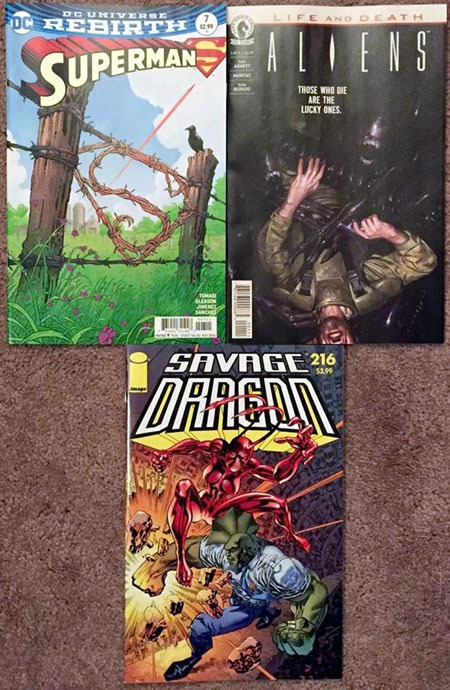
Just a couple issues I was looking for; grab ’em and go, right? Check out that Teenage Mutant Ninja Turtles issue below!

weeklyhaul_09212016_a

I wound up flipping through EVERY SINGLE ISSUE of Superman, just trying to ensure that what I was getting was NOT a variant.

I then did the same thing with the Aliens issue.

There was only the single copy left of the Savage Dragon, so I sincerely hope it is NOT a variant, either, or I am really gonna be mad.

Puzzling over the TMNT comic?

Yeah, there were 5-6 copies of the title on the rack…but they were VARIANTS! Several “SUB CVR” variants and at least one “RI CVR” variant!

But the regular, actual, main, REAL cover? Nope, nada.

I went to a second shop as well looking for it, but they didn’t even have the issue in ANY form, PERIOD.

So hey, saves ME money. I was gonna double-dip for immediacy…I’ll just have to wait til I get to Kenmore next week or so where the issue is pulled for me.

Shows just how intensely I dislike variants on principle that even if I am buying two copies of the issue for immediacy I still honestly do. not. want. the variants!

There’s a word for this–something like discouraging–but stronger.

If I ever flat-out just up and walk away from comics, it’s going to be on price, and variants-on-principle.

Zero Hour Revisited – Showcase ’94 #10

90srevisited_zerohour

showcase_94_0010Aftermath

Script: Alan Grant
Penciller: Mike Vosburg
Inker: Ron McCain
Colorist: Dave Hornung
Letterer: Ken Bruzenak
Consulting Editor: Dennis O’Neil
Editor: Neal Pozner
Published by: DC Comics
Cover Date: September 1994
Cover Price: $1.95

This particular story basically sees a despondent, defeated Jean-Paul Valley momentarily existing as a homeless man on the streets. He’s been stripped of his role as Batman, having abdicated his role as Azrael for that, and now hasn’t a clue what to do with himself. He contemplates himself, his life, where he is, what he’s been through, how his life has changed in a year (basically saying that from Sword of Azrael to Zero Hour has been about a year in the Bat-side of things–further backed by the Superman: The Man of Steel issue where Batman mentions to Superman both having quite a year). Valley intrudes on a group of homeless, "hogging the fire," and eventually one is brave enough to approach him and engage him (albeit one-sidedly…or so it seems). When he up and leaves, the remaining homeless crowd around the fire and then are threatened by another group. Valley returns and drives them off, and continues to mope about, though now accepting that he IS a person, like any of these others.

Story-wise, this seems both a sort of quasi-epilogue to KnightsEnd, partly following up on that and bridging that story and the start of the ongoing Azrael series that started sometime later in 1994, I believe. This is definitely where a title like this–Showcase ‘__–excels. You don’t have to have an entire issue of some other title dedicated to a story, but you can have a standard-issue-length story presented once without having to be entirely its own one-shot or Special Issue or whatever. There’s room for this Azrael (Jean-Paul Valley) story, prior to/without an Azrael title (yet), but without hijacking another issue of Batman or Detective or Robin or Catwoman or whatever.

Given that, I like this story, and somehow was kinda surprised that it DID run the "full length" of a standard-sized issue. Then, for only 45 cents more (1994 pricing) we get another issue-or-so’s worth of content spotlighting other stuff.

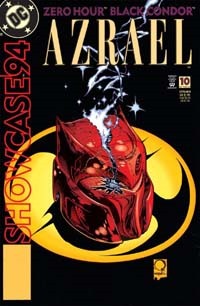
And the cover–featuring Azrael–is a nice Quesada/Kesel piece with the destroyed Az-Bats helmet on the Az-Bats-period Bat-symbol. Iconic, simple, and applicable to the story.

The Tempting part 1: The Beating of Wings

Writer/Creator: Brian Augustyn
Penciller: Anthony Chun
Inker: Matt Banning
Letterer: Steve Haynie
Colorist: Lee Loughridge
Editor: Neal Pozner

I’d swear I’ve read stuff with Black Condor before–specifically in Justice League America–but this did not feel like that at all. I think it’s safe to say this is the first "solo outing" I’ve read of the character, and it felt like a bit of a first-issue thing, introducing the main character, a supporting character, and a conflict. Of course, the hero starts to seem victorious, before being presented with a greater challenge, and we’re left with a cliffhanger (I ought to see if I have the next issue of this, but honestly I doubt I’ll get to it anytime soon…I’m interested, but not necessarily enough to hunt it down for an immediate read. Chances are if I ever get around to assembling the several years of these Showcase Years I’ll read it someday).

The story and art are both good, and as mentioned above for the Azrael story, this is a solid outing that seems like it could lead into an ongoing series; but barring that/prior to that, serves in that stead, being allowed to be put out there as part of an anthology ongoing even where any singular character/story would not support its own thing.

No real complaints, and I do feel I’ve a bit more insight into the character, or at least the context, than I would have had without having read this.

Deja Views

Story: Mike McAvennie
Pencils: Jason Armstrong
Inks: Stan Woch
Colors: Stuart Chaifetz
Letters: Willie Schubert
Consulting Editor: KC Carlson
Editor: Neal Pozner

This story was all over the place, but essentially focuses on a group of Time-themed villains including Clock-King (I believe) and Calendar Man (I think–and not at all like the revamped Rebirth version!). The group is trying to steal some helmet or armor, and stuck in a time-loop, and they got confused in-story right after I got confused reading and jumping to the conclusion that there was some significant editorial error before realizing that was part of the story. And before things are completely sorted out, the story fades to white, signifying the "join" to Zero Hour.

Visually, no great issue on this story for me…it’s not bad, not wonderful. I’m not overly familiar with the characters, don’t really care about them, and this story doesn’t seem to directly come out of anything…it’s just "a story set during _______" (here, Zero Hour). This tie is enough to "justify" including this in reading Zero Hour stuff, but the issue does not sport the official Zero Hour banner or trade dress. Of course, that’s in keeping to the title‘s trade dress of generic fonts for "logos" rather than some bold solo-title logo.

At least it’s more tie-in than a number of tie-ins had, so it’s worth reading for the sake of completeness, though does not ultimately "matter."

OVERALL THOUGHTS

While this title itself–Showcase ’94–may not in and of itself matter all that much, I’m more convinced than ever at its greatness for its time. That’s not to say I could see following such a book long-term in the present, in 2016…but going back 22 years and the three issues I’ve now read for their having a segment each tied to Zero Hour, I recognize what the book’s existence allowed to be published without hijacking other books’ pages or the stories just not getting told. Add to that my not recognizing many of the creators and a slight memory suggesting this: the book was the sort for giving "new talent" a chance without being otherwise committed to a book. Try a writer out, give an artist a story to do, without compromising a "regular" or "ongoing" title, but still get their work out there, see how they do with various characters and creative team lineups.

This issue as a whole is not worth it in terms of Zero Hour, really…but it’s a strong issue, with a distinctive cover, and for the quasi-self-contained Azrael story, it’s well worth a bargain-bin buy (just not worth some collector’s premium or markup despite the issue’s age or cover).

Zero Hour Revisited – Anima #7

90srevisited_zerohour

anima_0007Suddenly, Johnny Gets a Feeling

Writers: Elizabeth Hand & Paul Witcover
Guest Penciller: Brent Anderson
Inker: Will Blyberg
Letterer: Chris Eliopoulos
Colorist: Patricia Mulvihill
Assistant Editor: Chris Eades
Editor: Rob Simpson
Published by: DC Comics
Cover Date: September 1994
Cover Price: $1.50

I recall Anima being one of the characters introduced during the Bloodlines Annuals event in 1993, and of course remember the character more than others as she (obviously) had her own series or a short time. That said, this is the first I can consciously remember actually reading of the character.

Reading this issue, though “only” 7 into its run, was not a fun thing out-of-context. I could recognize the main character and associates by context-clues and figure stuff out, but the story seemed (in part for my lack of familiarity with any of the characters or the full context of the continuity/situation at this point) to jump all over the place enough that I’m not even gonna try to summarize it. Suffice it to say that this felt like diving into a mid-season episode of some tv show and maybe not being disgusted or put off enough by it to turn it off, but it definitely was not the most engaging nor (detail-wise) memorable.

Essentially, there’s this girl, known as Anima, with a bond to some sort of demon named Animus. Animus is imprisoned by siblings/colleagues, as others conspire to do something nasty to the realm of Man, and Anima/Animus are key to stopping that, hence an adversarial situation.

Outside of Eliopoulos on lettering, I really don’t recognize the creative team. Then, the fact that outside of probably this issue (seeing it in the Zero Hour stack and as an issue coming up in the queue) I haven’t really even considered the series for years adds to this series’ isolation in history and continuity. This character came out of the DC Universe Bloodlines stuff; carries the standard DC logo, carries in this case the Zero Hour and DC Universe banner, so it was (at the time at least) certainly in-continuity and such (mid-1990s!). But you would hardly know it to look at any contemporary DC lineup, probably not SINCE the actual 1990s (1999/2000 or so).

That lack of recognition, memory, impact, lends to the weirdness of reading this…certainly refreshing in its way as one of those titles that I seriously doubt would even get a publishing chance nowadays, let alone an audience to go seven issues (let alone any further). The parts with Animus and siblings struck me as rather Hellblazer-esque (ok, perhaps this’d fit in with the new Hellblazer title in Rebirth?) and thus in continuity but tucked off into their own little separated section of continuity.

There’s an offhanded reference indicating Anima had gotten Superman’s message (from waaaaaayyyyy back at the start of Zero Hour!) but outside of that and the fade-to-white abruptness ending this issue, you wouldn’t know it had anything to do with a bigger crossover. This certainly fits the “red skies” designation of sorts…that is, there’s a passing shoe-horned-in reference for a panel or two, but otherwise the issue’s actual story is not impacted nor does it in turn impact, the main event story it supposedly ties in with.

I think this issue would probably fit pretty solidly in with its own series as a run–reading Anima from first issue to however long the series ran–but it’s not even really “fun” as an isolated, standalone issue; it does not advance Zero Hour itself, nor does it shed any real light on something that the main Zero Hour just didn’t have space to do. I would not recommend this outside of an Anima read-through; and given (if only) my own conscious lack of memory of anything impactful even from this series long-term, I certainly would not recommend paying more than 25-50 cents for this in a bargain-bin purchase.