• March 2026
    S M T W T F S
    1234567
    891011121314
    15161718192021
    22232425262728
    293031  
  • On Facebook

  • Archives

  • Categories

  • Comic Blog Elite

    Comic Blogs - BlogCatalog Blog Directory

The ’90s Revisited: Lord Pumpkin #0

ultraverse_lord_pumpkin_0000The Return of the Great Pumpkin

Storyteller: Dan Danko
Illustrator: Aaron Lopresti
Finishers: Gary Martin, Aaron Lopresti
Letters: Gail Beckett
Color Design: Micky Rose
Interior colors: Foodhammer! with Sharleen Gaertner
Editor: Roland Mann
Published by: Malibu Comics
Cover Date: October, 1994
Cover Price: $2.50

Happy Halloween! For this day, I figured I’d post about one of my favorite "Halloween-themed" characters… Lord Pumpkin! (Even though this totally jumps the gun on an "eventual" Ultraverse reading project).

And why not just cover an entire issue devoted to the character as my means of doing so?

Much as I enjoy the character/concept (if only for the sheer visual ridiculousness), I still have a huge blind spot in terms of concrete comic knowledge of the character and events involving him, outside of a slight memory of the character being featured on the Ultraforce cartoon series, and sharing a "flipbook" for three issues of NecroMantra before the two characters’ stories collided in NecroMantra #4.

But that gets ahead of things a bit.

This issue opens with a pumpkin-headed (or rather, Jack O’Lantern-headed) character arriving on Earth, seemingly with no memory of who or what he is. We then flash back to the GodWheel where we witness a band of fighters seeking to take down the Pumpkin King. On Earth, we see the character essentially "enslaved" by a traveling carnival, and befriended by a young boy. Another player enters the scene, looking to stir up some mischief, providing the boy with a special candle for his pumpkin-headed friend…which leads to a sort of awakening. Ultimately, we see the fate of the fighters and their simultaneously doomed attempt on the evil king’s life as well as said attempt’s impact on Earth, and we see our abused character exact a certain key revenge for his imprisonment…while getting some foreshadowing for the sinister, recurring nature and visual iconography of Lord Pumpkin.

To the best of my un-confirmed, un-researched knowledge, this issue was a one-shot, providing us with a Lord Pumpkin-centric story giving some background on the character–where he came from, who/what he is, and all of that…an "origin story" of sorts. (Yet with the aforementioned NecroMantra flip-book, and a Limited Special Edition variant, one can functionally have Lord Pumpkin #s 1-4 in addition to this #0).

I enjoyed this well enough as a standalone special. We’re introduced to the character, given some background, witness some developments that’ll likely factor into the character’s position as a villain of the Ultraverse, and get a conclusion (while stuff’s left open for later stories). While the character concept is rather ridiculous–a villainous Jack O’Lantern with a human body?–it works, and I am more than willing to suspend disbelief regarding the character. Of course, certain factors that one might question with the character–particularly the pumpkin-for-a-head–is actually dealt with in context of the character/story, and makes for an interesting element for the "villain is seemingly killed but we still know he might be back" trope.

Story-wise in itself, I’m not overly impressed…but then, for a single-issue self-contained thing with a character I recognize more than I "know," and lacking other immediate/conscious context, I don’t supposed I should be. Still, it’s a solid issue and a complete story in itself…serving both as a one-off tale and situating the character within the then-current Ultraverse line.

Visually, I really dug this. The art seems at once simplistic in a way, yet rather complex…and looking at it, it just feels like an Ultraverse comic. It does not look out of place for what memories I have of the line. I was rather interested at realizing Lopresti did the art here, recognizing his name from later Marvel and DC stuff, and not remembering that he was involved in at least this issue of the Ultraverse.

ultraverse_lord_pumpkin_0000bAlong with the "main" cover, there’s a cool variant (I can’t believe I just said that, but I’ll get into the subject of Ultraverse variants in another post) that is also quite fitting for Halloween, and I’m glad to have BOTH.

While not AS "special" as, say, a mail-away special (Ultraverse Premiere #0, Rune #0, The Solution #0) this is still a worthwhile issue to get if you come across it in a 25-cent or 50-cent bin. It stands alone as a self-contained story, but should provide additional complex if you’ve come across the character in other issues…and sets the character up for appearances in later Ultraverse comics (there’s an ad in this issue for the GodWheel mini-series that Lord Pumpkin gets a role in).

I found it rather fortuitous the timing of going through my Ultraverse comics and realizing I had just the time to get to this issue for Halloween.

Sad thing (to me)? I wasn’t yet 13 when this issue was new…yet with an October 1994 cover date, this issue is now 22 years old!

The ’90s Revisited: Wildstorm Chamber of Horrors #1

wildstorm_chamber_of_horrors_0001Warblade
Story: Ron Marz
Layouts: Bernie Wrightson
Finished Art: Alex Bialy
Colors: Lee Ann Clark
Computer Color: Ominous Color

Lord Emp
Story: Steven Grant
Art: Trevor Scott
Color: Gina Going
Computer Color: Quantum Color

Tapestry
Story: Merv
Pencils: Jason Johnson
Inks: Chris Carlson
Color: Monica Bennett
Computer Color: Ominous Color

Savant
Story:
Jeff Mariotte
Pencils: Tom Raney
Inks: Al Vey
Color: Gina Going
Computer Color: Ominous Color

Framing Pages
Pencils:
Aron Wiesenfeld
Inks: John Beatty, Alex Garner, Al Vey
Color: Monica Bennett
Computer Color: WildStorm Effects, Ominous Color
Production: WildStorm Effects

Letters: Chris Eliopoulos
Cover: Simon Bisley
Pinup: Jeff Rebner & Richard Friend
Editor: Jonathan Peterson
Editorial Coordinator: Amy Zimand
Cover Date: October, 1995
Cover Price: $3.50

Well, that’s an extremely long list of creator credits for this issue! For purposes of this post, I suppose that’s my fault, as I’m not breaking them up for individual-segment thoughts on writing/art/etc. Because while I read the issue, I quickly realized it’s a collaborative one-off piece…essentially a bunch of characters coming together, hanging out, exchanging stories while doing so…and different creators handling the different parts that are then stitched together into this single comic book.

I found this issue in a quarter-bin, and the main reason it even caught my attention was the "generic" Wildstorm in the title…then drew me in with the Chamber of Horrors bit. Hey, Halloween is almost here, and I haven’t acknowledged October. So I’d thought ok, I’ll get this issue, and maybe read it in time to do a post before Halloween. So here we are.

I know the "high points," or the "bullet points" of Image in the ’90s…and largely consider (personally) that most of what gives "The ’90s" a bad rap in comics IS the Image stuff. And while there’s some nostalgia for me, I’ve yet to really dive in and erase the blind spot so much of ’90s Image still has for me. That said, or as such…I’m not all that familiar with characters in this issue…very few by name, just looking at them. I recognize a few, and a couple others sort of look familiar…but this is a jam piece I fail to appropriately "appreciate," I’m sure.

This issue is–as said–a "jam piece," with 5-6 "creative teams" involved in multiple segments that collectively make up the issue. At its core, characters come together and wind up in their own space at a party, but outside of "authorized space" at the museum that’s hosting them, and are free to tell stories amongst themselves that would not work for a general public. So the characters swap stories about horror situations they’ve found themselves in–from dating/making moves on a body possessed by spiders, to experience with the Salem Witch Trials, to a mirror that led to horrible versions of what should have been one’s best dream.

As a whole, this issue was entertaining enough. Reading it, I simply breezed through–I noticed the visual changes, but the story overall seemed relatively seamless…or at least, nothing jarring that didn’t mesh with the other parts. As said, I’m not familiar enough with any of these characters or individual series to come to the table with any real expectations, so stuff really just "is."

The art’s not bad in and of itself…though I really "see" a lot of ’90s Image in the stuff (considering this IS "’90s Image," that’s to be expected!). For a 25-cent purchase that I had zero real "expectation" for going in…I honestly enjoyed the issue, and it was worth the purchase and reading. Despite the title, and the cover, other than it incidentally being the characters gathering around a Halloween party, this could be "any time," just messed-up situations or "out there" stuff.

I never knew this issue existed, nor sought it out. I wouldn’t say it’s really anything to go to great lengths to acquire…but it’s worth a 25-cent purchase/read-through, and can serve (at least visually) as a sort of "sampler" of stuff being put out at the time.

There’s an ad in the back of the issue for a $30 "chromium" poster version of the cover…which makes me wonder if there might be a "chromium" version of this issue out there somewhere. If there is, I obviously haven’t seen it. The cover image gives me a bit of deja-vu…so perhaps I’ve seen it before without consciously taking it in; maybe I’ve seen the poster; maybe just the ad. (Or perhaps there’s some promotional trading card from Wizard with this image on it that I’ve seen).

Though titled Chamber of Horrors…you could definitely find worse horrors than this issue.

TMNT Revisited: Teenage Mutant Ninja Turtles Adventures #3

tmnt_adventures_revisited

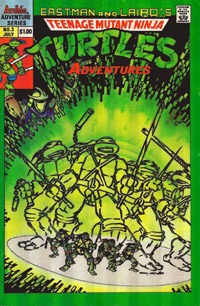
tmntadventures003The Incredible Shrinking Turtles Part 1

Adaptation: Beth & Ken Mitchroney
Pencilling: Ken Mitchroney
Inking: Dave Garcia
Lettering: Gary Fields
Coloring: Barry Grossman
Cover: Kevin Eastman, Peter Laird, Steve Lavigne
Editor: Victor Gorelick
Published by: Archie
Cover Date: July 1989
Cover Price: $1.00

Straight away, I think this is probably the most “fun” I’ve had re-reading any of these issues so far. The cover image is of course familiar to me–both from simply seeing it through the years as well as being an obvious “Mirage” piece, certainly a large influence of Eastman. The coloring–with all the green–is a little boring, but I am a fan of thick borders around an image…there’s just something about it that works for me, so overall I do like the cover.

I like the interior art quite a bit. Mitchroney keeps a certain “fun” feel to the visuals–and the characters recognizable–while bringing a slightly different style that hasn’t been seen in the Archie issues til this. I think it’s that the turtles look like comic characters here, MEANT FOR comics, rather than just being drawn to look like the tv show. The rest of the characters hold a consistent look to previous issues, but work well to me.

The story is a straight up adaptation of the first part of the cartoon episode, but I like it here. We find the turtles working out and see them interacting when a spaceship crashes in a lake right near where the turtles were hanging out (mighty convenient, that). The turtles leap in to see if there are any survivors, and pull an alien out. The alien references an “Eye of Sarnath” and gives them a device to track the Eye. Shredder (who EXTREMELY CONVENIENTLY has been watching from within a nearby bush) decides he must have the Eye. Later, the turtles are on the hunt, as is Shredder–now having brought Baxter Stockman along. The first piece of the Eye is found on a garbage barge, and while the turtles find it first, Shredder’s right there to take it from them. They fight–Shredder defeating the turtles–and then the piece activates, shrinking the turtles. They escape to the sewers and Splinter enlists April. Before those two can act, they hear a news bulletin about the Empire State Building being shrunk and race to the scene. Already at the scene, Baxter (in a fake Police uniform) takes the shrunken building. Shortly, at Shredder’s hideout we see the villain preparing to use the building as proof of the Eye’s power to convince Krang to send him his foot soldiers.

As usual, there’s a lot crammed into a single issue, though this is thankfully less compressed than the original mini-series. Though the end isn’t much of a cliffhanger, it’s an ok breaking point to me (at least for my not yet having re-read the next issue nor rewatched the actual episode this is based on). There are some monstrous plotholes throughout the issue–something I blame on the simplicity of the cartoon this is adapted from. Despite those, as said above, this issue was a lot more fun to read than the previous five, and I look forward to getting to the second half, and maybe even re-watching the cartoon episode for good measure.

These first few issues had the look of being two-part adaptations of episodes…which could have carried this into the mid-20s on issues if the formula was kept of splitting each episode across two issues. As the first of two parts and the nature of the issues, one doesn’t really need to have read the last couple episodes to “get” this…just know the basics of the turtles and enjoy a “random” story in the (for obvious reasons) style of the ’80s cartoon.

Skipping YEARS ahead (comics-wise) I recall that this story comes back into play, which I think lends to my enjoyment of this issue…particularly with my eagerness to get back into the Clarrain/Allan run.

On the whole…nothing overly special to this issue in and of itself. No particular memories associated with this story beyond where it plays into things that story around #47. But I think it’s safe to say that of these early issues, this one’s my favorite yet!

TMNT Revisited: Teenage Mutant Ninja Turtles Adventures #2

tmnt_adventures_revisited

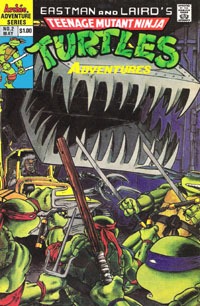
tmntadventures002Return of the Shredder (part 2 of 2)

Written, Drawn, and Lettered by: Dave Garcia
Adapted from Scripts by: Christy Marx and David Weiss
Colored by: Barry Grossman
Editor: Victor Gorelick
Cover by: Eastman, Laird, Lavigne
Published by: Archie/Mirage
Cover Price: $1.00
Cover Date: May 1989

This issue gives us the second part of the adaptation of Return of the Shredder. There’s a lot going on in the issue as it zips through the second half of the episode. Shredder breaks Baxter Stockman out of the asylum he’s being held in and recruits him to build the greatest rat-catcher ever–which he does, capturing Splinter while the turtles are out. The turtles, meanwhile, find and take down the fake turtles gang and discover a message from Shredder. This leads them to a confrontation with the villain as he stands by with Splinter ctied to a wall and a huge battering ram situated to swing down once its rope is cut. Baxter bursts in with his modified forklift/rat-trap and provides the distraction the turtles need to rescue their master. Shredder escapes, taking Baxter with him, and tries to explain the failure to Krang. Back at April’s office, we see her boss’s fling end, and the turtles have a meta-moment in the lair watching her news report on the capture of the Crooked Ninja Turtle Gang.

Story-wise, I’m still not impressed with this. I hold that for me, at least, looking back across 20+ years–there’s little characterization here and most of what I “know” is experiential rather than learned from the issue. There are plot-holes a truck (or giant rat-catcher) could be driven through, and things seem overly simplified in their way. I also continue to lay the bulk of the blame for that on this being an adaptation, and the material it had to work from (to say nothing of the fact that this is aimed more at the audience of the ’80s cartoon series, and my present-day self is certainly far from being the target audience). That said, the adaptation is pretty faithful to the cartoon, enough so that I can “hear” the characters’ voices as I read.

Visually, the issue is in a middle ground somewhere. The art is solid, good, but not exactly a favorite. All the characters are recognizable except April’s coworker Irma, who just looks significantly “off” from her appearance in the cartoon. Beyond that my main issue with the art is primarily that it doesn’t match the cartoon exactly, and the differences are very noticeable.

Overall, the issue simply “is what it is,” the second of a two-part adaptation of a single episode. Which is far preferable to the “ultra-compressed” nature of the mini-series. While this is still compressed by contemporary standards, it fits well enough into its place in history.

My copy of this issue is in fairly rough shape–a bit yelled, rough edges, the cover doesn’t quite line up with the pages. The cover image works well, though, and is far superior to any of the interior panels of the turtles facing Baxter.

I’m looking forward to the next issue, as it’s a story I haven’t read or particularly thought about in quite awhile…plus, I’m looking forward to getting into the “new stories” that made me love this series, beginning with #5.

The ’80s Revisited: Crisis on Infinite Earths #12

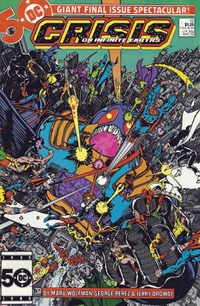
crisis_on_infinite_earths_0012Final Crisis

Writer/Editor: Marv Wolfman
Co-Plotter/Penciller: George Perez
Embellisher: Jerry Ordway
Letterer: John Costanza
Colorist: Tom Ziuko
Published by: DC Comics
Cover Date: March, 1986
Cover Price: $1.25

This is a large, convoluted issue with way too much going on to really summarize and address in any great detail in the general length I allow myself, and to do so without having to go into a lot of detail. Essentially, an infinite multiverse has been condensed down to one universe, though a bunch of heroes from parallel universes remain, having been outside time when that consolidation occurred. They’re split up to address issues on multiple fronts…namely the Anti-Monitor. Said villain just refuses to go down and STAY DOWN, rising multiple times from seeming defeat. In the course of this, a number of elements get loosely addressed, we have some characters killed off, others get a sendoff, and others simply get brief appearances with loose/quick details "setting stuff up" for moving forward (such as Wally learning of Barry’s death and becoming Flash instead of Kid Flash).

While I tend to like and appreciate Wolfman‘s art, and certainly enjoy Perez and Ordway both, reading this issue was a chore. I first read it about a decade ago–sometime around Infinite Crisis, if I recall correctly–having "finally" sought out the collected volume to actually read the "original Crisis" for myself given its 20-year anniversary had cropped up with a "sequel" of sorts (yet, amazing to consider yet another 10 years have passed and we’ve had a 30-year anniversary edition!).

Given what it is, and dealing with an entire universe and wrapping up stuff from a year’s worth of issues and all that, I have no real problem with the story…it’s just dense and seems like it has a huge amount of ground to cover in its limited pages despite being an extra-sized issue.

The art, of course, is fantastic–Perez and Ordway teamed up? Doesn’t get much better than that!

The creative team as a whole packs a heckuva lot into this, which I do like; but I can only imagine what I’d feel about it if it were a brand-new issue in 2016.

While we do have the "ultimate defeat" of the Anti-Monitor in this issue and a bit of an epilogue explaining a few things, overall this issue itself caps off the series, and I feel like I missed a lot by not reading the previous couple issues, and lost the scope or "epic-ness" of the story jumping in on this alone. As the story has been a "complete, full story" for three decades, I don’t think I’d recommend this as something to just sit down and read as an isolated issue. It’s sort of neat to flip through and see just the isolated chapter rather than the final segment of pages in a collected volume…but I think Crisis works much better read as a whole than just grabbing an issue.

For a 25-cent issue, it’s not a horrible read…but there’s certainly a lot of nuance that I am not picking up on given the decade’s space between this and when I last read the earlier issues.

Old-School Variance: Superman #75

I’ve often referenced it, but rarely had actual "live" photographic example to illustrate the point.

I do not consider 1990s "Collector’s Edition" and "Newsstand Edition" comics to be variants. Technically, I’ll give you that they are variants–one issue with two (or more) different covers.

Perhaps it’s that typically there would be two covers, and two covers "only" in such cases. There was also the notion of the selling channel–one version was intended for the "direct market" (comic shops) and the other for standard newsstand distribution. Also the fact that they were equally orderable by a shop–no "regularity" of 1:10 or other worse "ratios" on ordering and the other ridiculousness seen today. (special cases such as "platinum" or "gold" editions could be an exception, but those tended to seem truly "special" compared to 2016 1:50 or 1:100 or 1:500 or 1:1000 ratios!)

Back in 1992, there was the cover image. This is what people were looking for. They’d seen the image on tv, in the newspapers, in magazines, etc…so this is what they were looking for; and it was the content of the issue, the "event" of the story that was key, not which of fifty dozen alternative covers you had.

superman_0075_all_4_printings_newsstand

The variance (as opposed to variants/multiple editions) of the Superman #75 covers is due to the multiple print-runs. You have your standard first print; and then for later printings, rather than taking interior art or additional artists, the color of the Superman logo and text The Death of Superman! was changed, and a small Roman Numeral was added to the cover copy to clearly indicate which printing the issue was. (I recently came across at copy of The Killing Joke that I had and couldn’t find anything saying which printing it was…I finally realized/remembered that which printing is indicated simply by the color of the book’s title and the cover price). That’s part of why the issue(s) are so clearly "iconic" and memorable…they’ve not been diluted by umpteen hundred different images for just one issue.

It’s occurred to me that there’s likely additional variance–the UPC box. In my photo here, the first print has an actual bar code…while printings II, III, and IV have the creator credits (these are direct market copies of the "newsstand edition.") I also make a distinction there–bar code vs. not–I consider the same. I’m not actually sure if the later printings have a version with the bar code, or if the later printings were comic-shops-only (newsstands perhaps having gotten the first printing only, and anyone else had to go to the direct market?)

Anyway…the ultimate point of this post is the photo; that these are 4 different versions of the same edition of the same issue, just produced as separate print-runs. Yet same cover image, still instantly recognizable as the same issue, despite not all being printed at the same time.

TMNT Revisited: Teenage Mutant Ninja Turtles Adventures #1

tmnt_adventures_revisited

tmntadventures001Return of the Shredder (part 1 of 2)

Art and letters by: Dave Garcia
Adapted from Scripts by: Christy Marx and David Wise
Color by: Barry Grossman
Editor: Victor Gorelick
Cover: Eastman, Laird, Lavigne
Published by: Mirage/Archie
Cover Price: $1.00
Cover Date: March 1989

We begin the issue with Mikey and Leo in a supermarket, doing some casual shopping. A couple of would-be thieves try to hold up the place, but the turtles stop them without any trouble at all. Back home, they wax nostalgic of the workout Shredder’s foot-bots gave them. Meanwhile in Dimension X, Shredder laments his recent defeat and begs Krang to send him back to earth. Tiring of the whining, Krang does so…but sends him alone. To Shredder’s surprise, he’s been left without any of his previous resources, and must make do with himself and anything new he can do.

Still meanwhile, at Channel 6, April’s boss has a new girlfriend who hates turtles, and thus he tries to impress her by pushing an anti-turtle agenda that April (of course) rebels against. Shredder recruits some thugs at a dojo and has them dress in turtle costumes…on the idea that if he turns the citizenry against the turtles, they’ll be forced to come out to defend themselves. Krang disagrees, and maintains his strict notion: Shredder’s on his own until he produces results. We leave off on Shredder musing that he’s left with just one place to turn…

While still rather corny and hokey (and I mostly blame the plot the comic’s creative team had to work with), this is a huge step up from the initial mini-series. While that was cramming nearly an episode and a half into each issue, this series gives the adaptation room to breathe. This entire issue comprises a mere HALF of one single episode.

The story feels a lot more open and a bit more complex as a result of the extra space for pacing. However, the characters all still seem rather surfacey and underdeveloped. If I didn’t already know plenty about them, I’d hardly know one from another. Additionally, April’s coworkers are little more than plot-point gags.

The art has a much different feel to it while maintaining a certain familiarity. The creative team is different from the mini-series, and other than the cover doesn’t seem to be utilizing any names I recognize as being from Mirage. The art isn’t bad, but it’s not wonderful…though I do definitely appreciate the layouts and that we aren’t given a bunch of huge splash panels or full or double-page splashes. This sticks very much to a “typical” comics feel and appearance, just differentiated by the turtles.

All in all, nothing terribly special about the issue–though I definitely like the cover. It’s one of the most “iconic” to me, and to this day it would hold up well as a poster or some oversized print, I think.

This was one of my earliest #1 issues of anything…back when #1s were actually a ‘special’ and significant thing, not something that came around every year or two for the same series again and again. Though I remember this as one of my earliest, I can’t honestly remember where I got this issue–whether it was a $5 issue at Capp’s Comics, or something I found at Comics & Collectibles. And I’m pretty sure I did not get it through American Entertainment–I remember a couple other issues from the mail-order route.

While I’ll get to it when I cover it, I’m actually more inclined to count these earliest issues as a longer mini-series, and see #5 of TMNT Adventures as being the true first issue of the run.

The ’80s Revisited: The Flash (1987) #1

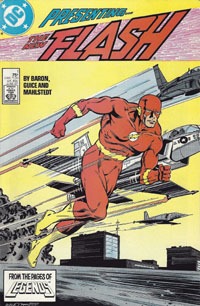
flash(1987)_0001Flash

Writer: Mike Baron
Penciller: Jackson Guice
Inker: Larry Mahlstedt
Letterer: Steve Haynie
Colorist: Carl Gafford
Editor: Mike Gold
Published by: DC Comics
Cover Date: June, 1987
Cover Price: 75 Cents

I’ve been quite aware of The Flash–particularly Wally–since my initial foray into comics back in 1989/1990…my earliest conscious exposure to the character offhand was Adventures of Superman #463. Mr. Mxyzptlk forced the two to race…and this stands out to me because of the fact of Wally constantly eating, the notion that even with the super-speed, he was still burning calories and all that (to my 8/9 year old self, the simple “have to eat to keep going” was enough). I became more aware of the character with guest-appearances here and there, and the “key” role he played at the start of Zero Hour, and as I learned more about “continuity” and such, I became aware of Barry and generally got to where the Flash was an accepted character for me.

I didn’t start picking up any issues of his actual series on any regular basis, though, until #197 (Geoff Johns, first issue of the Blitz arc) in 2003 or so, and I’ve moved forward from there. I’ve become aware of several creative teams, and it was all the positive “buzz” for Mark Waid‘s run and then the (at the time) up and coming Geoff Johns that eventually led to me trying the series. But outside of maybe a couple issues, I really have never actually gotten (around) to reading Wally’s series, particularly from this period.

So jumping into #1 here rather arbitrarily was definitely an interesting experience.

We open on Wally–now 20–at a convenience store and come to find out he’s marking time before a “surprise” party for his 20th birthday. He’s no longer a teenager (and now being The Flash and not Kid Flash, no longer a “teen” Titan). He’s “graduated” into the role, stepping into the costume previously worn by Barry Allen, and he’s got huge boots to fill. Before the party can really get rolling, Wally receives a phone call: a heart is available for a transplant…in Seattle. And conventional technology cannot get it there in time, so it’s up to Wally to race the heart to the opposite coast. He extracts some conditions, pointing out that he’s doing a favor, and these doctors are getting paid huge sums, but he (Wally) could use medical insurance (wow…30 years ago!) and such…that it’s the principle of the matter. (To say nothing of the fact that he needs the calories for such an extensive trip). Along the way Wally encounters someone who was apparently attacked by Vandal Savage, and witnesses other situations he can’t stop for…but he eventually arrives and the transplant’s a success, and (after 17 hours’ sleep) Wally gets to meet the patient, who conveniently has some knowledge of (at least the rumour of) Vandal Savage. After being returned home (via plane), Wally receives a package…with a heart–and meets Vandal Savage.

I just double-checked…and this issue is “only” 22 pages of story. So much in it, and clear to follow, and it’s all crammed into 22 pages. We meet the main character, and start off on this key day–he’s now The Flash (not Kid Flash), he’s just turned 20; we see him with friends/teammates for context; we get details about who he is, what he is, how he got here, limitations of his powers, etc; we see him in action AS the Flash; clear differences between THIS Flash and his predecessor are highlighted; immediate threats overcome and a new threat set up, and close on the introduction of a “big bad” for the upcoming issues. Basically, this is an excellent sort of first issue!

This issue looks and feels like a mid/late-’80s book…which is quite appropriate. Guice‘s art is top-notch, and I really like it here. The detail may not quite be quite the level of, say, George Perez of this time, but it’s quite good and works very well for me, with all relevant characters looking as I’d expect for my contextual knowledge of the time, they look familiar/recognizable, and the visuals never failed me as to what was going on.

Story-wise, as said, this is an excellent first issue with numerous “bullet points” touched on that I would hope and expect a first issue to do…I genuinely want to read the next issue, such that I find myself thinking I’d willingly buy the next several issues at “full back issue pricing” (up to $2-$3 per) just for the sake of immediacy on getting to read them (or $1.99 for digital; same reasoning).

I really like that we get a concrete age for Wally–I’m not sure how old I’d’ve pegged him by the early 200s (probably mid-20s at least), and concrete ages don’t often seem to be established for characters. While I get that many don’t want to nail characters down or “limit” them that way, I’m one that really likes that sort of detail, even if it comparatively “ages” other characters. I also really like that Wally seems young-ish (I’m in my mid-30s myself!) and I truly get that sense of his just now stepping up into the Flash role–I can “see” the Kid Flash there, essentially “trying on” the “real Flash” costume; he wears it but does not seem particularly comfortable in it. (And I know from other stuff I’ve read ABOUT the series that that’s something that largely continues for a number of years of stories, such that the reader gets to see Wally’s progression to where he truly comes into his own as The Flash).

I enjoyed this issue, and it was honestly a real treat to read. I know I snagged this copy from a quarter bin, and it’s absolutely worth 25 cents, or $1…as a #1 from when such things were treats and rarities, I’d say this would even be well worth getting up to $5ish. As you can get it digitally for about $2, I wouldn’t recommend going much above that, though, unless you’re particularly interested in owning this issue. It’s well worth the $2 to at least read, and I very much look forward to digging up the next few issues, either from my own collection or re-buying in some form for the immediacy.

The ’80s Revisited: Captain Atom Annual #1

captain_atom_annual_0001The Dark Side of the Force

Writer: Cary Bates
Co-Plotter: Greg Weisman
Penciller: Pat Broderick
Inker: Bob Smith
Colorist: Carl Gafford
Letterer: Duncan Andrews
Editor: Denny O’Neil
Published by: DC Comics
Cover Date: 1988
Cover Price: $1.25

I’ve long been aware of Captain Atom, and have even read some issues here and there with the character. I believe he was in some Justice League (America) issues; I know he was in Armageddon 2001; I read at least most of the Captain Atom: Armageddon series he was in, blowing up the Wildstorm universe some time back; there’s the parallel with Dr. Manhattan in Watchmen…and of course, the character’s brief but pivotal role in Kingdom Come, to name a few offhand. I think I may even have read the first issue or two/few of his 1980s ongoing series at one point, though I don’t consciously remember much beyond the basic origin (so I probably read it around the time I read Watchmen back in the early 2000s).

Going through a stack of comics recently, I happened across this issue–certainly a quarter-bin find–and it struck me as interesting "in the moment" to read due to the cover proclamation: "Enter: Major Force!" I’m more familiar with Major Force as the character that killed Kyle Rayner’s girlfriend (stuffing her body in the refrigerator) back in the early days of the new direction for Green Lantern. Having briefly revisited that era recently in covering the Zero Hour crossover, I was all the more curious about how long the character had been around. This issue seems either a first appearance, or at least a post-Crisis on Infinite Earths (CoIE) first appearance. Given the character tying into Captain Atom’s origin and some guessing, I’m pretty sure this is the first appearance of the character.

The issue opens with a conspiracy-theorist radio show, the host talking about a corroborated incident of a UFO crashing in a quarry. We then move to Captain Atom arriving on the scene, and something emerges–an alien creature that the Captain winds up fighting. Meanwhile, an anonymous Major joins the scene, and we see that events are being manipulated to create an apparent origin of a new super-hero: that of a Major helping Captain Atom and being fused with an alien creature. When, in fact, this is the result of a later experiment like the one that created Captain Atom, but with different variables…and the "alien" is in fact another test subject. Due to his position and government involvement, Captain Atom goes along with things, introducing/endorsing this new guy to the public…as they get Major Force. Predictably (this comic is from 28 years ago!) Force doesn’t "work out" in the role of super-hero, as his methods are violent and don’t account for innocents/civilians. When CA tries to rein things in, the Major fights back. Captain Atom emerges from the battle victorious…though in its course he seems to have made a decision, delivering his message ("I quit!") along with the unconscious Major Force to his government handlers.

The issue has page numbers, with the story ending on a page numbered ’39’ so this is basically a double-length issue. As an Annual, it’s a ‘special’ issue, with a bigger story (but relatively self-contained) than just another issue of an ongoing series. Being from the late 1980s, and evaluating this (having read it), it seems to be an Annual from when such things "counted," and were truly a bonus or special issue along with the ongoing run, and having stuff important to the character’s ongoing status quo. In this case, the issue seems to be the point at which Captain Atom has had enough of just going with the flow and taking orders, and after seeing what the government/his handlers are up to, he can’t stick around simply accepting the status quo.

As an Annual (and a first one, at that), I figured this to be a decent sort of one-shot, though a lot of that comes from my own experience with comics, and DC history/continuity. We don’t get a lot of context/background on Captain Atom or a supporting cast in this issue, but we do get some slight references such that knowing what I do, it all fits.

I’m good with the art–it neither blows me away nor disappoints…it just "is." This looks and feels (visually and story-wise) like an ’80s comic, and something to it (such as the introduction of a character I know gets used more and in key ways years later) feels a lot LIKE the start of a new super-hero universe…which at this point, the then-current DC Universe essentially was. And I like that.

The story itself is decent, and seems to draw on existing continuity (at least from the Captain Atom series) and expects the reader to at least somewhat know what’s going on; introduces a new villain/antagonist or opposite version of the hero with an origin, background, some character/world-building, and ultimately resolution…while leaving things open for later use of the character as well as modifying the status quo (presumably, at least!) for the ongoing series. I notice that quite unrelatedly, this is the second issue in the last few days I’ve read written by Bates (the other was Action Comics #428) and am pretty sure the co-plotter (Greg Weisman) is the same who eventually did Gargoyles for Disney years after this.

For an issue that I only paid a quarter to purchase, this was definitely a good value for the time it took to read, and I enjoyed adding this piece to the puzzle–I’ve now read the introduction of Major Force and this also re-kindles a bit of my interest in the early Captain Atom series (I believe I have the first year or so of issues SOMEWHERE in my collection).

While this issue won’t hold the reader’s hand, it’s a solid piece with a nice length, and is definitely worth a read if you’re interested in the title character, villain, or this period in DC‘s history. If you find it in a bargain-bin–MAYBE up to $2ish–its well worthwhile. At a higher price, I’d say you’d have to really have a specific interest in this, rather than anything casual.

The ’70s Revisited: Action Comics #428

action_comics_0428Whatever Happened to Superman?

Story: Cary Bates
Art: Curt Swan and Murphy Anderson
Editing: Julius Schwartz
Published by: DC Comics
Cover Date: October, 1973
Cover Price: 20 cents

The Plot to Kill Black Canary!

Story by: Elliot Maggin
Drawn by: Dick Giordano
Edited by: Julie Schwartz

GBS has had a new satellite launched. Superman flies into action to stop a fire raging far above easy reach of firemen, and conveniently (and extremely quickly) locates and flies in an iceberg, melting it with his heat vision to put out the fire. But the world sees just a storm cloud and rain. As Superman investigates this phenomenon, he becomes aware of the fact that everyone believes Superman hasn’t been seen in ten years–even going so far as to (as Clark Kent) do a shirt-rip on live TV…but all anyone sees is Clark revealing an undershirt. Of course, the real villain turns out to be Lex Luthor. Luthor mouths off, revealing his plan when Superman poses as a newly-assigned inmate occupying the "empty cell," convincing Luthor he’d been double-crossed and had himself been "forgotten." All’s well that ends well, right?

Meanwhile, in the Green Arrow (and Black Canary) portion of the issue, we see Ollie on the phone, declaring "Listen, Trump–when Ollie Queen says his Public Relations Agency will make your motorcycles sell…they’ll sell!" He then springs into action, recruiting Dinah Lance (aka Black Canary), and convinces her to participate in a stunt for a commercial. Later, Ollie’s made aware of a planned attempt on Dinah’s life, so he goes back into action and saves her (though she’s not at all happy about it, as he should’ve just told her what was going on). Again, all’s well that ends well, right?

Visually, this issue simply "looks like" one of Grandpa’s comics. And I’m pretty confident that that literally is what this one is–one of Grandpa’s comics, from back in the day, that somehow got mixed into stuff that wound up in my family’s garage, where I found it recently.

And that obviously makes sense–Curt Swan? Murphy Anderson? Dick Giordano? Big names I recognize from the time period and associate (particularly) with DC Comics; Swan all the moreso with Superman. And of course, I recognize the other credited names as well from the time. For where I’m at, the credits read like a roll call of classic creators, all of which have a good name to me when it comes to comics.

I’m not the fondest guy when it comes to pre-Byrne Superman comics–I was introduced to and grew up on the post-CoIE Superman, and hold that as my favorite to this day. But I also have plenty of fond memories of laying on a bed, having pulled out many of Grandpa’s comics from a cabinet, literally surrounded with more comics than I could truly hope to read in the limited time(s) I had there. For the 8-9-year-old-Me, that was a key time for me, when Superman comics were just Superman comics, and I had no clue who any of the creators were, never noticed any of the credits, and hardly even noticed any numbers or saw much distinction, say, between Action Comics or Superman or such…they were just titles on a cover, and I don’t recall ever sorting the comics to put them into numerical order or systematically reading through any given title. I just looked for the coolest-looking cover, or whichever character(s) I was interested in reading at the time.

So, I can definitely say that this issue held up to that. It’s not the craziest or silliest or most out-there story. It’s–as many such were, and particularly compared to modern post-2010 comics–a highly-compressed story. Thirteen or so pages, and I could easily see how this would be grounds for a six-issue (at least) story nowadays*.

(*As a de-compressed story, I figure the first issue would include a bit more detail of Superman doing super-feats and perhaps a bit more foreshadowing with the satellite and such, and likely end with an initial revelation/question like "What are you talking about? Superman’s been missing for TEN YEARS!"–To Be Continued. We’d then get several issues of Superman investigating the phenomenon while performing further super feats and being increasingly stressed at not being "seen" as Superman; we’d get details of it affecting him in private life, and possibly relationships with others, as he starts questioning his own sanity. There might even be one-shots or a JLA mini-series to see how other characters are reacting to a world seemingly without Superman; how their attitudes toward the hero gig are affected by believing Superman’s been missing for a decade, and so on; and maybe even a couple new characters introduced that are trying to follow in the legacy of the "missing" hero.)

As-is, it’s fast-paced, introducing the problem, exploring it, and resolving it, with little deep exploration of the implications of stuff, and we’re done start-to-finish in just this issue, half the issue.

The Green Arrow piece looks remarkably good…though I guess I shouldn’t seem surprised (yet, I was!) The character looks exactly as I like him, with the hat and goatee and such. I looked up the dates, because it felt like the Ollie from the Green Lantern/Green Arrow run, but I suspect this was from just after or near the end of that run…this being 1973, while that run started in 1970.

The GA story itself is rather simplistic, and seemed a little heavy on pushing whatever dynamic it is with Ollie and Dinah. Being such a short story and characters I’m less familiar with from this time, it’s a bit short to try to dig in and analyze much…suffice it to say I wasn’t enamored with it as a singular, stand-alone story. It seems like something that would read better in a group of stories for longer context. Of course, there’s also the fact that it was a Green Arrow story when I set out to read a Superman comic. That said, I was quite grabbed by the opening with Ollie yelling into the phone to Trump.

THAT Trump.

The Liberal Oliver Queen, Green Arrow, enthusiastically doing business for Donald Trump.

What a difference 40+ years makes, right?

All in all, this issue was an enjoyable read, and a nice trip down memory lane. I’m glad to have read the issue, for myself. I’m awed at considering the timeframe, that the cover references 35 years of Superman, and here it’s been another 43 years since then…this issue is from less than HALFway into its run and Superman’s existence and all that.

Other than the Trump reference in the Green Arrow/Black Canary piece or interest in the actual reading experience of the Superman story given my lack of brevity discussing the issue, I don’t really see or know anything of this issue to make it singularly a stand-out issue or to overly differentiate it from any other issue from the early-’70s with the creative teams. Still, it’s not a bad issue, and if you find it cheaply, it’s not a bad one.