• April 2026
    S M T W T F S
     1234
    567891011
    12131415161718
    19202122232425
    2627282930  
  • On Facebook

  • Archives

  • Categories

  • Comic Blog Elite

    Comic Blogs - BlogCatalog Blog Directory

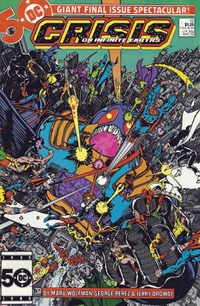
The ’80s Revisited: Crisis on Infinite Earths #12

crisis_on_infinite_earths_0012Final Crisis

Writer/Editor: Marv Wolfman
Co-Plotter/Penciller: George Perez
Embellisher: Jerry Ordway
Letterer: John Costanza
Colorist: Tom Ziuko
Published by: DC Comics
Cover Date: March, 1986
Cover Price: $1.25

This is a large, convoluted issue with way too much going on to really summarize and address in any great detail in the general length I allow myself, and to do so without having to go into a lot of detail. Essentially, an infinite multiverse has been condensed down to one universe, though a bunch of heroes from parallel universes remain, having been outside time when that consolidation occurred. They’re split up to address issues on multiple fronts…namely the Anti-Monitor. Said villain just refuses to go down and STAY DOWN, rising multiple times from seeming defeat. In the course of this, a number of elements get loosely addressed, we have some characters killed off, others get a sendoff, and others simply get brief appearances with loose/quick details "setting stuff up" for moving forward (such as Wally learning of Barry’s death and becoming Flash instead of Kid Flash).

While I tend to like and appreciate Wolfman‘s art, and certainly enjoy Perez and Ordway both, reading this issue was a chore. I first read it about a decade ago–sometime around Infinite Crisis, if I recall correctly–having "finally" sought out the collected volume to actually read the "original Crisis" for myself given its 20-year anniversary had cropped up with a "sequel" of sorts (yet, amazing to consider yet another 10 years have passed and we’ve had a 30-year anniversary edition!).

Given what it is, and dealing with an entire universe and wrapping up stuff from a year’s worth of issues and all that, I have no real problem with the story…it’s just dense and seems like it has a huge amount of ground to cover in its limited pages despite being an extra-sized issue.

The art, of course, is fantastic–Perez and Ordway teamed up? Doesn’t get much better than that!

The creative team as a whole packs a heckuva lot into this, which I do like; but I can only imagine what I’d feel about it if it were a brand-new issue in 2016.

While we do have the "ultimate defeat" of the Anti-Monitor in this issue and a bit of an epilogue explaining a few things, overall this issue itself caps off the series, and I feel like I missed a lot by not reading the previous couple issues, and lost the scope or "epic-ness" of the story jumping in on this alone. As the story has been a "complete, full story" for three decades, I don’t think I’d recommend this as something to just sit down and read as an isolated issue. It’s sort of neat to flip through and see just the isolated chapter rather than the final segment of pages in a collected volume…but I think Crisis works much better read as a whole than just grabbing an issue.
For a 25-cent issue, it’s not a horrible read…but there’s certainly a lot of nuance that I am not picking up on given the decade’s space between this and when I last read the earlier issues.

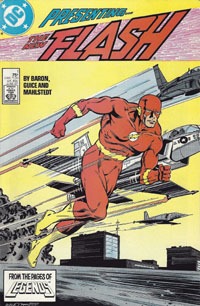
The ’80s Revisited: The Flash (1987) #1

flash(1987)_0001Flash

Writer: Mike Baron
Penciller: Jackson Guice
Inker: Larry Mahlstedt
Letterer: Steve Haynie
Colorist: Carl Gafford
Editor: Mike Gold
Published by: DC Comics
Cover Date: June, 1987
Cover Price: 75 Cents

I’ve been quite aware of The Flash–particularly Wally–since my initial foray into comics back in 1989/1990…my earliest conscious exposure to the character offhand was Adventures of Superman #463. Mr. Mxyzptlk forced the two to race…and this stands out to me because of the fact of Wally constantly eating, the notion that even with the super-speed, he was still burning calories and all that (to my 8/9 year old self, the simple “have to eat to keep going” was enough). I became more aware of the character with guest-appearances here and there, and the “key” role he played at the start of Zero Hour, and as I learned more about “continuity” and such, I became aware of Barry and generally got to where the Flash was an accepted character for me.

I didn’t start picking up any issues of his actual series on any regular basis, though, until #197 (Geoff Johns, first issue of the Blitz arc) in 2003 or so, and I’ve moved forward from there. I’ve become aware of several creative teams, and it was all the positive “buzz” for Mark Waid‘s run and then the (at the time) up and coming Geoff Johns that eventually led to me trying the series. But outside of maybe a couple issues, I really have never actually gotten (around) to reading Wally’s series, particularly from this period.

So jumping into #1 here rather arbitrarily was definitely an interesting experience.

We open on Wally–now 20–at a convenience store and come to find out he’s marking time before a “surprise” party for his 20th birthday. He’s no longer a teenager (and now being The Flash and not Kid Flash, no longer a “teen” Titan). He’s “graduated” into the role, stepping into the costume previously worn by Barry Allen, and he’s got huge boots to fill. Before the party can really get rolling, Wally receives a phone call: a heart is available for a transplant…in Seattle. And conventional technology cannot get it there in time, so it’s up to Wally to race the heart to the opposite coast. He extracts some conditions, pointing out that he’s doing a favor, and these doctors are getting paid huge sums, but he (Wally) could use medical insurance (wow…30 years ago!) and such…that it’s the principle of the matter. (To say nothing of the fact that he needs the calories for such an extensive trip). Along the way Wally encounters someone who was apparently attacked by Vandal Savage, and witnesses other situations he can’t stop for…but he eventually arrives and the transplant’s a success, and (after 17 hours’ sleep) Wally gets to meet the patient, who conveniently has some knowledge of (at least the rumour of) Vandal Savage. After being returned home (via plane), Wally receives a package…with a heart–and meets Vandal Savage.

I just double-checked…and this issue is “only” 22 pages of story. So much in it, and clear to follow, and it’s all crammed into 22 pages. We meet the main character, and start off on this key day–he’s now The Flash (not Kid Flash), he’s just turned 20; we see him with friends/teammates for context; we get details about who he is, what he is, how he got here, limitations of his powers, etc; we see him in action AS the Flash; clear differences between THIS Flash and his predecessor are highlighted; immediate threats overcome and a new threat set up, and close on the introduction of a “big bad” for the upcoming issues. Basically, this is an excellent sort of first issue!

This issue looks and feels like a mid/late-’80s book…which is quite appropriate. Guice‘s art is top-notch, and I really like it here. The detail may not quite be quite the level of, say, George Perez of this time, but it’s quite good and works very well for me, with all relevant characters looking as I’d expect for my contextual knowledge of the time, they look familiar/recognizable, and the visuals never failed me as to what was going on.

Story-wise, as said, this is an excellent first issue with numerous “bullet points” touched on that I would hope and expect a first issue to do…I genuinely want to read the next issue, such that I find myself thinking I’d willingly buy the next several issues at “full back issue pricing” (up to $2-$3 per) just for the sake of immediacy on getting to read them (or $1.99 for digital; same reasoning).

I really like that we get a concrete age for Wally–I’m not sure how old I’d’ve pegged him by the early 200s (probably mid-20s at least), and concrete ages don’t often seem to be established for characters. While I get that many don’t want to nail characters down or “limit” them that way, I’m one that really likes that sort of detail, even if it comparatively “ages” other characters. I also really like that Wally seems young-ish (I’m in my mid-30s myself!) and I truly get that sense of his just now stepping up into the Flash role–I can “see” the Kid Flash there, essentially “trying on” the “real Flash” costume; he wears it but does not seem particularly comfortable in it. (And I know from other stuff I’ve read ABOUT the series that that’s something that largely continues for a number of years of stories, such that the reader gets to see Wally’s progression to where he truly comes into his own as The Flash).

I enjoyed this issue, and it was honestly a real treat to read. I know I snagged this copy from a quarter bin, and it’s absolutely worth 25 cents, or $1…as a #1 from when such things were treats and rarities, I’d say this would even be well worth getting up to $5ish. As you can get it digitally for about $2, I wouldn’t recommend going much above that, though, unless you’re particularly interested in owning this issue. It’s well worth the $2 to at least read, and I very much look forward to digging up the next few issues, either from my own collection or re-buying in some form for the immediacy.

The ’80s Revisited: Captain Atom Annual #1

captain_atom_annual_0001The Dark Side of the Force

Writer: Cary Bates
Co-Plotter: Greg Weisman
Penciller: Pat Broderick
Inker: Bob Smith
Colorist: Carl Gafford
Letterer: Duncan Andrews
Editor: Denny O’Neil
Published by: DC Comics
Cover Date: 1988
Cover Price: $1.25

I’ve long been aware of Captain Atom, and have even read some issues here and there with the character. I believe he was in some Justice League (America) issues; I know he was in Armageddon 2001; I read at least most of the Captain Atom: Armageddon series he was in, blowing up the Wildstorm universe some time back; there’s the parallel with Dr. Manhattan in Watchmen…and of course, the character’s brief but pivotal role in Kingdom Come, to name a few offhand. I think I may even have read the first issue or two/few of his 1980s ongoing series at one point, though I don’t consciously remember much beyond the basic origin (so I probably read it around the time I read Watchmen back in the early 2000s).

Going through a stack of comics recently, I happened across this issue–certainly a quarter-bin find–and it struck me as interesting "in the moment" to read due to the cover proclamation: "Enter: Major Force!" I’m more familiar with Major Force as the character that killed Kyle Rayner’s girlfriend (stuffing her body in the refrigerator) back in the early days of the new direction for Green Lantern. Having briefly revisited that era recently in covering the Zero Hour crossover, I was all the more curious about how long the character had been around. This issue seems either a first appearance, or at least a post-Crisis on Infinite Earths (CoIE) first appearance. Given the character tying into Captain Atom’s origin and some guessing, I’m pretty sure this is the first appearance of the character.
The issue opens with a conspiracy-theorist radio show, the host talking about a corroborated incident of a UFO crashing in a quarry. We then move to Captain Atom arriving on the scene, and something emerges–an alien creature that the Captain winds up fighting. Meanwhile, an anonymous Major joins the scene, and we see that events are being manipulated to create an apparent origin of a new super-hero: that of a Major helping Captain Atom and being fused with an alien creature. When, in fact, this is the result of a later experiment like the one that created Captain Atom, but with different variables…and the "alien" is in fact another test subject. Due to his position and government involvement, Captain Atom goes along with things, introducing/endorsing this new guy to the public…as they get Major Force. Predictably (this comic is from 28 years ago!) Force doesn’t "work out" in the role of super-hero, as his methods are violent and don’t account for innocents/civilians. When CA tries to rein things in, the Major fights back. Captain Atom emerges from the battle victorious…though in its course he seems to have made a decision, delivering his message ("I quit!") along with the unconscious Major Force to his government handlers.

The issue has page numbers, with the story ending on a page numbered ’39’ so this is basically a double-length issue. As an Annual, it’s a ‘special’ issue, with a bigger story (but relatively self-contained) than just another issue of an ongoing series. Being from the late 1980s, and evaluating this (having read it), it seems to be an Annual from when such things "counted," and were truly a bonus or special issue along with the ongoing run, and having stuff important to the character’s ongoing status quo. In this case, the issue seems to be the point at which Captain Atom has had enough of just going with the flow and taking orders, and after seeing what the government/his handlers are up to, he can’t stick around simply accepting the status quo.

As an Annual (and a first one, at that), I figured this to be a decent sort of one-shot, though a lot of that comes from my own experience with comics, and DC history/continuity. We don’t get a lot of context/background on Captain Atom or a supporting cast in this issue, but we do get some slight references such that knowing what I do, it all fits.

I’m good with the art–it neither blows me away nor disappoints…it just "is." This looks and feels (visually and story-wise) like an ’80s comic, and something to it (such as the introduction of a character I know gets used more and in key ways years later) feels a lot LIKE the start of a new super-hero universe…which at this point, the then-current DC Universe essentially was. And I like that.

The story itself is decent, and seems to draw on existing continuity (at least from the Captain Atom series) and expects the reader to at least somewhat know what’s going on; introduces a new villain/antagonist or opposite version of the hero with an origin, background, some character/world-building, and ultimately resolution…while leaving things open for later use of the character as well as modifying the status quo (presumably, at least!) for the ongoing series. I notice that quite unrelatedly, this is the second issue in the last few days I’ve read written by Bates (the other was Action Comics #428) and am pretty sure the co-plotter (Greg Weisman) is the same who eventually did Gargoyles for Disney years after this.

For an issue that I only paid a quarter to purchase, this was definitely a good value for the time it took to read, and I enjoyed adding this piece to the puzzle–I’ve now read the introduction of Major Force and this also re-kindles a bit of my interest in the early Captain Atom series (I believe I have the first year or so of issues SOMEWHERE in my collection).

While this issue won’t hold the reader’s hand, it’s a solid piece with a nice length, and is definitely worth a read if you’re interested in the title character, villain, or this period in DC‘s history. If you find it in a bargain-bin–MAYBE up to $2ish–its well worthwhile. At a higher price, I’d say you’d have to really have a specific interest in this, rather than anything casual.

Zero Hour Revisited – Zero Hour #0

90srevisited_zerohour

zero_hour_0000Zero Hour

Story and Layout Art: Dan Jurgens
Ink Art: Jerry Ordway
Letters: Gaspar
Colors: Gregory Wright
Asst. Editor: Mike McAvennie
Editor: KC Carlson
Published by: DC Comics
Cover Date: September 1994
Cover Price: $1.50

Here we are, at last–the final issue of Zero Hour itself. We’ve seen time anomalies pop up, and worsen. We’ve seen heroes discover time is being destroyed in the past and the future, working toward the present. We’ve seen the emergence of Extant, and the fall of the Justice Society. We’ve had dozens of tie-in issues where few have directly been part of this core event, though a fair number have danced on the edges. We’ve seen Hall Jordan–former Green Lantern, now Parallax–revealed as the sentient, actual manipulator of things as he seeks to wipe the slate clean after his own trajedies. The heroes have failed, all time and space has been destroyed, and a handful of heroes pulled outside it all, while another small handful remains with Parallax.

Hal prepares energies for the re-creation of the universe, of all existence. His way will see many worlds, and all wrongs will be set right. There will be the Earth everyone knew, minus stuff like the Coast City disaster. There will be a world that Batgirl remembers, in which she was never assaulted by the Joker. Even Extant will have his own world to rule over. Everyone will be happy. This is opposed–how can Hal be God? Waverider and his group of heroes attacks, disrupting Hal, and ultimately–after quite a scuffle–the universe IS reborn…but it unfolds "naturally" withOUT any one entity controlling it, tweaking it. As such, events unfold mostly as remembered, but here there are no alternate timelines, so everyone, everything is folded into one single chronology. The potential time-loop is closed, and all it costs is Hal Jordan and the young Kyle Rayner…while Green Arrow is wracked by the guilt of losing (having had to try to kill) his best friend.

For some reason, the phrasing "the universe is born old" sticks out to me, reading the issue. That may be random or personal and get into stuff I’m not really going to get into in a comics blog, but it’s a key phrasing to my reading.

A lot happens in this issue–look a couple paragraphs above, and that feels like scratching the surface. And yet, it’s a simplistic issue. Time is restarted; Hal wants to tweak it his way, but he’s stopped and so it restarts and unfolds naturally, so it’s similar to before, with small adjustments that functionally "explain away" continuity glitches and timing and such; shuffling a few events here and there to mash into one specific timeline.

We’re left with the notion that anyone that died via entropy or the time fissures has been restored…while anyone who died "outside of Time" (such as the Justice Society) remains dead. Victory, but at a cost.

The art and visuals remain excellent here with clean, crisp pages and dynamic layouts and (to me) iconic scenes playing out.

I don’t know if I’d recommend this as a stand-alone issue out of context of its other issues, but in a way it does work as a singular thing. You open on nothingness, and from that, Hal and his group; the opposing group, we see the FINAL final battle, the villain defeated and the universe restored…and a hint of what’s to come, as well as a fold-out timeline laying everything out for now and moving forward into the rest of 1994 and beyond. So it works as an artifact of sorts, as seeing the end of the story. And if you’re actually going to read it–whether re-read or you’ve never before read it–it’s definitely worth getting if you come across it. But it’s even better if you can snag all five issues–4/3/2/1/0–and read this core story even without any of the other tie-ins!


Going beyond the issue itself and expanding on stuff…

This is a really effective issue and makes me think. There’s a part where Hal smiles, explaining he just wants to make everything right, he wants everyone to live, where I wonder if the intent was to go for a "creepy" smile, or a "mad" smile, as if Hal’s insane. Personally, I have always–and again this time through–found myself wondering ok, why SHOULDN’T he be able to fix things? He’s not talking about recreating a universe that he RULES, or subjugating entire populations, or ending his actions with half the living entities dead, or stuff like that. He’s not targeting any particular people to wipe them out–he’s not even talking about killing Mongul. He just wants a universe where wrongs are set right, and Coast City never blows up.

Yet the argument opposing him makes sense–who is HE to singularly dictate events? Things happened for a reason, and need to remain that way, or Time WILL be altered. So really, my heart hurts for the guy, on the surface, and without considering that he was willing to wipe out the entire universe (he was gonna put it back…). And in the end, all the ramifications and little detailed points are far too numerous to address in a blog post.

I buy into this. I didn’t get into comics until about 2 1/2 years after the original Crisis. While I’d read a couple issues of Armageddon 2001, and a number of Eclipso: The Darkness Within and eve more of the Bloodlines stuff…and of course Doomsday/Funeral for a Friend/Reign of the Supermen, as well as Knightfall, KnightQuest, and KnightsEnd…this was my first DC Universe-wide event of this scale. This story ironed out details I didn’t even know at the time were issues. But it did solidify for me the notion of everything being in one single timeline…and the issue even provides a timeline, concretely laying out where/when major things happened (at least as relevant to the publishing schedule of DC in 1994!).

This was epic, and really set the standard for me of what great events could be. Of course, I’d mainly read only the core series, the Superman chapters, and several others, so it wasn’t until my current reading project of going through the entirety of the event–every single tie-in I’m aware of–that I saw the major cracks in that, and how so many issues were only loosely connected.

Looking back on this current reading experience vs. 22 years ago, I don’t feel like I actually DID "miss out on" anything back then. I did not find anything in these various issues that expanded my understanding of the story or filled in any gaps that I’d truly wondered about or that truly impacted the story…and I was disappointed at some that I’d expected would be expanded on/filled in that really were not. It seems like the issues I’d read back in the day–the Superman titles, Batman, Green Lantern, the core mini–were very much a complete enough experience.

That said, this has provided me a "survey" of a month’s worth of DC titles from July 1994, basically sampling over 30 different titles (though several "families" of related titles are in that).

There’s a lot more that can be discussed on Zero Hour itself–as a story, as an event, on ramifications and implications in-story and on a meta level. Structurally, I found this to be a solid event, and going back the 22 years, it really "set the standard" for me, and I truly MISS when even a universe-wide MAJOR event would "only" take up one publication month–with a WEEKLY core series and just one issue of tie-in per TITLE (though related titles could expand to have larger arcs tying in).

The Weekly Haul – Week of September 28, 2016

As far as visiting a comic shop goes, this was another "small week" for me…with actually only one totally new-this-week issue!

weeklyhaul_09282016

Action Comics has remained an immediate-buy for me, even when it’s out the same week I expect the monthly shipment from DCBS. For "only" $2.99, the title has remained thoroughly enjoyable to me and well worth the immediacy to get to read it day of release.

At a friend’s recommendation, I’d checked out Teen Titans last week, though it was actually from the week before, with it following up on the situation with Tim Drake. But much as with Justice League #52 with the Lex Luthor "prologue" to the current Action Comics run, I wanted a copy in print to file with all my Rebirth stuff. (I passed on the Teen Titans: Rebirth issue as I’m expecting the DCBS shipment in the next couple days and figure I could wait a couple/few days rather than double-purchase numerous extra issues).

Finally, in part listening to a podcast with folks discussing the Mike Grell Green Arrow run, I decided to snag the first volume. I know there are already at least 5 or 6 volumes, with a 6th or 7th solicited for December, so I know it’s a good series of volumes with plenty available…not like I’ll get stuck only being able to read 1 or 2 before having to resort to singles or such. While not the "fat volumes" I’ve been preferring for late-’80s/early-’90s reprints from DC, at the smaller issue count, it has a smaller price…so…c’est la vie.

$21 for an all-DC purchase of a 6-issue TPB and 2 new/recent issues…where the same would likely have been $30ish for a Marvel purchase.

What If…’The Death of Superman’ Happened in 2016?

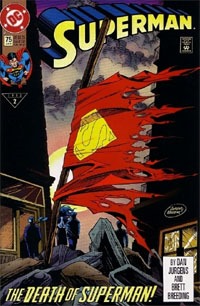
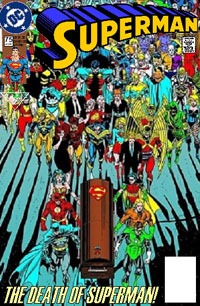
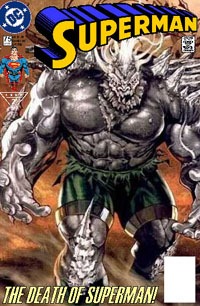
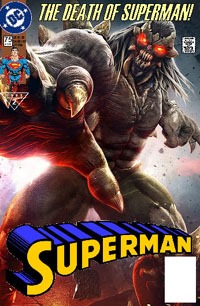
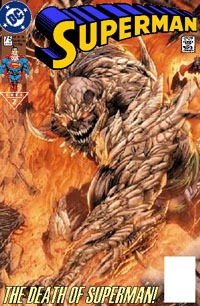
superman_075cBack in 1992, DC treated us to Doomsday!, or The Death of Superman. The event played out across six weekly issues of the Superman titles of the time, with a seventh chapter in a Justice League America tie-in issue.

While the various titles went through multiple printings, the cover images stayed the same. DC would add a Roman Numeral to the cover copy–II, III, IV, etc to denote which printing the issue was. To add further difference to the printings, the color of the title logo would be changed from the original.

This meant that the cover image of Superman: The Man of Steel #18 was distinctive and remains iconic, 24 years later. Ditto the various other issues.

Especially on the "key" issue–Superman #75.

Granted, there were actually multiple covers for Superman #75. There was the "black bag edition," also known as the "collector’s edition." This was only available through comic shops (the "direct market") and outside of a "platinum edition" I believe only had a single initial printing.

superman_075b     superman_075a

The "collector’s edition" cover itself was a grey tombstone. This edition was what would in contemporary terms be the "variant" edition.

The "regular" edition–the "newsstand edition"–fit the usual/standard trade dress of the time, and featured an image of Superman’s tattered cape caught on a pole amidst the destruction in Metropolis. Subsequent printings–as mentioned above–change the color of the Superman logo and included a Roman Numeral to denote that each printing was no longer the first printing.

I believe the issue went through four printings–I have never been made aware of a fifth or later. (Exception being years-later reprints, like the Millennium Edition or stuff included with toys, etc.)

That was all fine, I was ok with it–retailers could order however many copies of each edition (though "in the moment" few ordered enough). The later printings kept the issue around to satisfy overall demand…and the cover image became and has remained iconic. There’ve been a number of subsequent comic covers over the years doing the "homage" thing based on the Superman #75 newsstand edition.

That was 1992.


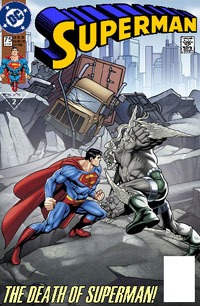
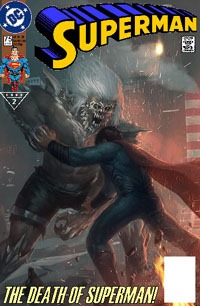
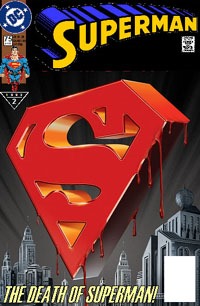
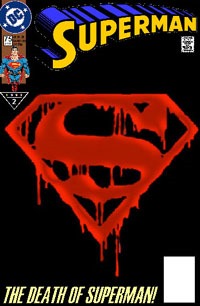
If Superman #75 was published in 2016, in the present? There’d be a zillion variants, totally diluting the cover and any singularly-iconic imagery.

deathofsuperman_03     deathofsuperman_04

A set of two covers that placed together form a single wider image. Why not get folks to buy two copies of the issue with different images just to get one image?

deathofsuperman_01

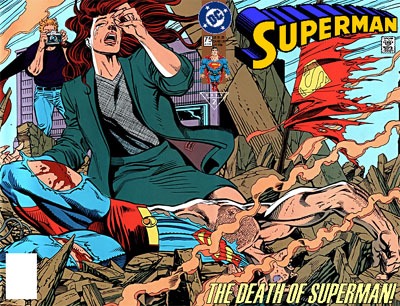
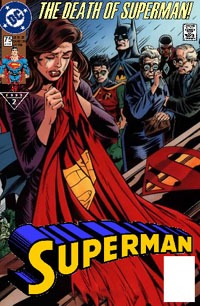
But hey, there’d also be the wraparound cover, showing the actual death of Superman as a single cover.

deathofsuperman_02

And another wraparound, showing a fallen Superman with Doomsday’s shadow…effective imagery in general, but also not in keeping with the story itself as the two fell together/simultaneously.

deathofsuperman_08     deathofsuperman_11

Regardless of the fact that there’d be the "upcoming" Funeral for a Friend story (also known as World Without a Superman), there’d be at least a couple of "funeral covers" for the actual death issue.

deathofsuperman_07     deathofsuperman_15

There’d be the generic-ish images of Doomsday’s fist with Superman symbols.

deathofsuperman_10     deathofsuperman_19

There’d be a couple that showed Superman is potentially victorious, despite the cover blurb proclaiming The Death of Superman!

deathofsuperman_05     deathofsuperman_06

deathofsuperman_09     deathofsuperman_21

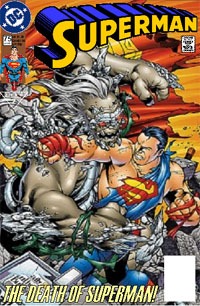
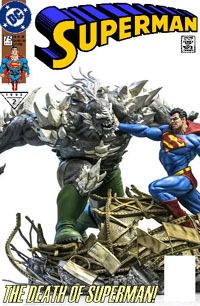
There’d be the generic-ish Superman and Doomsday slug-it-out images with even a "photo cover" of a statue thrown in.

deathofsuperman_25     deathofsuperman_26

Superman and Doomsday colliding covers…

deathofsuperman_23     deathofsuperman_22

Another collision cover, and a generic (yet cool-ish) Superman with Doomsday looming behind him (or the shadow of the creature somehow).

deathofsuperman_18     deathofsuperman_28

There’d be the generic "bleeding-S" covers. Promotion for the comics, and of course there’d be a ready-made animated movie already, with toys and such to further tie-in.

deathofsuperman_12     deathofsuperman_14

There’d be a painted "moment of death" cover, and a "concept sketches" cover.

deathofsuperman_13     deathofsuperman_16

deathofsuperman_24     deathofsuperman_27

There’d, of course, be the Doomsday-centric covers, showing off different takes on the creature in various poses. Recognizable as the creature, but not necessarily anything iconic or singularly stand-out. Or to BE stand-out, make that one of Doomsday reaching toward the reader a 3-D cover!

deathofsuperman_17     deathofsuperman_20

And aside from the different takes on the creature looking somewhat like he does in the actual story, there’d the the much more exaggerated, flashy takes on the character, going a bit beyond.

And there’d be way more fun than just these! See below for even more thoughts on the matter, as I’m "breaking" the post here for length on the front/main page of the blog.

Continue reading

Zero Hour Revisited – Booster Gold #0

90srevisited_zerohour

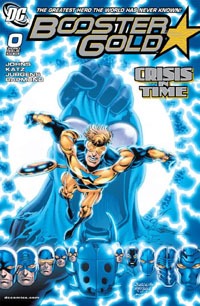
booster_gold_0000Blue & Gold Chapter 1: The Secret Origin of Booster Gold

Written by: Geoff Johns & Jeff Katz
Pencil Art by: Dan Jurgens
Finished Art by: Norm Rapmund
Colors by: Hi-Fi
Letters by: Randy Gentile
Asst. Editor: Harvey Richards
Editor: Michael Siglain
Cover by: Jurgens & Rapmund
Published by: DC Comics
Cover Date: September 1994
Cover Price: $1.50

I probably should have actually tucked this in with the "week 3" issues, as this 1. does not end on white pages and 2. takes place prior to events seen in "week 4." C’est la vie…I put this issue almost at the end of stuff because of it being a "retroactive tie-in" published a decade and a half AFTER the actual series.

This issue sees Booster Gold and the Blue Beetles travel through time, and cross paths in the timestream with Parallax (Hal Jordan) and Extant (Hank Hall) circa Zero Hour, 1994. Parallax damages their time-bubble and they’re forced into the 25th Century (with no need to chase down the time-trouble-makers, as they’ve already been dealt with IN Zero Hour–oops, we’ll see that shortly). Turns out the exact day the group emerges in is the day that Booster "threw" a football game and was caught doing so. While striving to ensure that this timestream is not disrupted, they use resources available to continue their own mission and we learn a bit more about Booster’s background as well as the Blue Beetle (several of ’em!) before things have to be dealt with–like putting Dan and Jaime back in their own times without any memory of this issue or the previous having happened…and Ted’s poised to be another "Hero You’ve Never Heard Of" alongside Booster… it’s Blue & Gold, reunited! Though the two quickly realize there’s a bit of a Brother Eye problem that may end things before they’ve truly begun.

This issue was actually published in 2008, some 13 1/2 years after Zero Hour. We were post-Infinite Crisis, post-52, mostly through Countdown, heading toward Final Crisis. And in the early issues of the Geoff Johns run on Booster Gold, with art by Dan Jurgens–the character’s creator and Norm Rapmund‘s excellent inks. And I recall this being one of the more fun series at the time, certainly one of my favorites.

In fact, I had covered the issue at the time, for comiXtreme (and republished in this blog years later), and rated it quite highly. That particular review was based on the issue in that context rather than as a random issue added to this mix, hence any discrepancies between then and now.

Ultimately (given the 14-year-gap in publication) this issue does nothing for the understanding of Zero Hour itself, moving the 1994 series along, etc. But this makes a fun tie-in and providing a more grounded "time" to touch base with–a nod to older/longer-time readers–while serving its own story.

This issue actually kicks off the second arc in the Booster Gold title, and leaves me quite interested in re-reading it…unfortunately, I don’t believe I have any of the early collected volumes, nor ready access (consolidated) to my singles at the moment.

I don’t recommend this in context of Zero Hour itself, really, but it was a great throwback issue, touching in continuity and playing off the #0 issues concept (this was the seventh issue of the series). But as a Booster Gold story, I very definitely recommend the Blue and Gold arc that this kicks off, as well as the first one, 52 Pickup.

Zero Hour Revisited – Showcase ’94 #10

90srevisited_zerohour

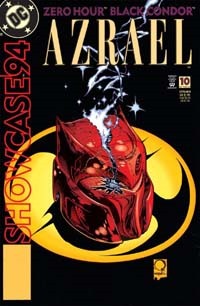
showcase_94_0010Aftermath

Script: Alan Grant
Penciller: Mike Vosburg
Inker: Ron McCain
Colorist: Dave Hornung
Letterer: Ken Bruzenak
Consulting Editor: Dennis O’Neil
Editor: Neal Pozner
Published by: DC Comics
Cover Date: September 1994
Cover Price: $1.95

This particular story basically sees a despondent, defeated Jean-Paul Valley momentarily existing as a homeless man on the streets. He’s been stripped of his role as Batman, having abdicated his role as Azrael for that, and now hasn’t a clue what to do with himself. He contemplates himself, his life, where he is, what he’s been through, how his life has changed in a year (basically saying that from Sword of Azrael to Zero Hour has been about a year in the Bat-side of things–further backed by the Superman: The Man of Steel issue where Batman mentions to Superman both having quite a year). Valley intrudes on a group of homeless, "hogging the fire," and eventually one is brave enough to approach him and engage him (albeit one-sidedly…or so it seems). When he up and leaves, the remaining homeless crowd around the fire and then are threatened by another group. Valley returns and drives them off, and continues to mope about, though now accepting that he IS a person, like any of these others.

Story-wise, this seems both a sort of quasi-epilogue to KnightsEnd, partly following up on that and bridging that story and the start of the ongoing Azrael series that started sometime later in 1994, I believe. This is definitely where a title like this–Showcase ‘__–excels. You don’t have to have an entire issue of some other title dedicated to a story, but you can have a standard-issue-length story presented once without having to be entirely its own one-shot or Special Issue or whatever. There’s room for this Azrael (Jean-Paul Valley) story, prior to/without an Azrael title (yet), but without hijacking another issue of Batman or Detective or Robin or Catwoman or whatever.

Given that, I like this story, and somehow was kinda surprised that it DID run the "full length" of a standard-sized issue. Then, for only 45 cents more (1994 pricing) we get another issue-or-so’s worth of content spotlighting other stuff.

And the cover–featuring Azrael–is a nice Quesada/Kesel piece with the destroyed Az-Bats helmet on the Az-Bats-period Bat-symbol. Iconic, simple, and applicable to the story.

The Tempting part 1: The Beating of Wings

Writer/Creator: Brian Augustyn
Penciller: Anthony Chun
Inker: Matt Banning
Letterer: Steve Haynie
Colorist: Lee Loughridge
Editor: Neal Pozner

I’d swear I’ve read stuff with Black Condor before–specifically in Justice League America–but this did not feel like that at all. I think it’s safe to say this is the first "solo outing" I’ve read of the character, and it felt like a bit of a first-issue thing, introducing the main character, a supporting character, and a conflict. Of course, the hero starts to seem victorious, before being presented with a greater challenge, and we’re left with a cliffhanger (I ought to see if I have the next issue of this, but honestly I doubt I’ll get to it anytime soon…I’m interested, but not necessarily enough to hunt it down for an immediate read. Chances are if I ever get around to assembling the several years of these Showcase Years I’ll read it someday).

The story and art are both good, and as mentioned above for the Azrael story, this is a solid outing that seems like it could lead into an ongoing series; but barring that/prior to that, serves in that stead, being allowed to be put out there as part of an anthology ongoing even where any singular character/story would not support its own thing.

No real complaints, and I do feel I’ve a bit more insight into the character, or at least the context, than I would have had without having read this.

Deja Views

Story: Mike McAvennie
Pencils: Jason Armstrong
Inks: Stan Woch
Colors: Stuart Chaifetz
Letters: Willie Schubert
Consulting Editor: KC Carlson
Editor: Neal Pozner

This story was all over the place, but essentially focuses on a group of Time-themed villains including Clock-King (I believe) and Calendar Man (I think–and not at all like the revamped Rebirth version!). The group is trying to steal some helmet or armor, and stuck in a time-loop, and they got confused in-story right after I got confused reading and jumping to the conclusion that there was some significant editorial error before realizing that was part of the story. And before things are completely sorted out, the story fades to white, signifying the "join" to Zero Hour.

Visually, no great issue on this story for me…it’s not bad, not wonderful. I’m not overly familiar with the characters, don’t really care about them, and this story doesn’t seem to directly come out of anything…it’s just "a story set during _______" (here, Zero Hour). This tie is enough to "justify" including this in reading Zero Hour stuff, but the issue does not sport the official Zero Hour banner or trade dress. Of course, that’s in keeping to the title‘s trade dress of generic fonts for "logos" rather than some bold solo-title logo.

At least it’s more tie-in than a number of tie-ins had, so it’s worth reading for the sake of completeness, though does not ultimately "matter."

OVERALL THOUGHTS

While this title itself–Showcase ’94–may not in and of itself matter all that much, I’m more convinced than ever at its greatness for its time. That’s not to say I could see following such a book long-term in the present, in 2016…but going back 22 years and the three issues I’ve now read for their having a segment each tied to Zero Hour, I recognize what the book’s existence allowed to be published without hijacking other books’ pages or the stories just not getting told. Add to that my not recognizing many of the creators and a slight memory suggesting this: the book was the sort for giving "new talent" a chance without being otherwise committed to a book. Try a writer out, give an artist a story to do, without compromising a "regular" or "ongoing" title, but still get their work out there, see how they do with various characters and creative team lineups.

This issue as a whole is not worth it in terms of Zero Hour, really…but it’s a strong issue, with a distinctive cover, and for the quasi-self-contained Azrael story, it’s well worth a bargain-bin buy (just not worth some collector’s premium or markup despite the issue’s age or cover).

Zero Hour Revisited – Anima #7

90srevisited_zerohour

anima_0007Suddenly, Johnny Gets a Feeling

Writers: Elizabeth Hand & Paul Witcover
Guest Penciller: Brent Anderson
Inker: Will Blyberg
Letterer: Chris Eliopoulos
Colorist: Patricia Mulvihill
Assistant Editor: Chris Eades
Editor: Rob Simpson
Published by: DC Comics
Cover Date: September 1994
Cover Price: $1.50

I recall Anima being one of the characters introduced during the Bloodlines Annuals event in 1993, and of course remember the character more than others as she (obviously) had her own series or a short time. That said, this is the first I can consciously remember actually reading of the character.

Reading this issue, though “only” 7 into its run, was not a fun thing out-of-context. I could recognize the main character and associates by context-clues and figure stuff out, but the story seemed (in part for my lack of familiarity with any of the characters or the full context of the continuity/situation at this point) to jump all over the place enough that I’m not even gonna try to summarize it. Suffice it to say that this felt like diving into a mid-season episode of some tv show and maybe not being disgusted or put off enough by it to turn it off, but it definitely was not the most engaging nor (detail-wise) memorable.

Essentially, there’s this girl, known as Anima, with a bond to some sort of demon named Animus. Animus is imprisoned by siblings/colleagues, as others conspire to do something nasty to the realm of Man, and Anima/Animus are key to stopping that, hence an adversarial situation.

Outside of Eliopoulos on lettering, I really don’t recognize the creative team. Then, the fact that outside of probably this issue (seeing it in the Zero Hour stack and as an issue coming up in the queue) I haven’t really even considered the series for years adds to this series’ isolation in history and continuity. This character came out of the DC Universe Bloodlines stuff; carries the standard DC logo, carries in this case the Zero Hour and DC Universe banner, so it was (at the time at least) certainly in-continuity and such (mid-1990s!). But you would hardly know it to look at any contemporary DC lineup, probably not SINCE the actual 1990s (1999/2000 or so).

That lack of recognition, memory, impact, lends to the weirdness of reading this…certainly refreshing in its way as one of those titles that I seriously doubt would even get a publishing chance nowadays, let alone an audience to go seven issues (let alone any further). The parts with Animus and siblings struck me as rather Hellblazer-esque (ok, perhaps this’d fit in with the new Hellblazer title in Rebirth?) and thus in continuity but tucked off into their own little separated section of continuity.

There’s an offhanded reference indicating Anima had gotten Superman’s message (from waaaaaayyyyy back at the start of Zero Hour!) but outside of that and the fade-to-white abruptness ending this issue, you wouldn’t know it had anything to do with a bigger crossover. This certainly fits the “red skies” designation of sorts…that is, there’s a passing shoe-horned-in reference for a panel or two, but otherwise the issue’s actual story is not impacted nor does it in turn impact, the main event story it supposedly ties in with.

I think this issue would probably fit pretty solidly in with its own series as a run–reading Anima from first issue to however long the series ran–but it’s not even really “fun” as an isolated, standalone issue; it does not advance Zero Hour itself, nor does it shed any real light on something that the main Zero Hour just didn’t have space to do. I would not recommend this outside of an Anima read-through; and given (if only) my own conscious lack of memory of anything impactful even from this series long-term, I certainly would not recommend paying more than 25-50 cents for this in a bargain-bin purchase.

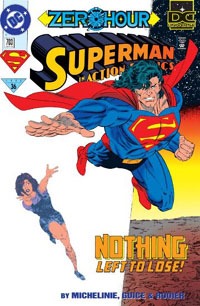
Zero Hour Revisited – Action Comics #703

90srevisited_zerohour

action_comics_0703Chronocide!

Writer: David Michelinie
Artists: Jackson Guice & Denis Rodier
Letterer: Bill Oakley
Colorist: Glenn Whitmore
Assistant Editor: Chris Duffy
Associate Editor: Frank Pittarese
Editor: Mike Carlin
Published by: DC Comics
Cover Date: September 1994
Cover Price: $1.50

This is an interesting sort of issue, though the cover puts me off a bit. It’s been a generic sort of image to me, one I haven’t really–truly–looked at in years, just sort of glossing over it, recognizing it, and that’s it, because of it being what it is. It sort of deals with the interior story, though it’s a bit misleading, suggesting Superman abandoning Lois to the Entropy thing of this story, saving himself…when the story is more his facing that sort of loss of his parents, and Lois is the last one standing.

Clark returns to the Daily Planet, having done HIS part, and leaving/trusting the other heroes to do their part. But then, Perry White fades out and Superman realizes they’ve failed. And if Time has been destroyed as recently as Perry’s birth, then his own parents–Ma and Pa Kent–won’t be far behind. So he races to them, but just as he arrives at the farm, finds himself in an alternate timeline/dimension with a younger version of his parents, and where the rocket that brought him to Earth was retrieved, while he had died as an infant. Superman and the younger Kents eventually find themselves faced with reality of Time’s destruction, and just as Superman’s about to save his own parents, he’s pulled into the Timestream for the final moments of Zero Hour, while the world–our perspective ending with Lois’ account of the approaching whiteness–is wiped out, going to the white pages ending all of the ZH books that shared this final week of July 1994.

With the Superman titles all tying in, we’ve seen Superman meet numerous alternate-timeline/universe versions of Batman; we’ve seen him meet a version of his biological parents from Krypton; an alternate super-hero filling his role on another Earth; and now an alternate version of his Earth-parents. All while essentially being part of the ongoing running battle with Extant and the power behind even him. It’s both cool in the sense that we get to see Superman stories taking advantage of the time-anomalies stuff; but stretches stuff a bit to figure all this PLUS his involvement in the "main story." Still, as flimsy as explanations are between his "side stories" and the main, both seem to stand alone pretty well.

I’m not overly fond of the art here, and yet it still triggers the nostalgia factor for me, and I both recognize and remember it. It fits the story and is definitely a product of its time, and I don’t know what I’d do for replacing it. It’s not bad art, just not my favorite art.

Given Dan Jurgens‘ role in Zero Hour itself and obvious ties on the Super-team, the Superman titles in general fit better with Zero Hour than most; and I certainly have better, clearer memory of them as part of the event, and their being a huge part of my exposure to the DC Universe beyond the event itself, so I’m certainly a bit biased. That said, I do feel like this does more to reference the actual, developing story of Zero Hour (if not itself further developing that story) than most other tie-ins. Even so, this hardly seems essential, and will be more of interest to someone reading through the Superman books of the time than someone just reading the "core" Zero Hour series.

Certainly not an issue worth paying more than $1 or so for; but not something to singularly avoid in a bargain bin, either.

We’re finally nearing the end of this event as a whole, and for that, I’m definitely glad.